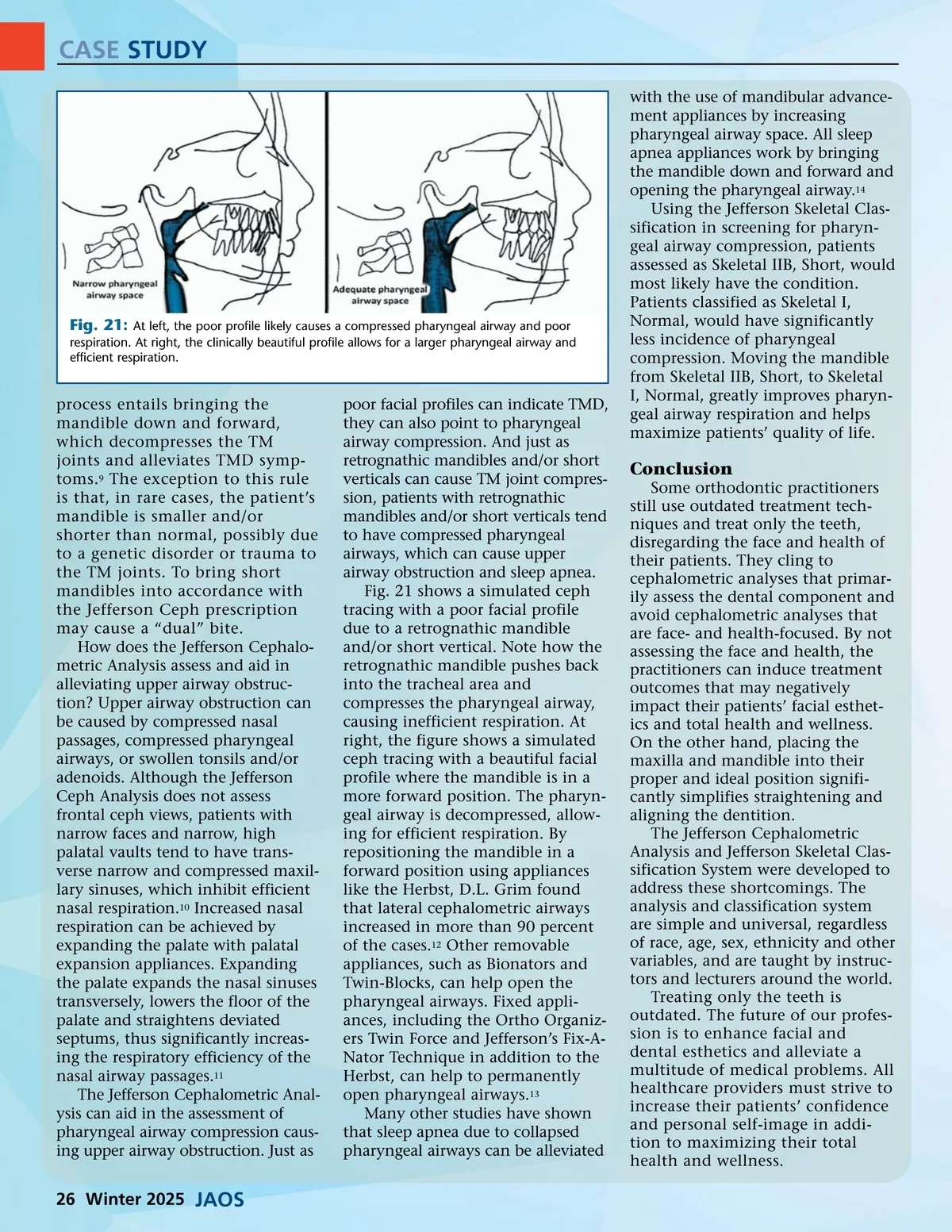
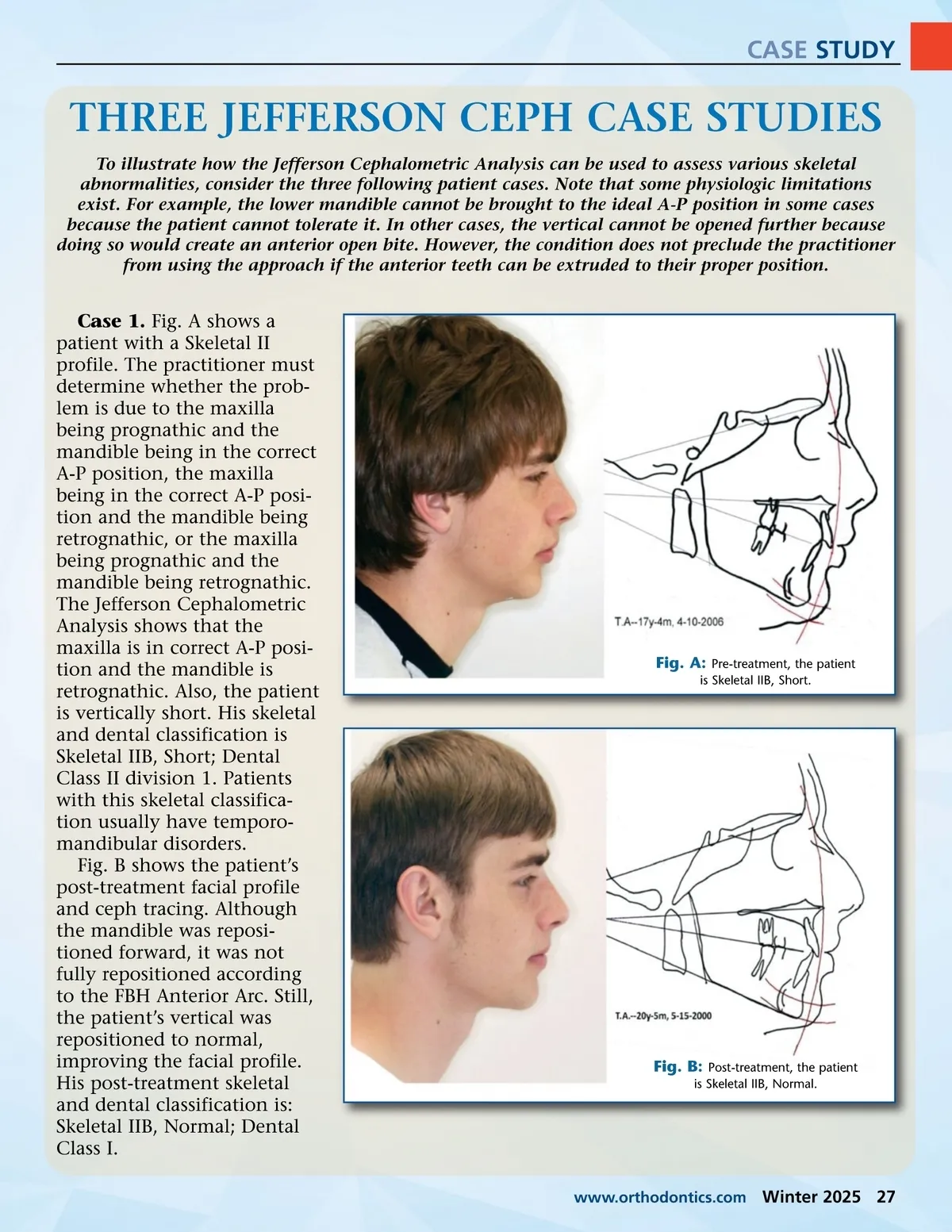
CASE STUDY THREE JEFFERSON CEPH CASE STUDIES To illustrate how the Jefferson Cephalometric Analysis can be used to assess various skeletal abnormalities, consider the three following patient cases. Note that some physiologic limitations exist. For example, the lower mandible cannot be brought to the ideal A-P position in some cases because the patient cannot tolerate it. In other cases, the vertical cannot be opened further because doing so would create an anterior open bite. However, the condition does not preclude the practitioner from using the approach if the anterior teeth can be extruded to their proper position. Case 1. Fig. A shows a patient with a Skeletal II profile. The practitioner must determine whether the prob-lem is due to the maxilla being prognathic and the mandible being in the correct A-P position, the maxilla being in the correct A-P posi-tion and the mandible being retrognathic, or the maxilla being prognathic and the mandible being retrognathic. The Jefferson Cephalometric Analysis shows that the maxilla is in correct A-P posi-tion and the mandible is retrognathic. Also, the patient is vertically short. His skeletal and dental classification is Skeletal IIB, Short; Dental Class II division 1. Patients with this skeletal classifica-tion usually have temporo-mandibular disorders. Fig. B shows the patient’s post-treatment facial profile and ceph tracing. Although the mandible was reposi-tioned forward, it was not fully repositioned according to the FBH Anterior Arc. Still, the patient’s vertical was repositioned to normal, improving the facial profile. His post-treatment skeletal and dental classification is: Skeletal IIB, Normal; Dental Class I. Fig. A: Pre-treatment, the patient is Skeletal IIB, Short. Fig. B: Post-treatment, the patient is Skeletal IIB, Normal. www.orthodontics.com Winter 2025 27
Journal of the American Orthodontic Society Winter 2025: Page 27