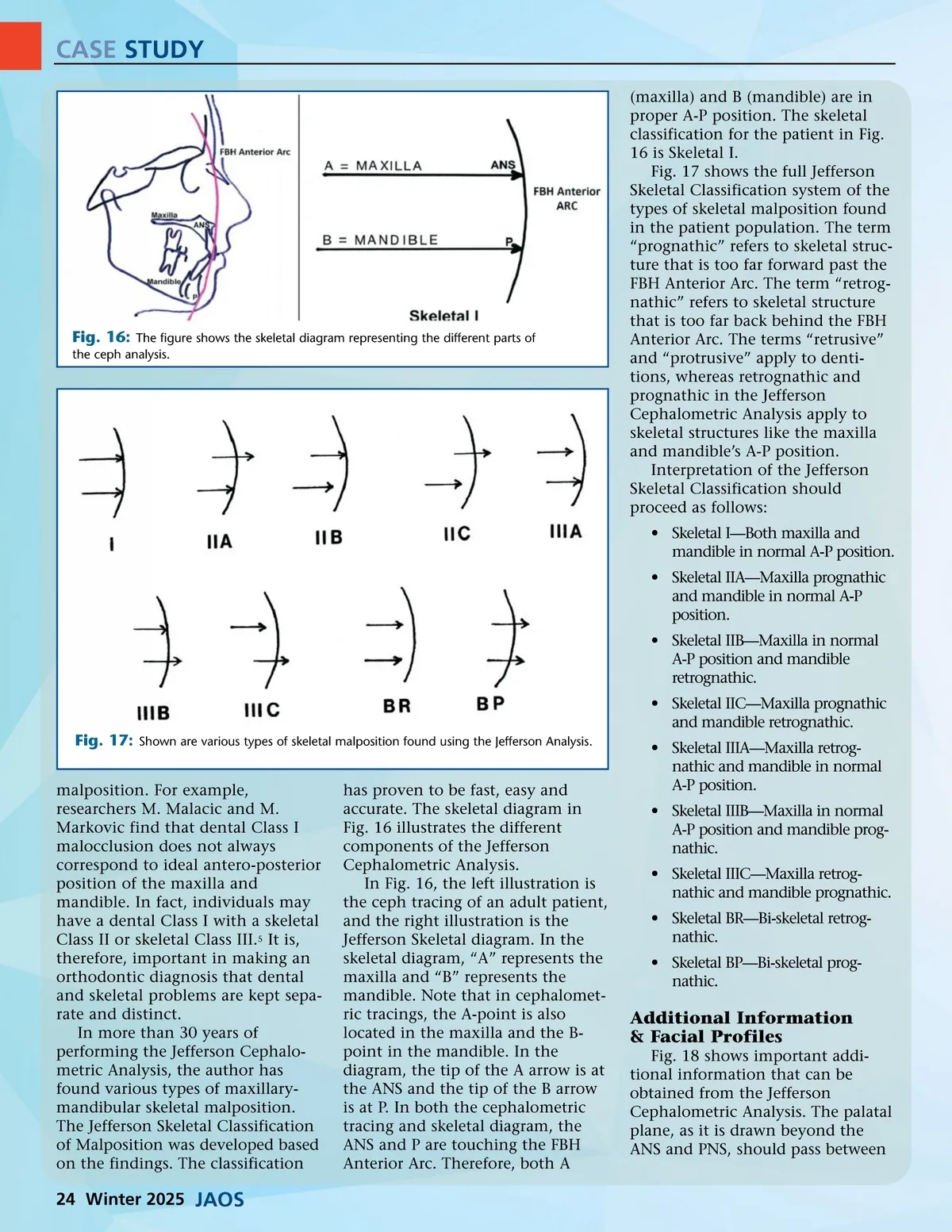
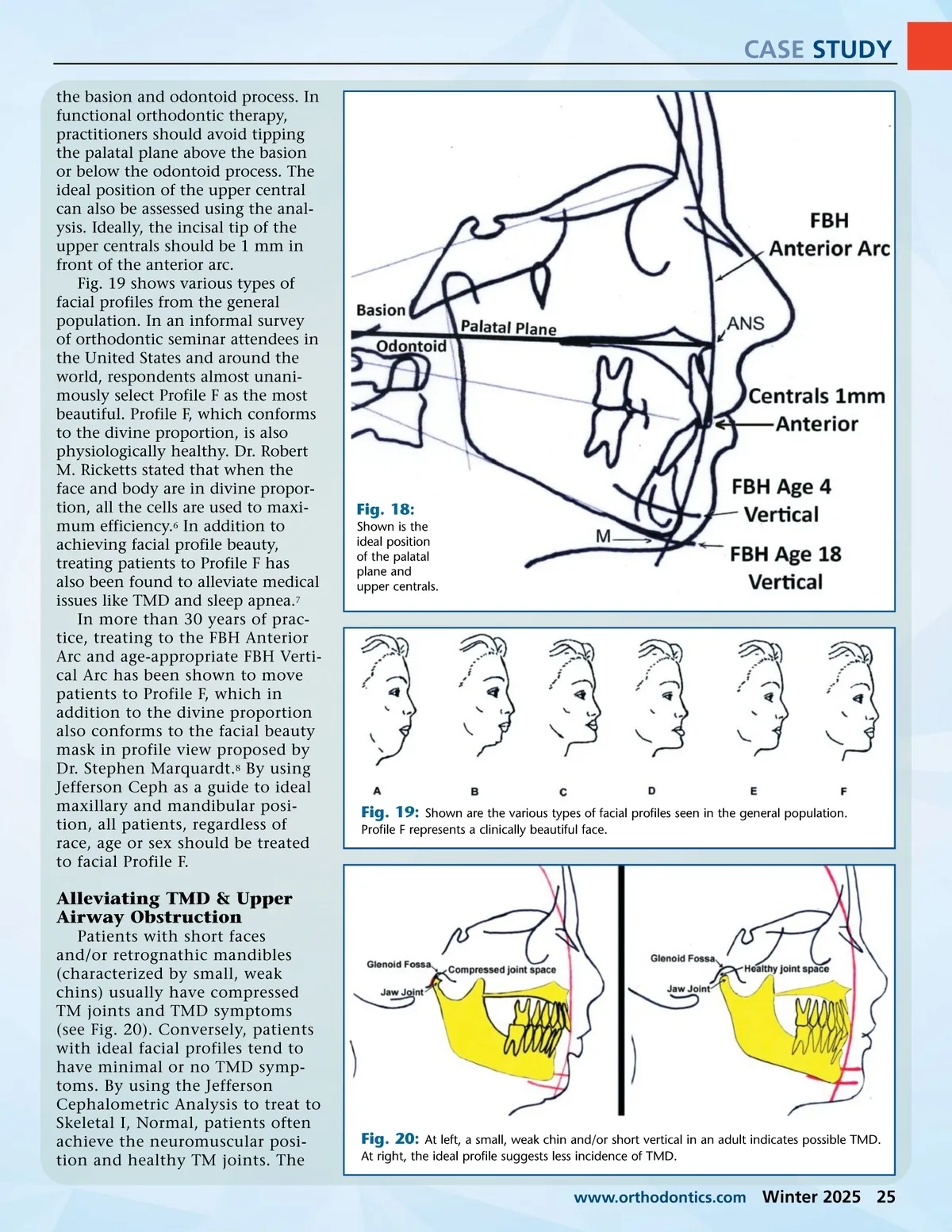
CASE STUDY the basion and odontoid process. In functional orthodontic therapy, practitioners should avoid tipping the palatal plane above the basion or below the odontoid process. The ideal position of the upper central can also be assessed using the anal-ysis. Ideally, the incisal tip of the upper centrals should be 1 mm in front of the anterior arc. Fig. 19 shows various types of facial profiles from the general population. In an informal survey of orthodontic seminar attendees in the United States and around the world, respondents almost unani-mously select Profile F as the most beautiful. Profile F, which conforms to the divine proportion, is also physiologically healthy. Dr. Robert M. Ricketts stated that when the face and body are in divine propor-tion, all the cells are used to maxi-mum efficiency. 6 In addition to achieving facial profile beauty, treating patients to Profile F has also been found to alleviate medical issues like TMD and sleep apnea. 7 In more than 30 years of prac-tice, treating to the FBH Anterior Arc and age-appropriate FBH Verti-cal Arc has been shown to move patients to Profile F, which in addition to the divine proportion also conforms to the facial beauty mask in profile view proposed by Dr. Stephen Marquardt. 8 By using Jefferson Ceph as a guide to ideal maxillary and mandibular posi-tion, all patients, regardless of race, age or sex should be treated to facial Profile F. Fig. 18: Shown is the ideal position of the palatal plane and upper centrals. Fig. 19: Shown are the various types of facial profiles seen in the general population. Profile F represents a clinically beautiful face. Alleviating TMD & Upper Airway Obstruction Patients with short faces and/or retrognathic mandibles (characterized by small, weak chins) usually have compressed TM joints and TMD symptoms (see Fig. 20). Conversely, patients with ideal facial profiles tend to have minimal or no TMD symp-toms. By using the Jefferson Cephalometric Analysis to treat to Skeletal I, Normal, patients often achieve the neuromuscular posi-tion and healthy TM joints. The Fig. 20: At left, a small, weak chin and/or short vertical in an adult indicates possible TMD. At right, the ideal profile suggests less incidence of TMD. www.orthodontics.com Winter 2025 25
Journal of the American Orthodontic Society Winter 2025: Page 25