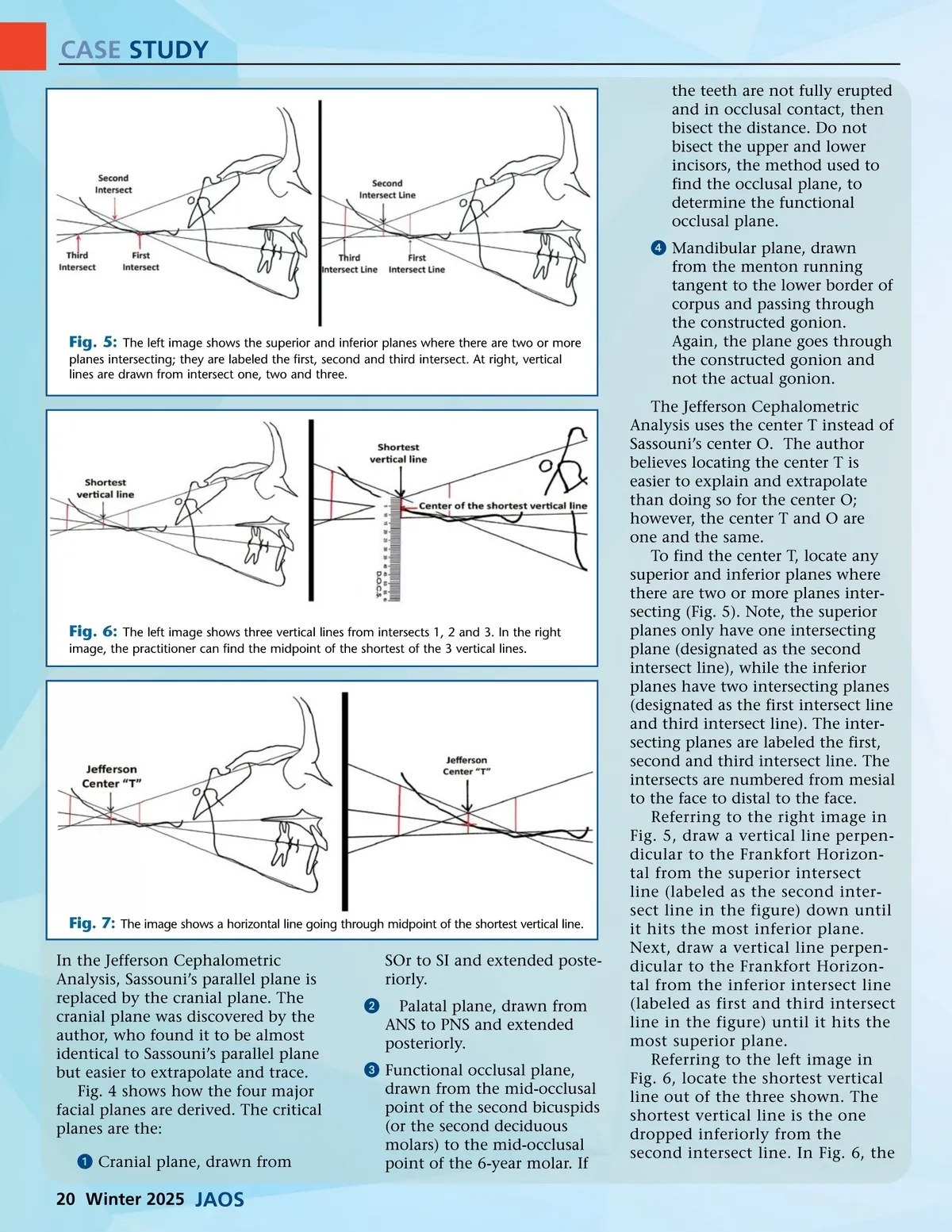
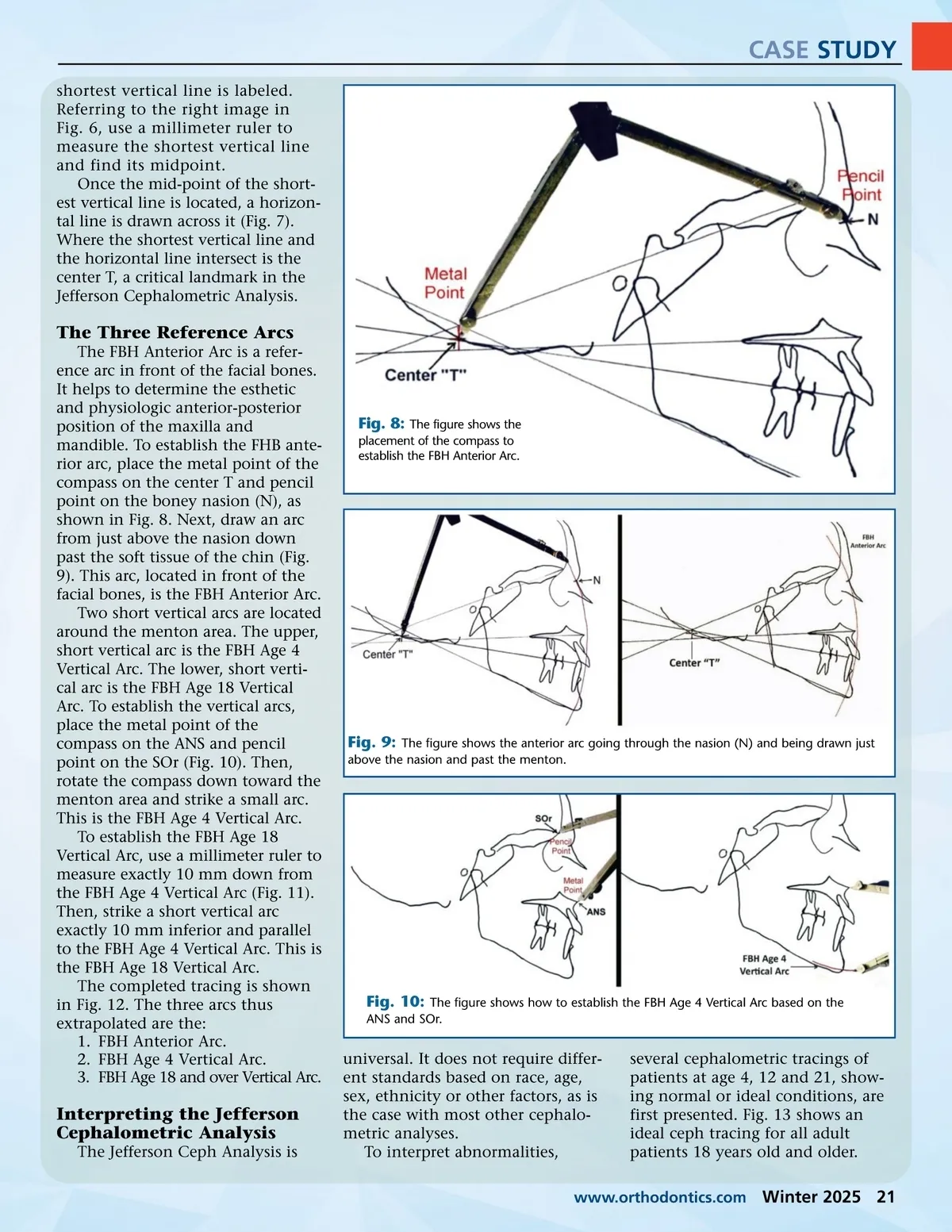
CASE STUDY shortest vertical line is labeled. Referring to the right image in Fig. 6, use a millimeter ruler to measure the shortest vertical line and find its midpoint. Once the mid-point of the short-est vertical line is located, a horizon-tal line is drawn across it (Fig. 7). Where the shortest vertical line and the horizontal line intersect is the center T, a critical landmark in the Jefferson Cephalometric Analysis. The Three Reference Arcs The FBH Anterior Arc is a refer-ence arc in front of the facial bones. It helps to determine the esthetic and physiologic anterior-posterior position of the maxilla and mandible. To establish the FHB ante-rior arc, place the metal point of the compass on the center T and pencil point on the boney nasion (N), as shown in Fig. 8. Next, draw an arc from just above the nasion down past the soft tissue of the chin (Fig. 9). This arc, located in front of the facial bones, is the FBH Anterior Arc. Two short vertical arcs are located around the menton area. The upper, short vertical arc is the FBH Age 4 Vertical Arc. The lower, short verti-cal arc is the FBH Age 18 Vertical Arc. To establish the vertical arcs, place the metal point of the compass on the ANS and pencil point on the SOr (Fig. 10). Then, rotate the compass down toward the menton area and strike a small arc. This is the FBH Age 4 Vertical Arc. To establish the FBH Age 18 Vertical Arc, use a millimeter ruler to measure exactly 10 mm down from the FBH Age 4 Vertical Arc (Fig. 11). Then, strike a short vertical arc exactly 10 mm inferior and parallel to the FBH Age 4 Vertical Arc. This is the FBH Age 18 Vertical Arc. The completed tracing is shown in Fig. 12. The three arcs thus extrapolated are the: 1. FBH Anterior Arc. 2. FBH Age 4 Vertical Arc. 3. FBH Age 18 and over Vertical Arc. Fig. 8: The figure shows the placement of the compass to establish the FBH Anterior Arc. Fig. 9: The figure shows the anterior arc going through the nasion (N) and being drawn just above the nasion and past the menton. Fig. 10: The figure shows how to establish the FBH Age 4 Vertical Arc based on the ANS and SOr. Interpreting the Jefferson Cephalometric Analysis The Jefferson Ceph Analysis is universal. It does not require differ-ent standards based on race, age, sex, ethnicity or other factors, as is the case with most other cephalo-metric analyses. To interpret abnormalities, several cephalometric tracings of patients at age 4, 12 and 21, show-ing normal or ideal conditions, are first presented. Fig. 13 shows an ideal ceph tracing for all adult patients 18 years old and older. www.orthodontics.com Winter 2025 21
Journal of the American Orthodontic Society Winter 2025: Page 21