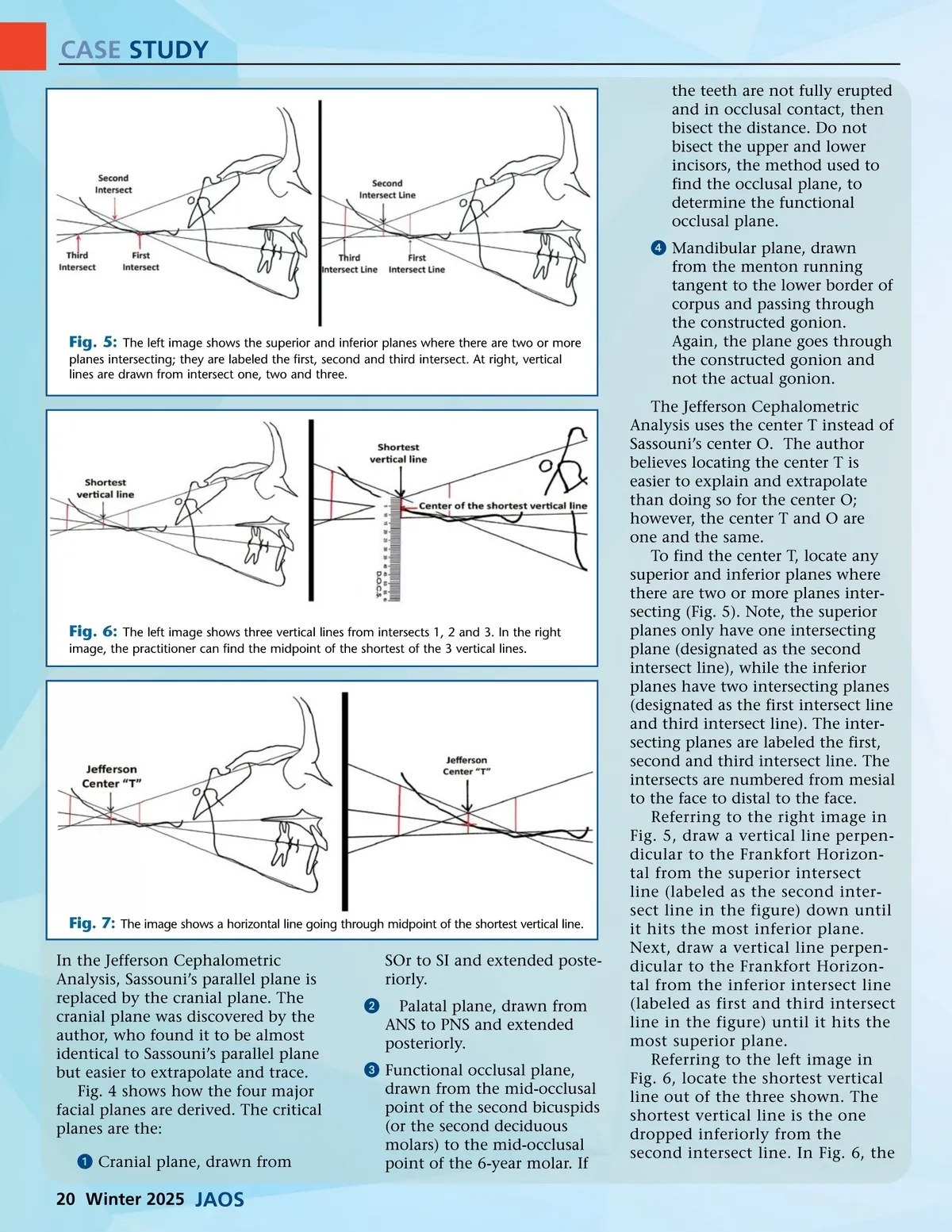
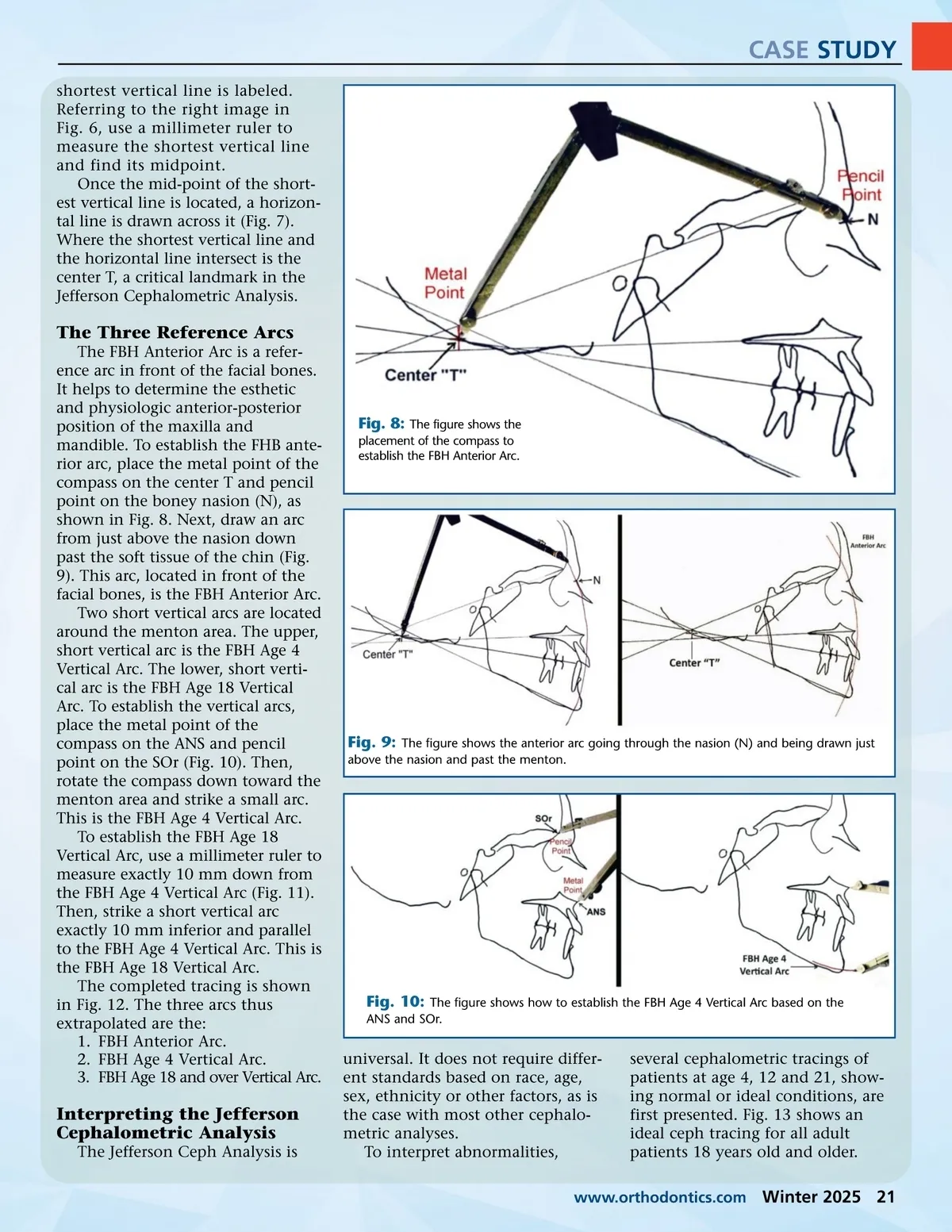
CASE STUDY the teeth are not fully erupted and in occlusal contact, then bisect the distance. Do not bisect the upper and lower incisors, the method used to find the occlusal plane, to determine the functional occlusal plane. ᕤ Mandibular plane, drawn from the menton running tangent to the lower border of corpus and passing through the constructed gonion. Again, the plane goes through the constructed gonion and not the actual gonion. The Jefferson Cephalometric Analysis uses the center T instead of Sassouni’s center O. The author believes locating the center T is easier to explain and extrapolate than doing so for the center O; however, the center T and O are one and the same. To find the center T, locate any superior and inferior planes where there are two or more planes inter-secting (Fig. 5). Note, the superior planes only have one intersecting plane (designated as the second intersect line), while the inferior planes have two intersecting planes (designated as the first intersect line and third intersect line). The inter-secting planes are labeled the first, second and third intersect line. The intersects are numbered from mesial to the face to distal to the face. Referring to the right image in Fig. 5, draw a vertical line perpen-dicular to the Frankfort Horizon-tal from the superior intersect line (labeled as the second inter-sect line in the figure) down until it hits the most inferior plane. Next, draw a vertical line perpen-dicular to the Frankfort Horizon-tal from the inferior intersect line (labeled as first and third intersect line in the figure) until it hits the most superior plane. Referring to the left image in Fig. 6, locate the shortest vertical line out of the three shown. The shortest vertical line is the one dropped inferiorly from the second intersect line. In Fig. 6, the Fig. 5: The left image shows the superior and inferior planes where there are two or more planes intersecting; they are labeled the first, second and third intersect. At right, vertical lines are drawn from intersect one, two and three. Fig. 6: The left image shows three vertical lines from intersects 1, 2 and 3. In the right image, the practitioner can find the midpoint of the shortest of the 3 vertical lines. Fig. 7: The image shows a horizontal line going through midpoint of the shortest vertical line. In the Jefferson Cephalometric Analysis, Sassouni’s parallel plane is replaced by the cranial plane. The cranial plane was discovered by the author, who found it to be almost identical to Sassouni’s parallel plane but easier to extrapolate and trace. Fig. 4 shows how the four major facial planes are derived. The critical planes are the: ᕡ Cranial plane, drawn from SOr to SI and extended poste-riorly. ᕢ Palatal plane, drawn from ANS to PNS and extended posteriorly. ᕣ Functional occlusal plane, drawn from the mid-occlusal point of the second bicuspids (or the second deciduous molars) to the mid-occlusal point of the 6-year molar. If 20 Winter 2025 JAOS
Journal of the American Orthodontic Society Winter 2025: Page 20