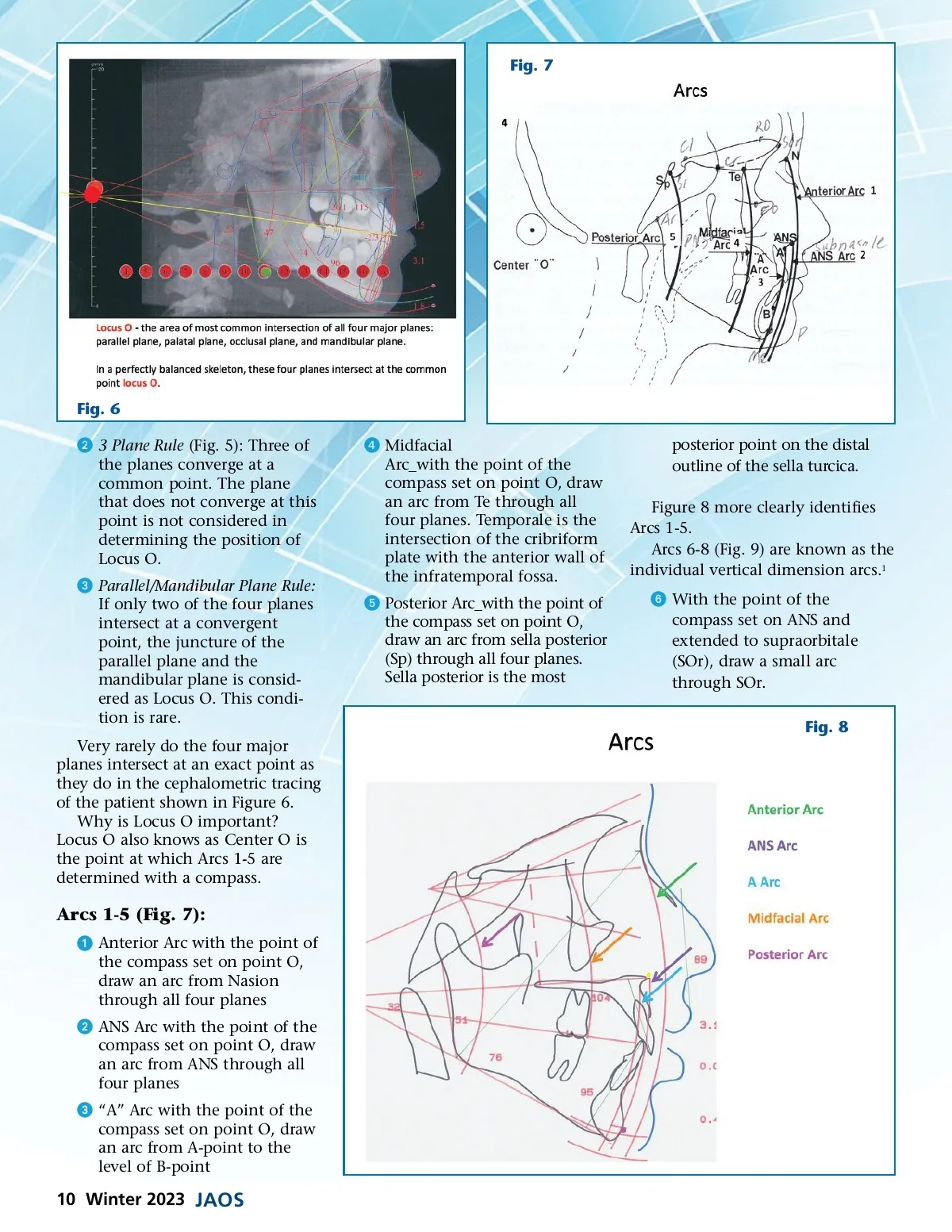
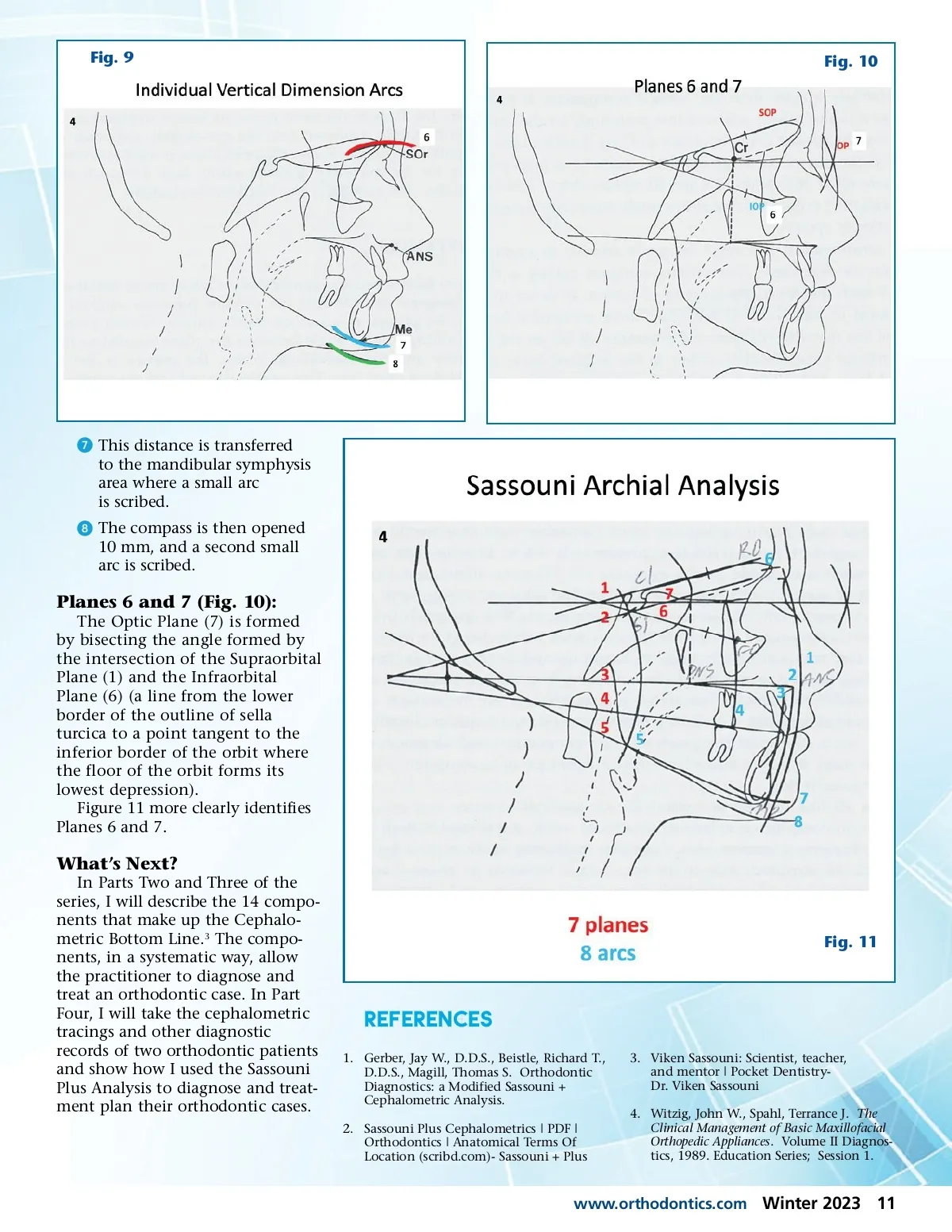
Fig. 7 Fig. 6 ᕢ 3 Plane Rule (Fig. 5): Three of the planes converge at a common point. The plane that does not converge at this point is not considered in determining the position of Locus O. ᕣ Parallel/Mandibular Plane Rule: If only two of the four planes intersect at a convergent point, the juncture of the parallel plane and the mandibular plane is consid-ered as Locus O. This condi-tion is rare. Very rarely do the four major planes intersect at an exact point as they do in the cephalometric tracing of the patient shown in Figure 6. Why is Locus O important? Locus O also knows as Center O is the point at which Arcs 1-5 are determined with a compass. ᕤ Midfacial Arc_with the point of the compass set on point O, draw an arc from Te through all four planes. Temporale is the intersection of the cribriform plate with the anterior wall of the infratemporal fossa. ᕥ Posterior Arc_with the point of the compass set on point O, draw an arc from sella posterior (Sp) through all four planes. Sella posterior is the most posterior point on the distal outline of the sella turcica. Figure 8 more clearly identifies Arcs 1-5. Arcs 6-8 (Fig. 9) are known as the individual vertical dimension arcs. 1 ᕦ With the point of the compass set on ANS and extended to supraorbitale (SOr), draw a small arc through SOr. Fig. 8 Arcs 1-5 (Fig. 7): ᕡ Anterior Arc with the point of the compass set on point O, draw an arc from Nasion through all four planes ᕢ ANS Arc with the point of the compass set on point O, draw an arc from ANS through all four planes ᕣ “A” Arc with the point of the compass set on point O, draw an arc from A-point to the level of B-point 10 Winter 2023 JAOS
Journal of the American Orthodontic Society Winter 2023: Page 10