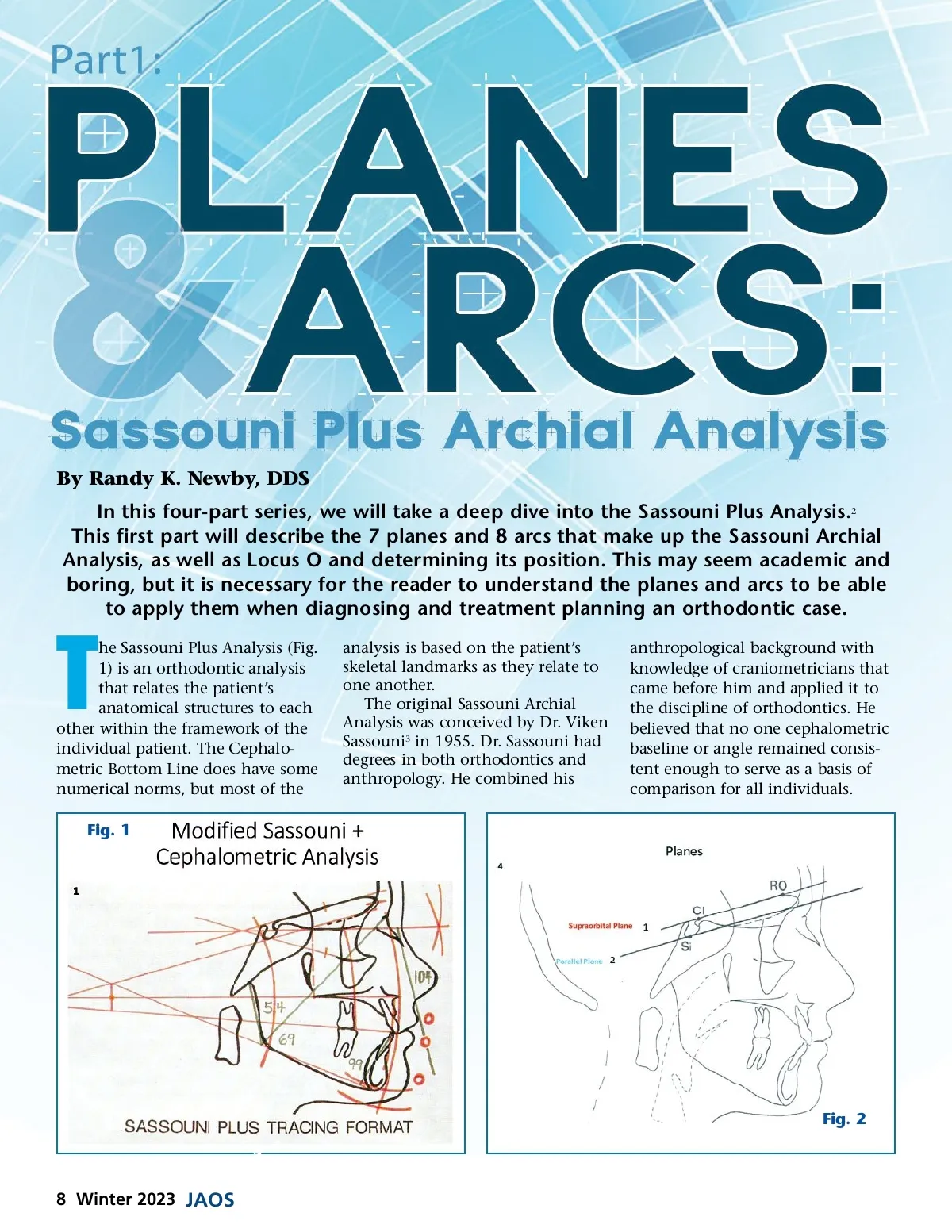
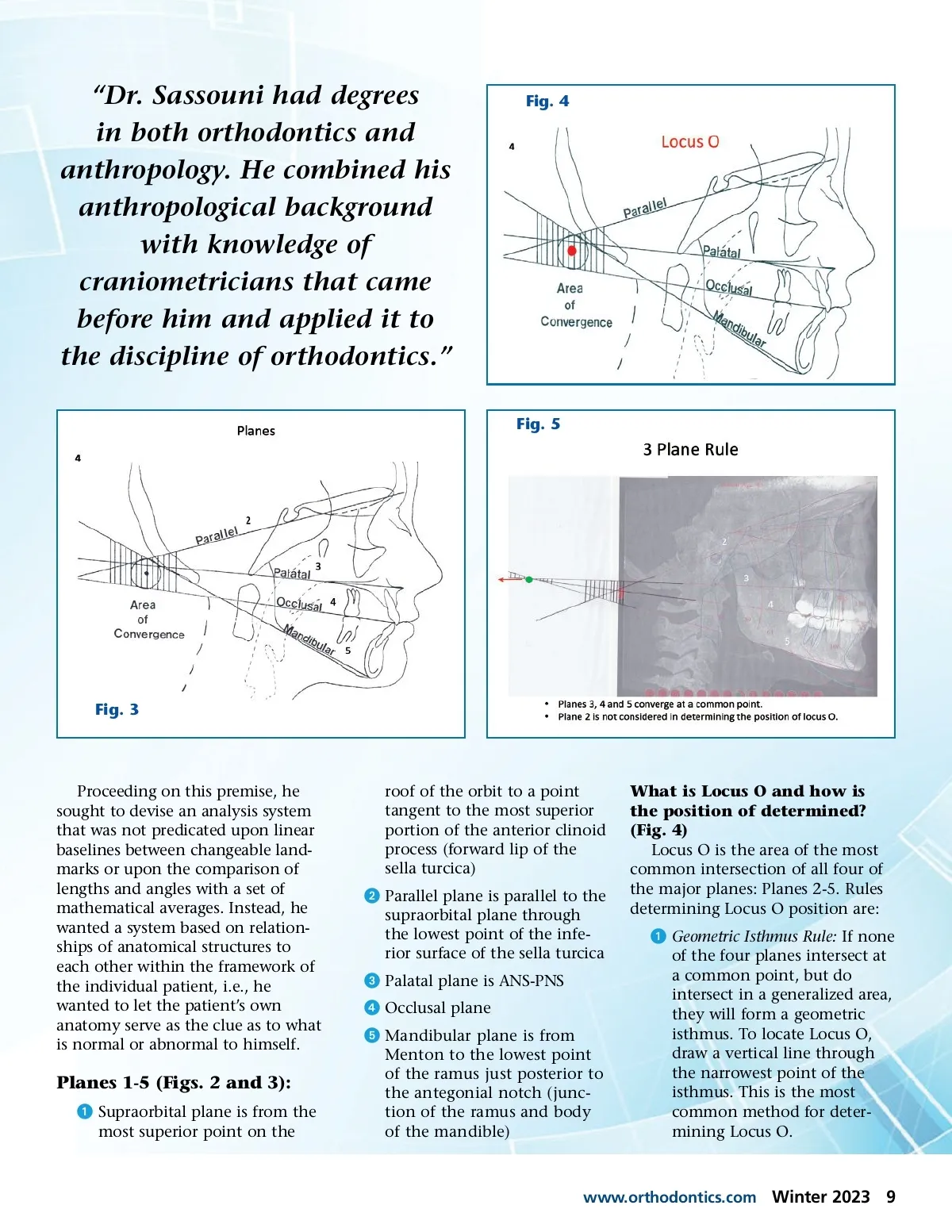
“Dr. Sassouni had degrees in both orthodontics and anthropology. He combined his anthropological background with knowledge of craniometricians that came before him and applied it to the discipline of orthodontics.” Fig. 4 Fig. 5 Fig. 3 Proceeding on this premise, he sought to devise an analysis system that was not predicated upon linear baselines between changeable land-marks or upon the comparison of lengths and angles with a set of mathematical averages. Instead, he wanted a system based on relation-ships of anatomical structures to each other within the framework of the individual patient, i.e., he wanted to let the patient’s own anatomy serve as the clue as to what is normal or abnormal to himself. roof of the orbit to a point tangent to the most superior portion of the anterior clinoid process (forward lip of the sella turcica) ᕢ Parallel plane is parallel to the supraorbital plane through the lowest point of the infe-rior surface of the sella turcica ᕣ Palatal plane is ANS-PNS ᕤ Occlusal plane ᕥ Mandibular plane is from Menton to the lowest point of the ramus just posterior to the antegonial notch (junc-tion of the ramus and body of the mandible) What is Locus O and how is the position of determined? (Fig. 4) Locus O is the area of the most common intersection of all four of the major planes: Planes 2-5. Rules determining Locus O position are: ᕡ Geometric Isthmus Rule: If none of the four planes intersect at a common point, but do intersect in a generalized area, they will form a geometric isthmus. To locate Locus O, draw a vertical line through the narrowest point of the isthmus. This is the most common method for deter-mining Locus O. Planes 1-5 (Figs. 2 and 3): ᕡ Supraorbital plane is from the most superior point on the www.orthodontics.com Winter 2023 9
Journal of the American Orthodontic Society Winter 2023: Page 9