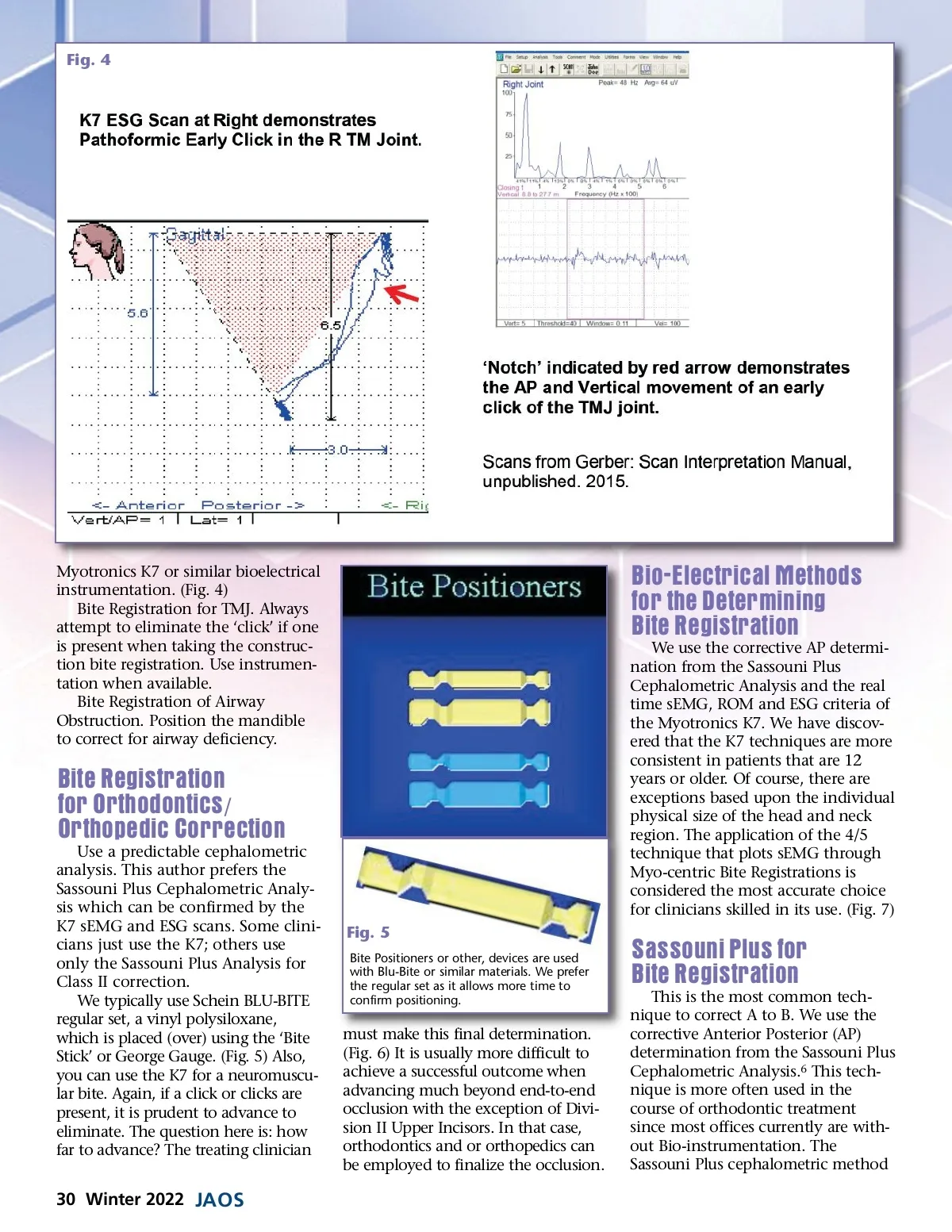
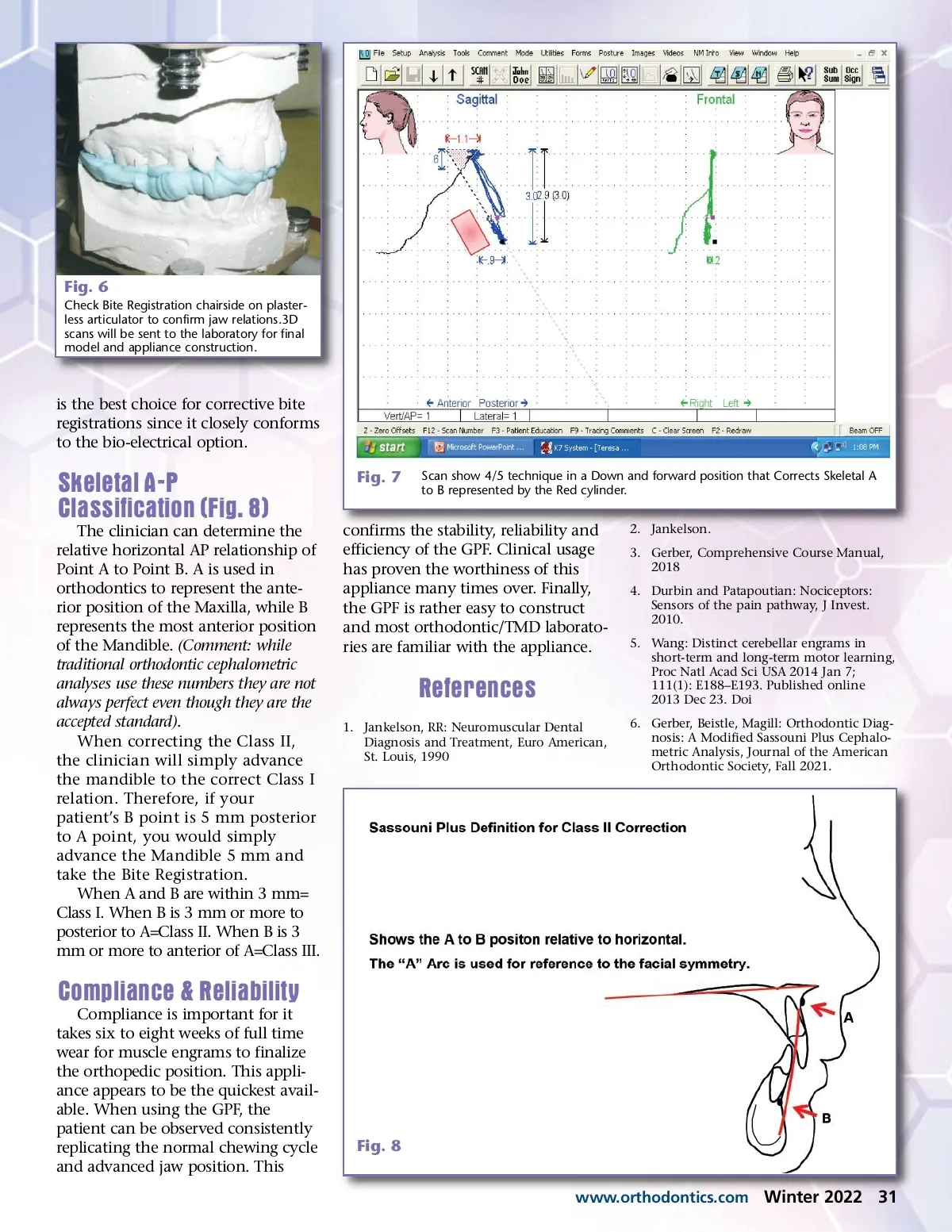
Fig. 4 Myotronics K7 or similar bioelectrical instrumentation. (Fig. 4) Bite Registration for TMJ. Always attempt to eliminate the ‘click’ if one is present when taking the construc-tion bite registration. Use instrumen-tation when available. Bite Registration of Airway Obstruction. Position the mandible to correct for airway deficiency. Bio-Electrical Methods for the Determining Bite Registration We use the corrective AP determi-nation from the Sassouni Plus Cephalometric Analysis and the real time sEMG, ROM and ESG criteria of the Myotronics K7. We have discov-ered that the K7 techniques are more consistent in patients that are 12 years or older. Of course, there are exceptions based upon the individual physical size of the head and neck region. The application of the 4/5 technique that plots sEMG through Myo-centric Bite Registrations is considered the most accurate choice for clinicians skilled in its use. (Fig. 7) Fig. 5 Bite Positioners or other, devices are used with Blu-Bite or similar materials. We prefer the regular set as it allows more time to confirm positioning. Bite Registration for Orthodontics / Orthopedic Correction Use a predictable cephalometric analysis. This author prefers the Sassouni Plus Cephalometric Analy-sis which can be confirmed by the K7 sEMG and ESG scans. Some clini-cians just use the K7; others use only the Sassouni Plus Analysis for Class II correction. We typically use Schein BLU-BITE regular set, a vinyl polysiloxane, which is placed (over) using the ‘Bite Stick’ or George Gauge. (Fig. 5) Also, you can use the K7 for a neuromuscu-lar bite. Again, if a click or clicks are present, it is prudent to advance to eliminate. The question here is: how far to advance? The treating clinician Sassouni Plus for Bite Registration This is the most common tech-nique to correct A to B. We use the corrective Anterior Posterior (AP) determination from the Sassouni Plus Cephalometric Analysis. 6 This tech-nique is more often used in the course of orthodontic treatment since most offices currently are with-out Bio-instrumentation. The Sassouni Plus cephalometric method must make this final determination. (Fig. 6) It is usually more difficult to achieve a successful outcome when advancing much beyond end-to-end occlusion with the exception of Divi-sion II Upper Incisors. In that case, orthodontics and or orthopedics can be employed to finalize the occlusion. 30 Winter 2022 JAOS
Journal of the American Orthodontic Society Winter 2022: Page 30