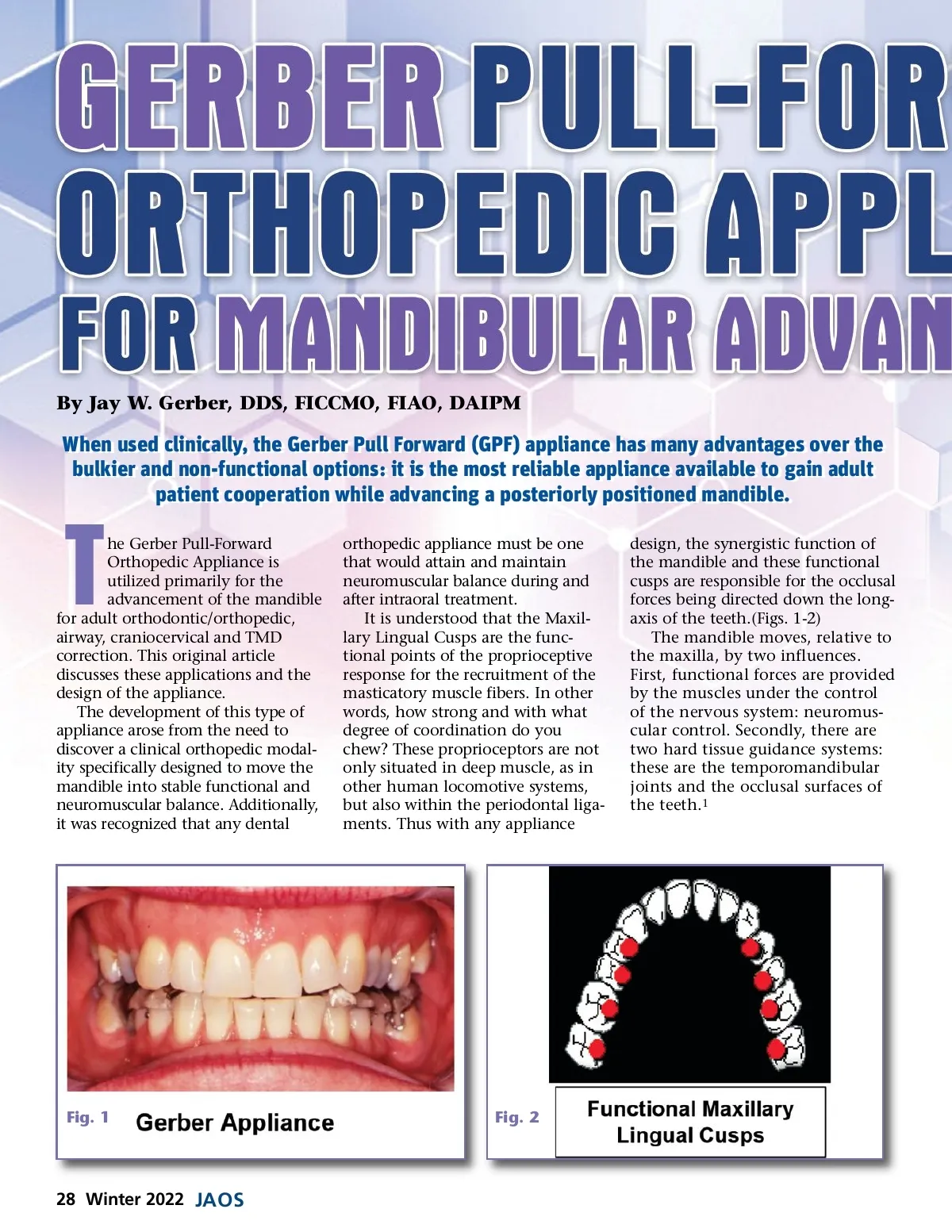
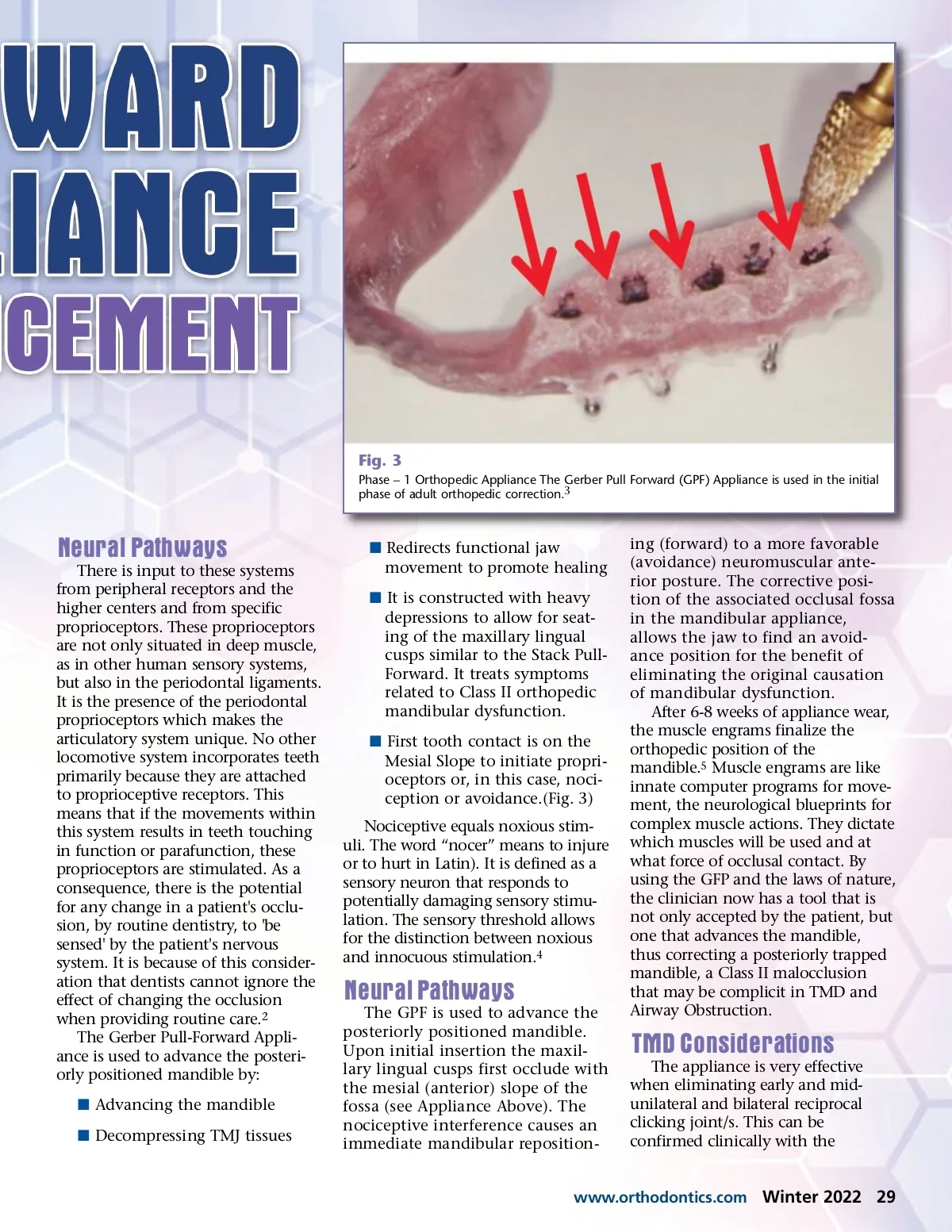
Fig. 3 Phase – 1 Orthopedic Appliance The Gerber Pull Forward (GPF) Appliance is used in the initial phase of adult orthopedic correction. 3 Neural Pathways There is input to these systems from peripheral receptors and the higher centers and from specific proprioceptors. These proprioceptors are not only situated in deep muscle, as in other human sensory systems, but also in the periodontal ligaments. It is the presence of the periodontal proprioceptors which makes the articulatory system unique. No other locomotive system incorporates teeth primarily because they are attached to proprioceptive receptors. This means that if the movements within this system results in teeth touching in function or parafunction, these proprioceptors are stimulated. As a consequence, there is the potential for any change in a patient's occlu-sion, by routine dentistry, to 'be sensed' by the patient's nervous system. It is because of this consider-ation that dentists cannot ignore the effect of changing the occlusion when providing routine care. 2 The Gerber Pull-Forward Appli-ance is used to advance the posteri-orly positioned mandible by: í Advancing the mandible í Decompressing TMJ tissues í Redirects functional jaw movement to promote healing í It is constructed with heavy depressions to allow for seat-ing of the maxillary lingual cusps similar to the Stack Pull-Forward. It treats symptoms related to Class II orthopedic mandibular dysfunction. í First tooth contact is on the Mesial Slope to initiate propri-oceptors or, in this case, noci-ception or avoidance.(Fig. 3) Nociceptive equals noxious stim-uli. The word “nocer” means to injure or to hurt in Latin). It is defined as a sensory neuron that responds to potentially damaging sensory stimu-lation. The sensory threshold allows for the distinction between noxious and innocuous stimulation. 4 Neural Pathways The GPF is used to advance the posteriorly positioned mandible. Upon initial insertion the maxil-lary lingual cusps first occlude with the mesial (anterior) slope of the fossa (see Appliance Above). The nociceptive interference causes an immediate mandibular reposition-ing (forward) to a more favorable (avoidance) neuromuscular ante-rior posture. The corrective posi-tion of the associated occlusal fossa in the mandibular appliance, allows the jaw to find an avoid-ance position for the benefit of eliminating the original causation of mandibular dysfunction. After 6-8 weeks of appliance wear, the muscle engrams finalize the orthopedic position of the mandible. 5 Muscle engrams are like innate computer programs for move-ment, the neurological blueprints for complex muscle actions. They dictate which muscles will be used and at what force of occlusal contact. By using the GFP and the laws of nature, the clinician now has a tool that is not only accepted by the patient, but one that advances the mandible, thus correcting a posteriorly trapped mandible, a Class II malocclusion that may be complicit in TMD and Airway Obstruction. TMD Considerations The appliance is very effective when eliminating early and mid-unilateral and bilateral reciprocal clicking joint/s. This can be confirmed clinically with the www.orthodontics.com Winter 2022 29
Journal of the American Orthodontic Society Winter 2022: Page 29