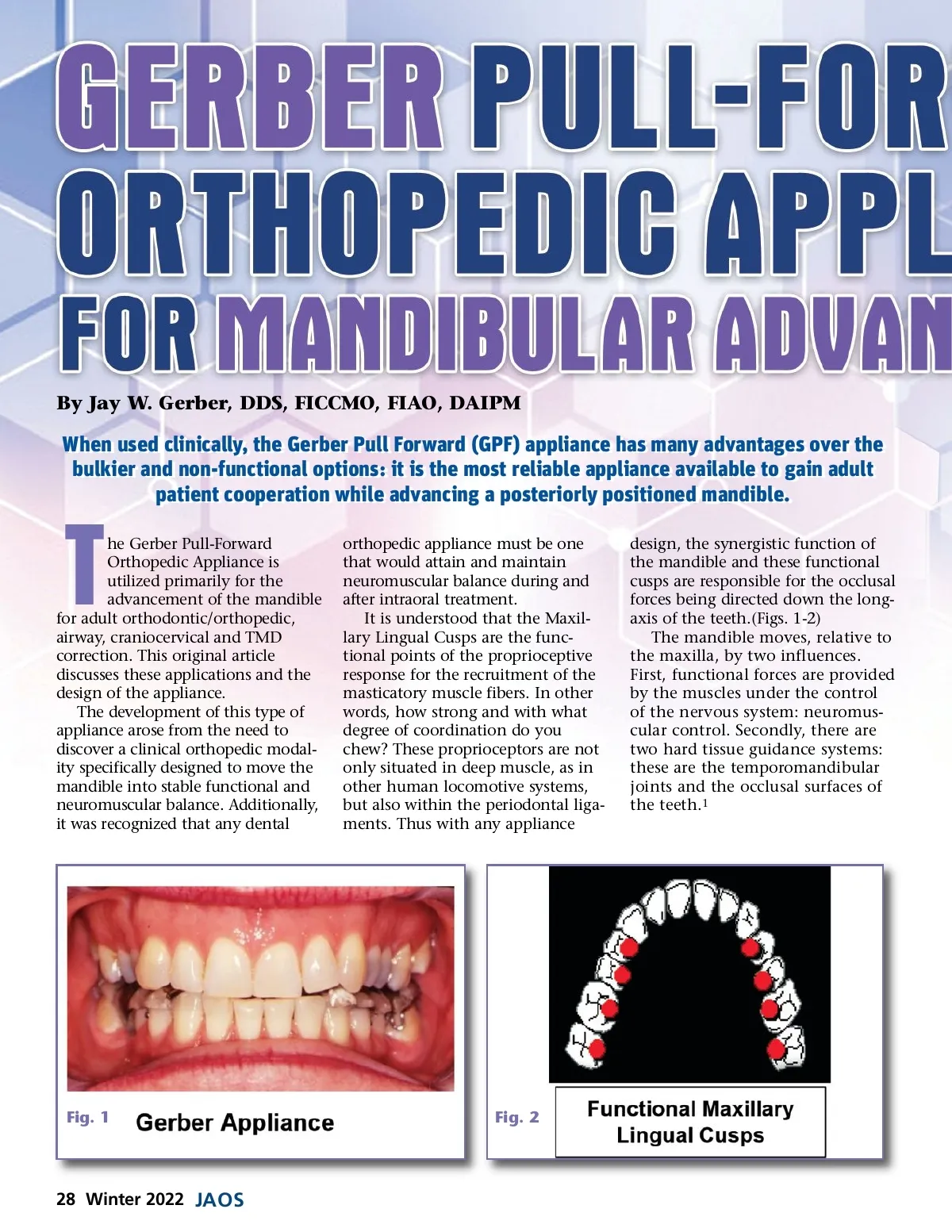
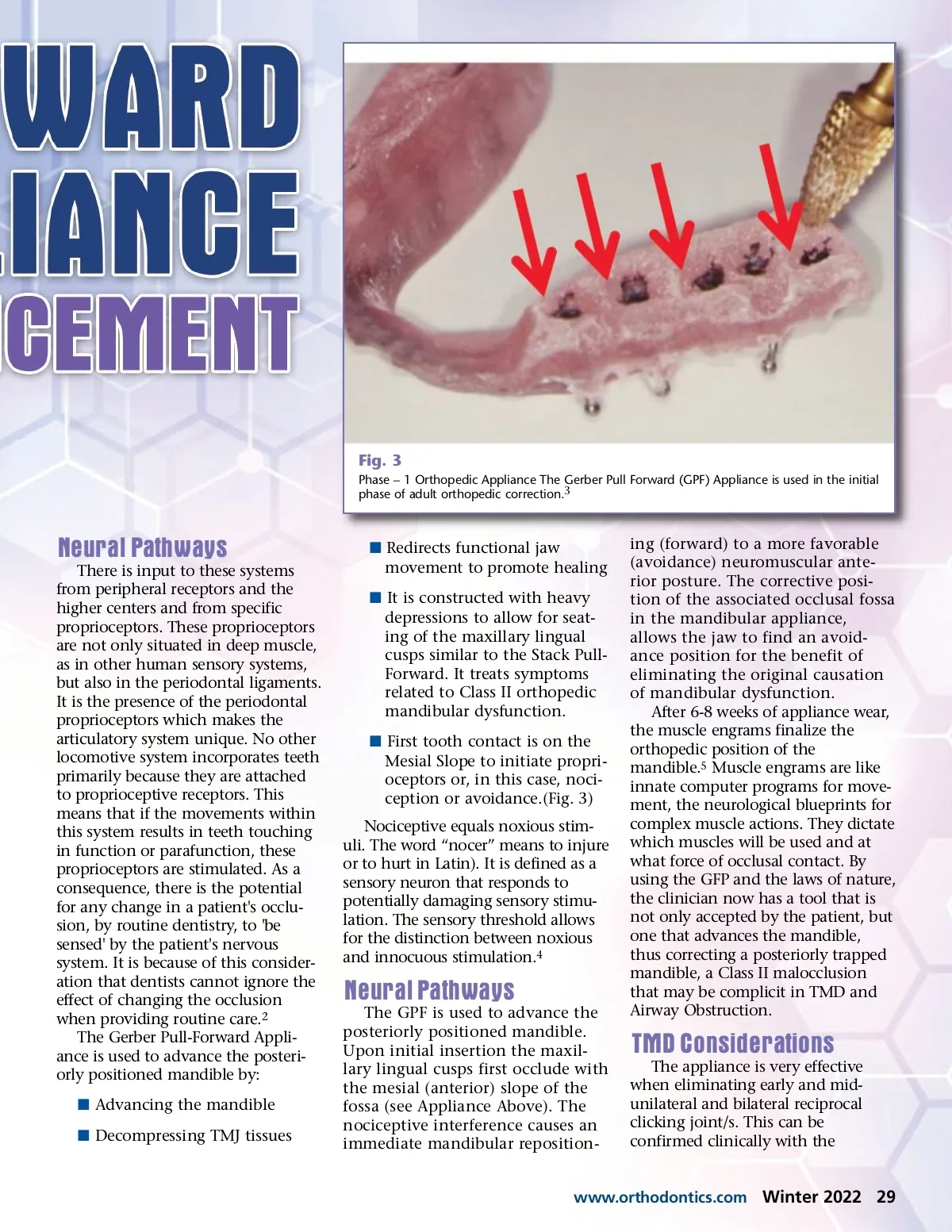
By Jay W. Gerber, DDS, FICCMO, FIAO, DAIPM When When used used clinically, clinically, the the Gerber Gerber Pull Pull Forward Forward (GPF) (GPF) appliance appliance has has many many advantages advantages over over the the bulkier bulkier and and non-functional non-functional options: options: it it is is the the most most reliable reliable appliance appliance available available to to gain gain adult adult patient patient cooperation cooperation while while advancing advancing a a posteriorly posteriorly positioned positioned mandible. mandible. T he Gerber Pull-Forward Orthopedic Appliance is utilized primarily for the advancement of the mandible for adult orthodontic/orthopedic, airway, craniocervical and TMD correction. This original article discusses these applications and the design of the appliance. The development of this type of appliance arose from the need to discover a clinical orthopedic modal-ity specifically designed to move the mandible into stable functional and neuromuscular balance. Additionally, it was recognized that any dental orthopedic appliance must be one that would attain and maintain neuromuscular balance during and after intraoral treatment. It is understood that the Maxil-lary Lingual Cusps are the func-tional points of the proprioceptive response for the recruitment of the masticatory muscle fibers. In other words, how strong and with what degree of coordination do you chew? These proprioceptors are not only situated in deep muscle, as in other human locomotive systems, but also within the periodontal liga-ments. Thus with any appliance design, the synergistic function of the mandible and these functional cusps are responsible for the occlusal forces being directed down the long-axis of the teeth.(Figs. 1-2) The mandible moves, relative to the maxilla, by two influences. First, functional forces are provided by the muscles under the control of the nervous system: neuromus-cular control. Secondly, there are two hard tissue guidance systems: these are the temporomandibular joints and the occlusal surfaces of the teeth. 1 Fig. 1 Fig. 2 28 Winter 2022 JAOS
Journal of the American Orthodontic Society Winter 2022: Page 28