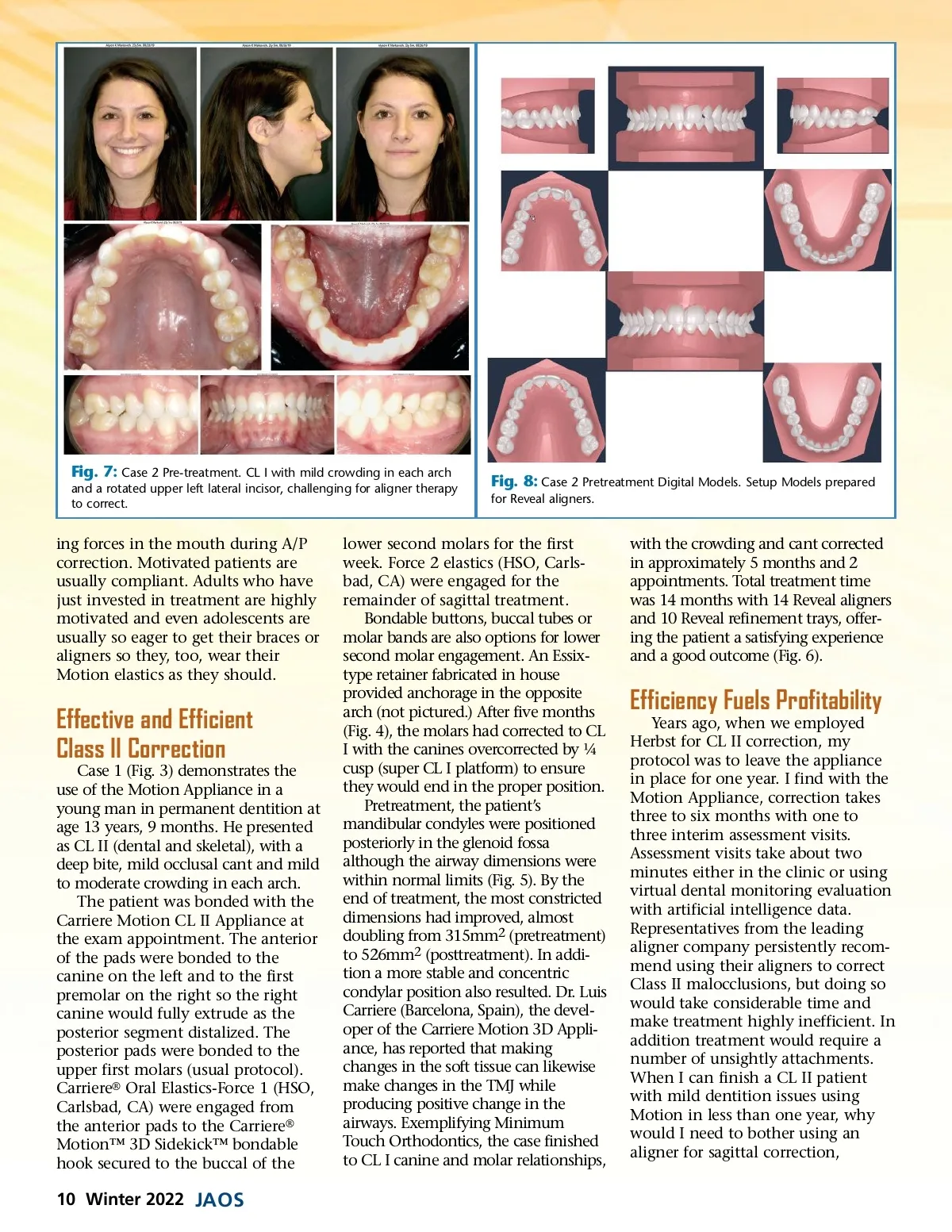
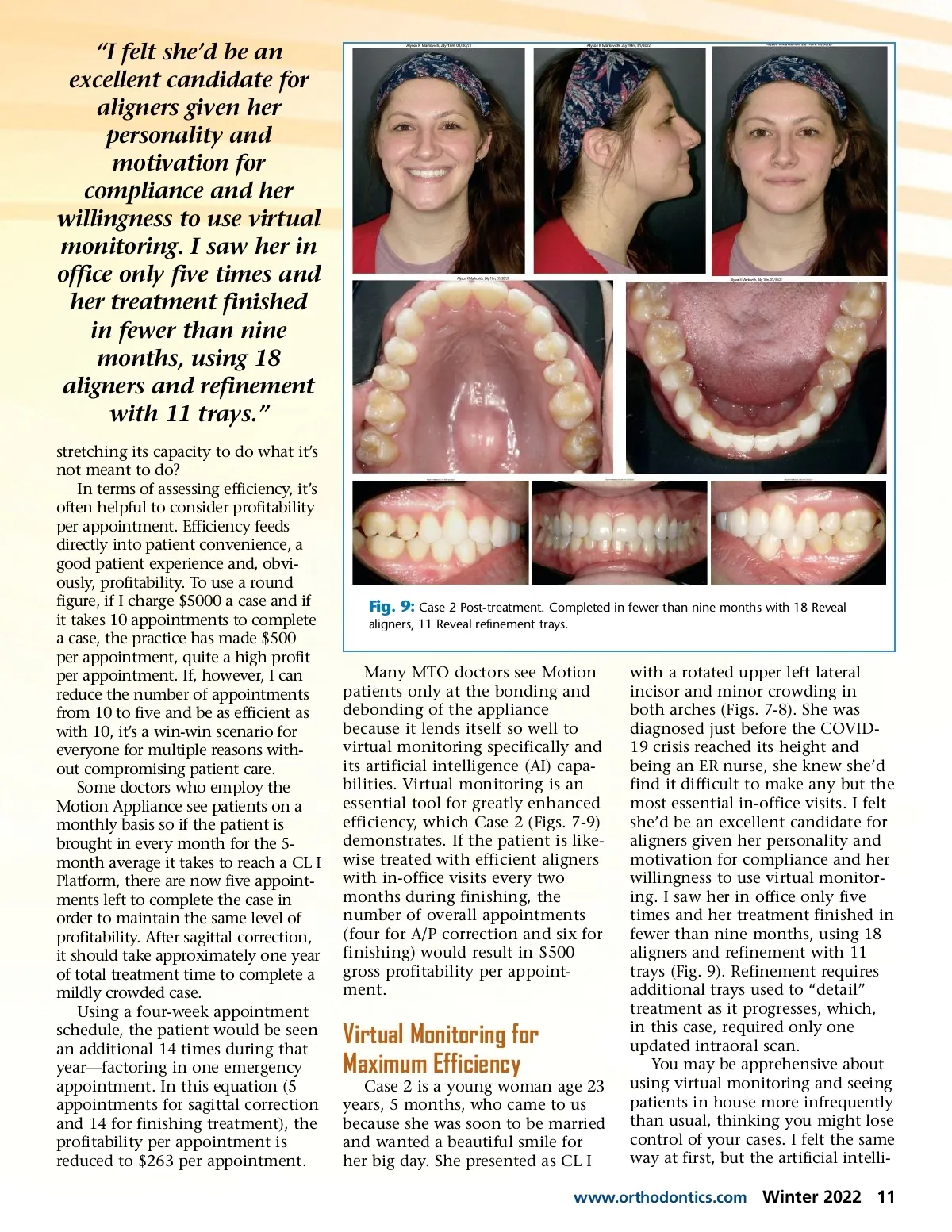
“I felt she’d be an excellent candidate for aligners given her personality and motivation for compliance and her willingness to use virtual monitoring. I saw her in office only five times and her treatment finished in fewer than nine months, using 18 aligners and refinement with 11 trays.” stretching its capacity to do what it’s not meant to do? In terms of assessing efficiency, it’s often helpful to consider profitability per appointment. Efficiency feeds directly into patient convenience, a good patient experience and, obvi-ously, profitability. To use a round figure, if I charge $5000 a case and if it takes 10 appointments to complete a case, the practice has made $500 per appointment, quite a high profit per appointment. If, however, I can reduce the number of appointments from 10 to five and be as efficient as with 10, it’s a win-win scenario for everyone for multiple reasons with-out compromising patient care. Some doctors who employ the Motion Appliance see patients on a monthly basis so if the patient is brought in every month for the 5-month average it takes to reach a CL I Platform, there are now five appoint-ments left to complete the case in order to maintain the same level of profitability. After sagittal correction, it should take approximately one year of total treatment time to complete a mildly crowded case. Using a four-week appointment schedule, the patient would be seen an additional 14 times during that year—factoring in one emergency appointment. In this equation (5 appointments for sagittal correction and 14 for finishing treatment), the profitability per appointment is reduced to $263 per appointment. Fig. 9: Case 2 Post-treatment. Completed in fewer than nine months with 18 Reveal aligners, 11 Reveal refinement trays. Many MTO doctors see Motion patients only at the bonding and debonding of the appliance because it lends itself so well to virtual monitoring specifically and its artificial intelligence (AI) capa-bilities. Virtual monitoring is an essential tool for greatly enhanced efficiency, which Case 2 (Figs. 7-9) demonstrates. If the patient is like-wise treated with efficient aligners with in-office visits every two months during finishing, the number of overall appointments (four for A/P correction and six for finishing) would result in $500 gross profitability per appoint-ment. Virtual Monitoring for Maximum Efficiency Case 2 is a young woman age 23 years, 5 months, who came to us because she was soon to be married and wanted a beautiful smile for her big day. She presented as CL I with a rotated upper left lateral incisor and minor crowding in both arches (Figs. 7-8). She was diagnosed just before the COVID-19 crisis reached its height and being an ER nurse, she knew she’d find it difficult to make any but the most essential in-office visits. I felt she’d be an excellent candidate for aligners given her personality and motivation for compliance and her willingness to use virtual monitor-ing. I saw her in office only five times and her treatment finished in fewer than nine months, using 18 aligners and refinement with 11 trays (Fig. 9). Refinement requires additional trays used to “detail” treatment as it progresses, which, in this case, required only one updated intraoral scan. You may be apprehensive about using virtual monitoring and seeing patients in house more infrequently than usual, thinking you might lose control of your cases. I felt the same way at first, but the artificial intelli-www.orthodontics.com Winter 2022 11
Journal of the American Orthodontic Society Winter 2022: Page 11