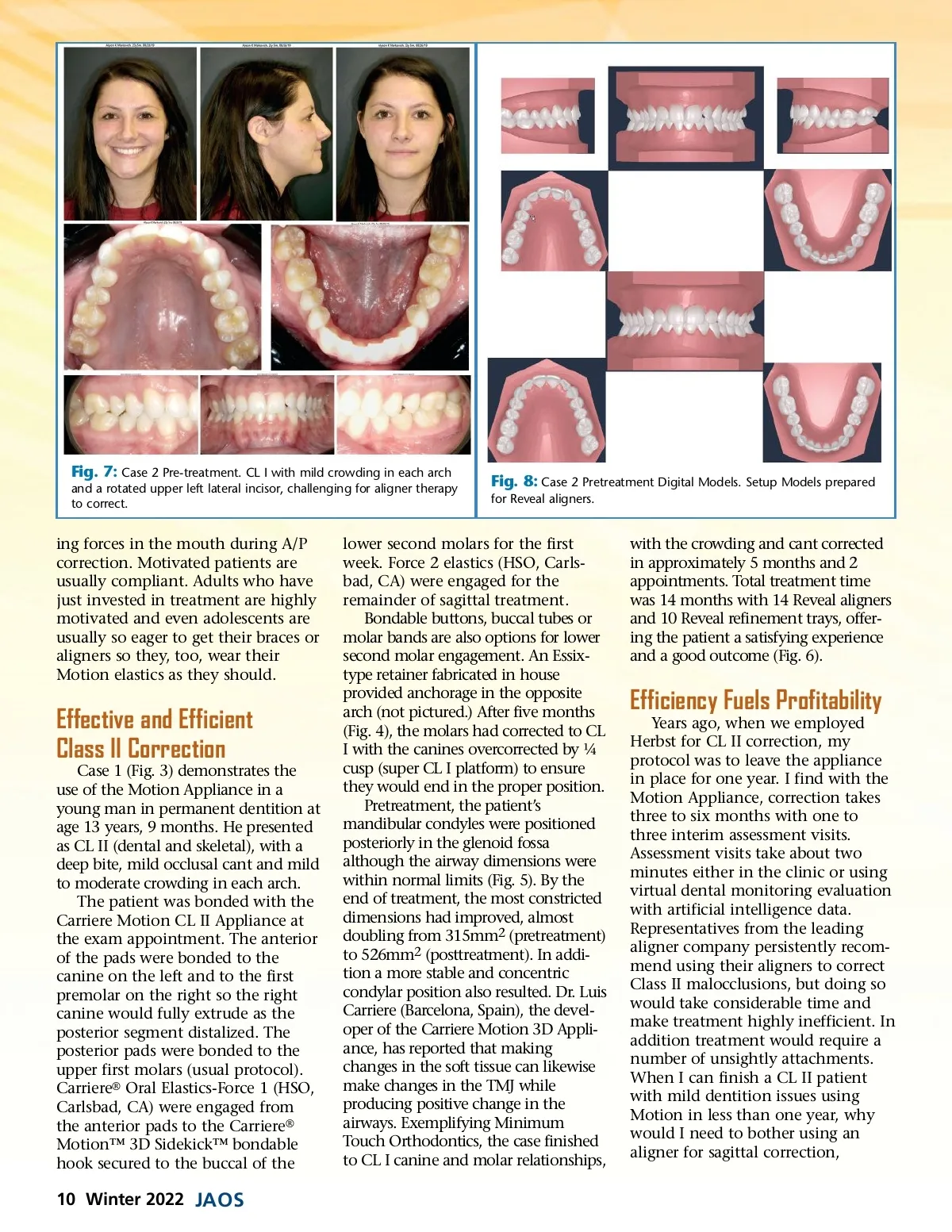
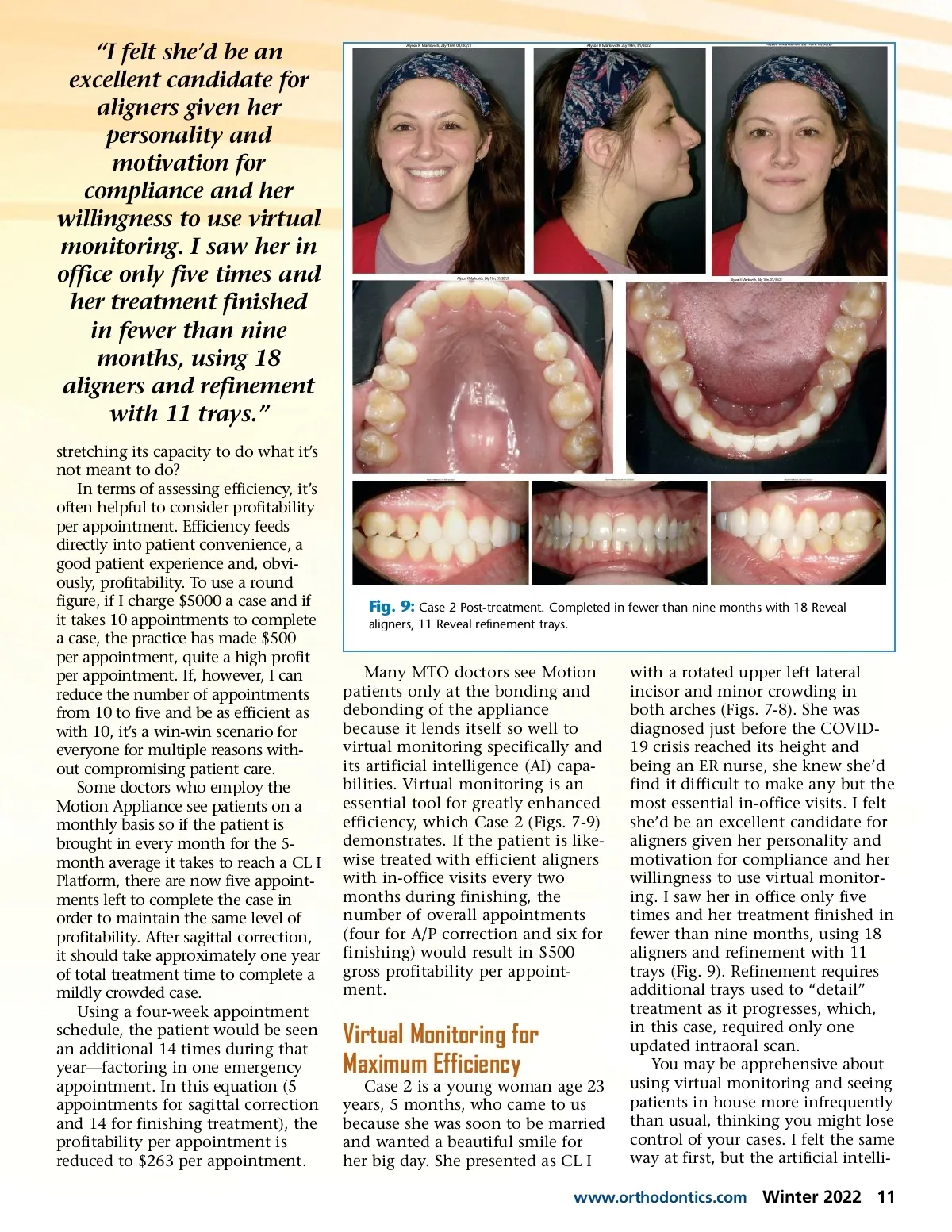
Fig. 7: Case 2 Pre-treatment. CL I with mild crowding in each arch and a rotated upper left lateral incisor, challenging for aligner therapy to correct. Fig. 8: Case 2 Pretreatment Digital Models. Setup Models prepared for Reveal aligners. ing forces in the mouth during A/P correction. Motivated patients are usually compliant. Adults who have just invested in treatment are highly motivated and even adolescents are usually so eager to get their braces or aligners so they, too, wear their Motion elastics as they should. Effective and Efficient Class II Correction Case 1 (Fig. 3) demonstrates the use of the Motion Appliance in a young man in permanent dentition at age 13 years, 9 months. He presented as CL II (dental and skeletal), with a deep bite, mild occlusal cant and mild to moderate crowding in each arch. The patient was bonded with the Carriere Motion CL II Appliance at the exam appointment. The anterior of the pads were bonded to the canine on the left and to the first premolar on the right so the right canine would fully extrude as the posterior segment distalized. The posterior pads were bonded to the upper first molars (usual protocol). Carriere ® Oral Elastics-Force 1 (HSO, Carlsbad, CA) were engaged from the anterior pads to the Carriere ® Motion™ 3D Sidekick™ bondable hook secured to the buccal of the lower second molars for the first week. Force 2 elastics (HSO, Carls-bad, CA) were engaged for the remainder of sagittal treatment. Bondable buttons, buccal tubes or molar bands are also options for lower second molar engagement. An Essix-type retainer fabricated in house provided anchorage in the opposite arch (not pictured.) After five months (Fig. 4), the molars had corrected to CL I with the canines overcorrected by ¼ cusp (super CL I platform) to ensure they would end in the proper position. Pretreatment, the patient’s mandibular condyles were positioned posteriorly in the glenoid fossa although the airway dimensions were within normal limits (Fig. 5). By the end of treatment, the most constricted dimensions had improved, almost doubling from 315mm 2 (pretreatment) to 526mm 2 (posttreatment). In addi-tion a more stable and concentric condylar position also resulted. Dr. Luis Carriere (Barcelona, Spain), the devel-oper of the Carriere Motion 3D Appli-ance, has reported that making changes in the soft tissue can likewise make changes in the TMJ while producing positive change in the airways. Exemplifying Minimum Touch Orthodontics, the case finished to CL I canine and molar relationships, with the crowding and cant corrected in approximately 5 months and 2 appointments. Total treatment time was 14 months with 14 Reveal aligners and 10 Reveal refinement trays, offer-ing the patient a satisfying experience and a good outcome (Fig. 6). Efficiency Fuels Profitability Years ago, when we employed Herbst for CL II correction, my protocol was to leave the appliance in place for one year. I find with the Motion Appliance, correction takes three to six months with one to three interim assessment visits. Assessment visits take about two minutes either in the clinic or using virtual dental monitoring evaluation with artificial intelligence data. Representatives from the leading aligner company persistently recom-mend using their aligners to correct Class II malocclusions, but doing so would take considerable time and make treatment highly inefficient. In addition treatment would require a number of unsightly attachments. When I can finish a CL II patient with mild dentition issues using Motion in less than one year, why would I need to bother using an aligner for sagittal correction, 10 Winter 2022 JAOS
Journal of the American Orthodontic Society Winter 2022: Page 10