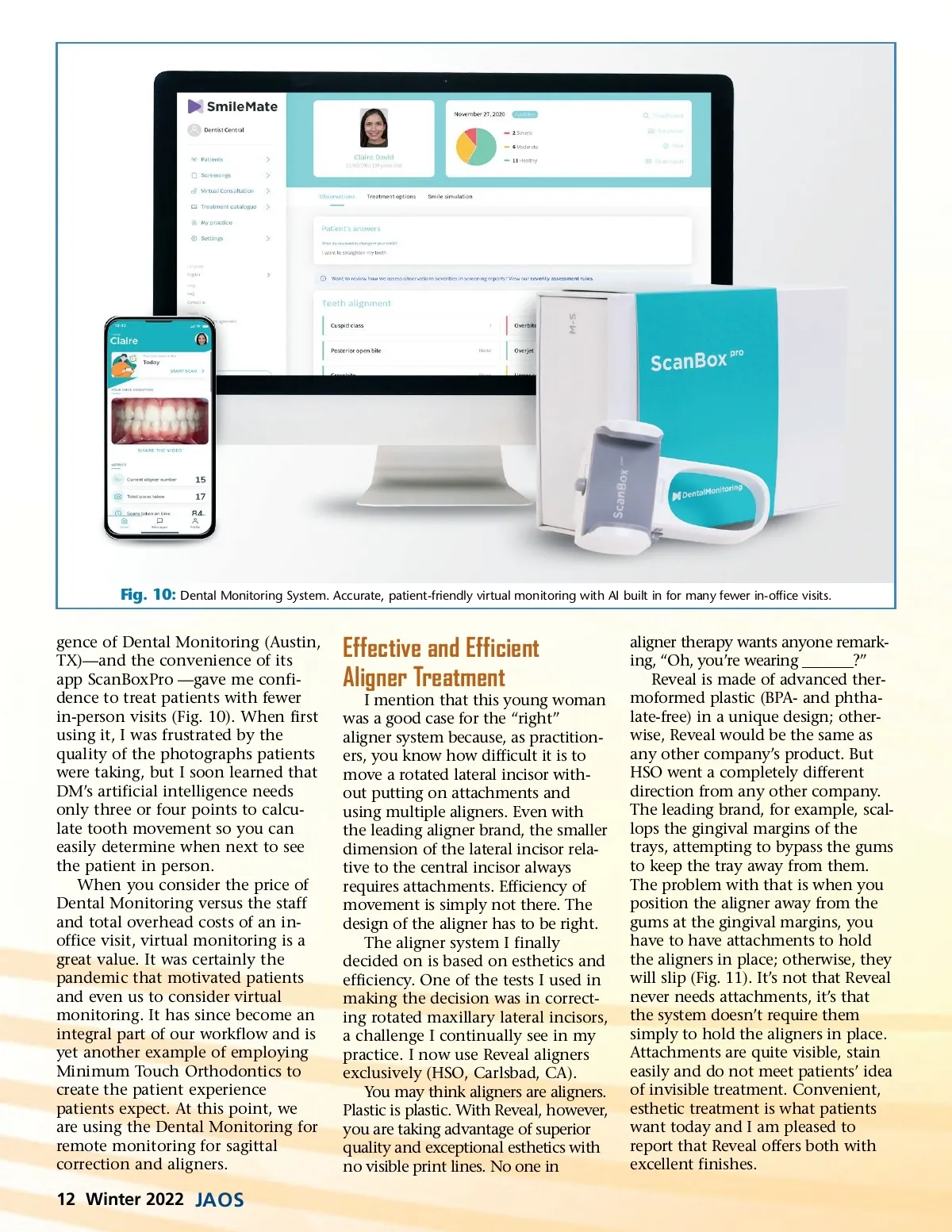
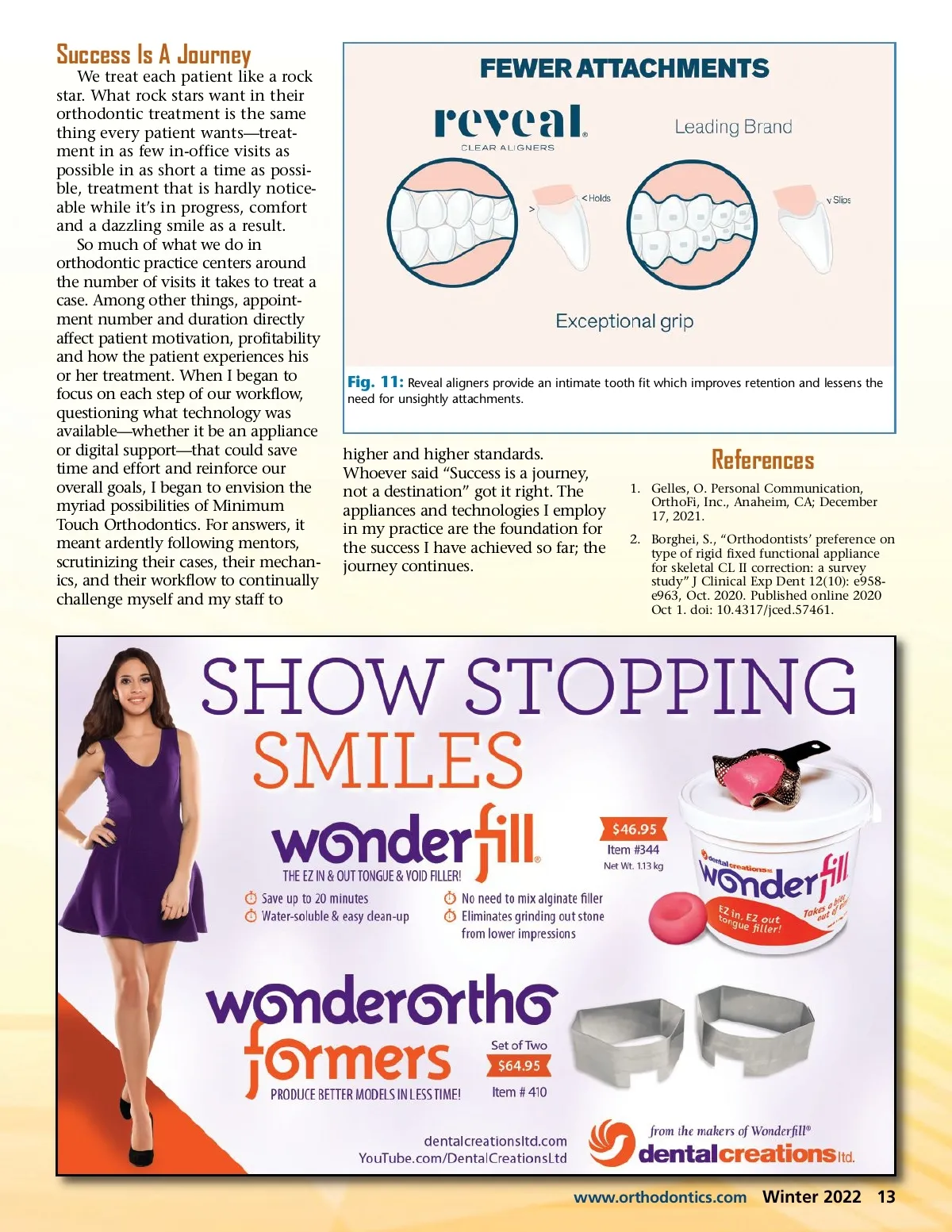
Fig. 10: Dental Monitoring System. Accurate, patient-friendly virtual monitoring with AI built in for many fewer in-office visits. gence of Dental Monitoring (Austin, TX)—and the convenience of its app ScanBoxPro —gave me confi-dence to treat patients with fewer in-person visits (Fig. 10). When first using it, I was frustrated by the quality of the photographs patients were taking, but I soon learned that DM’s artificial intelligence needs only three or four points to calcu-late tooth movement so you can easily determine when next to see the patient in person. When you consider the price of Dental Monitoring versus the staff and total overhead costs of an in-office visit, virtual monitoring is a great value. It was certainly the pandemic that motivated patients and even us to consider virtual monitoring. It has since become an integral part of our workflow and is yet another example of employing Minimum Touch Orthodontics to create the patient experience patients expect. At this point, we are using the Dental Monitoring for remote monitoring for sagittal correction and aligners. Effective and Efficient Aligner Treatment I mention that this young woman was a good case for the “right” aligner system because, as practition-ers, you know how difficult it is to move a rotated lateral incisor with-out putting on attachments and using multiple aligners. Even with the leading aligner brand, the smaller dimension of the lateral incisor rela-tive to the central incisor always requires attachments. Efficiency of movement is simply not there. The design of the aligner has to be right. The aligner system I finally decided on is based on esthetics and efficiency. One of the tests I used in making the decision was in correct-ing rotated maxillary lateral incisors, a challenge I continually see in my practice. I now use Reveal aligners exclusively (HSO, Carlsbad, CA). You may think aligners are aligners. Plastic is plastic. With Reveal, however, you are taking advantage of superior quality and exceptional esthetics with no visible print lines. No one in aligner therapy wants anyone remark-ing, “Oh, you’re wearing _______?” Reveal is made of advanced ther-moformed plastic (BPA-and phtha-late-free) in a unique design; other-wise, Reveal would be the same as any other company’s product. But HSO went a completely different direction from any other company. The leading brand, for example, scal-lops the gingival margins of the trays, attempting to bypass the gums to keep the tray away from them. The problem with that is when you position the aligner away from the gums at the gingival margins, you have to have attachments to hold the aligners in place; otherwise, they will slip (Fig. 11). It’s not that Reveal never needs attachments, it’s that the system doesn’t require them simply to hold the aligners in place. Attachments are quite visible, stain easily and do not meet patients’ idea of invisible treatment. Convenient, esthetic treatment is what patients want today and I am pleased to report that Reveal offers both with excellent finishes. 12 Winter 2022 JAOS
Journal of the American Orthodontic Society Winter 2022: Page 12