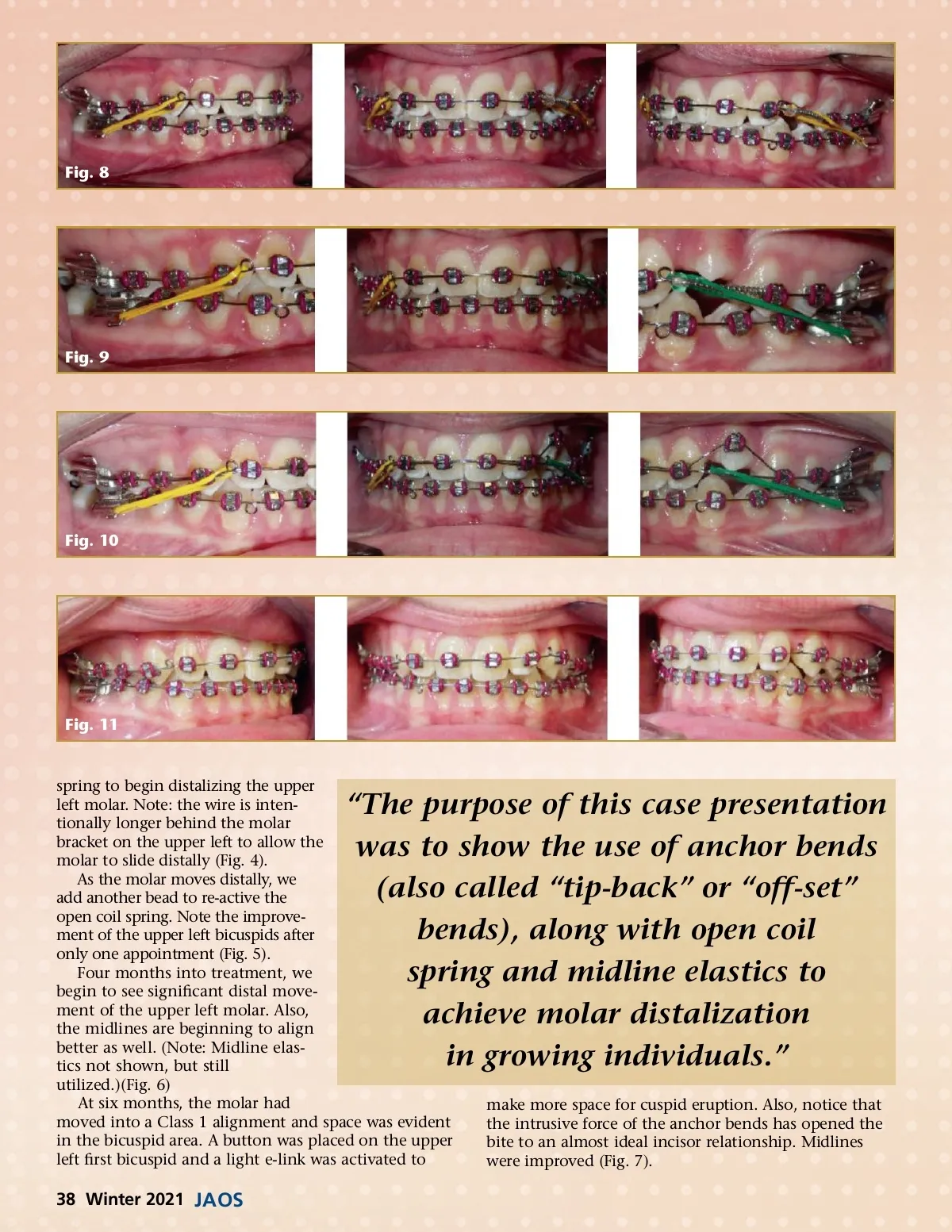
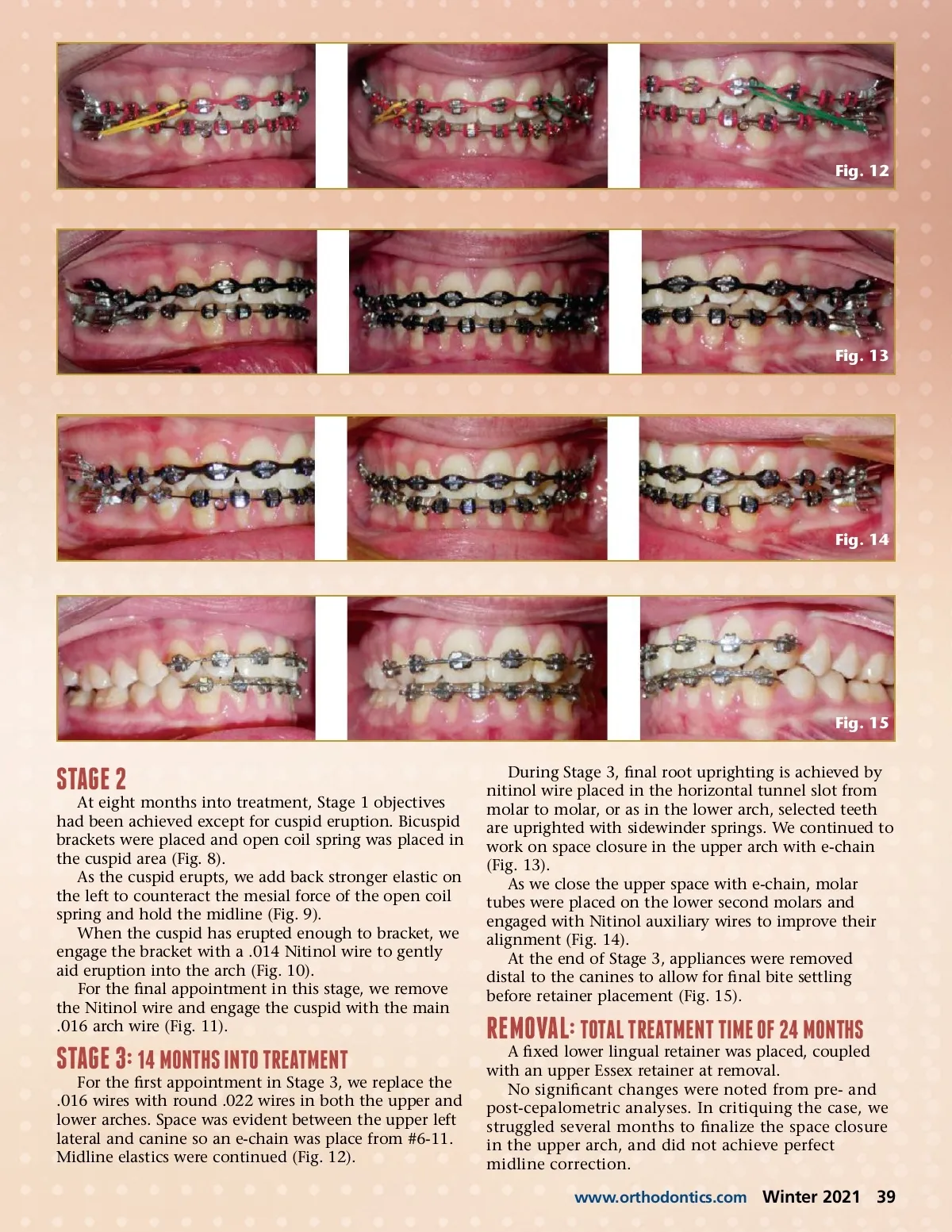
Fig. 12 Fig. 13 Fig. 14 Fig. 15 stagE 2 At eight months into treatment, Stage 1 objectives had been achieved except for cuspid eruption. Bicuspid brackets were placed and open coil spring was placed in the cuspid area (Fig. 8). As the cuspid erupts, we add back stronger elastic on the left to counteract the mesial force of the open coil spring and hold the midline (Fig. 9). When the cuspid has erupted enough to bracket, we engage the bracket with a .014 Nitinol wire to gently aid eruption into the arch (Fig. 10). For the final appointment in this stage, we remove the Nitinol wire and engage the cuspid with the main .016 arch wire (Fig. 11). During Stage 3, final root uprighting is achieved by nitinol wire placed in the horizontal tunnel slot from molar to molar, or as in the lower arch, selected teeth are uprighted with sidewinder springs. We continued to work on space closure in the upper arch with e-chain (Fig. 13). As we close the upper space with e-chain, molar tubes were placed on the lower second molars and engaged with Nitinol auxiliary wires to improve their alignment (Fig. 14). At the end of Stage 3, appliances were removed distal to the canines to allow for final bite settling before retainer placement (Fig. 15). stagE 3 : 14 MOnths intO trEatMEnt rEMOval: tOtal trEatMEnt tiME Of 24 MOnths For the first appointment in Stage 3, we replace the .016 wires with round .022 wires in both the upper and lower arches. Space was evident between the upper left lateral and canine so an e-chain was place from #6-11. Midline elastics were continued (Fig. 12). A fixed lower lingual retainer was placed, coupled with an upper Essex retainer at removal. No significant changes were noted from pre-and post-cepalometric analyses. In critiquing the case, we struggled several months to finalize the space closure in the upper arch, and did not achieve perfect midline correction. www.orthodontics.com Winter 2021 39
Journal of the American Orthodontic Society Winter 2021: Page 39