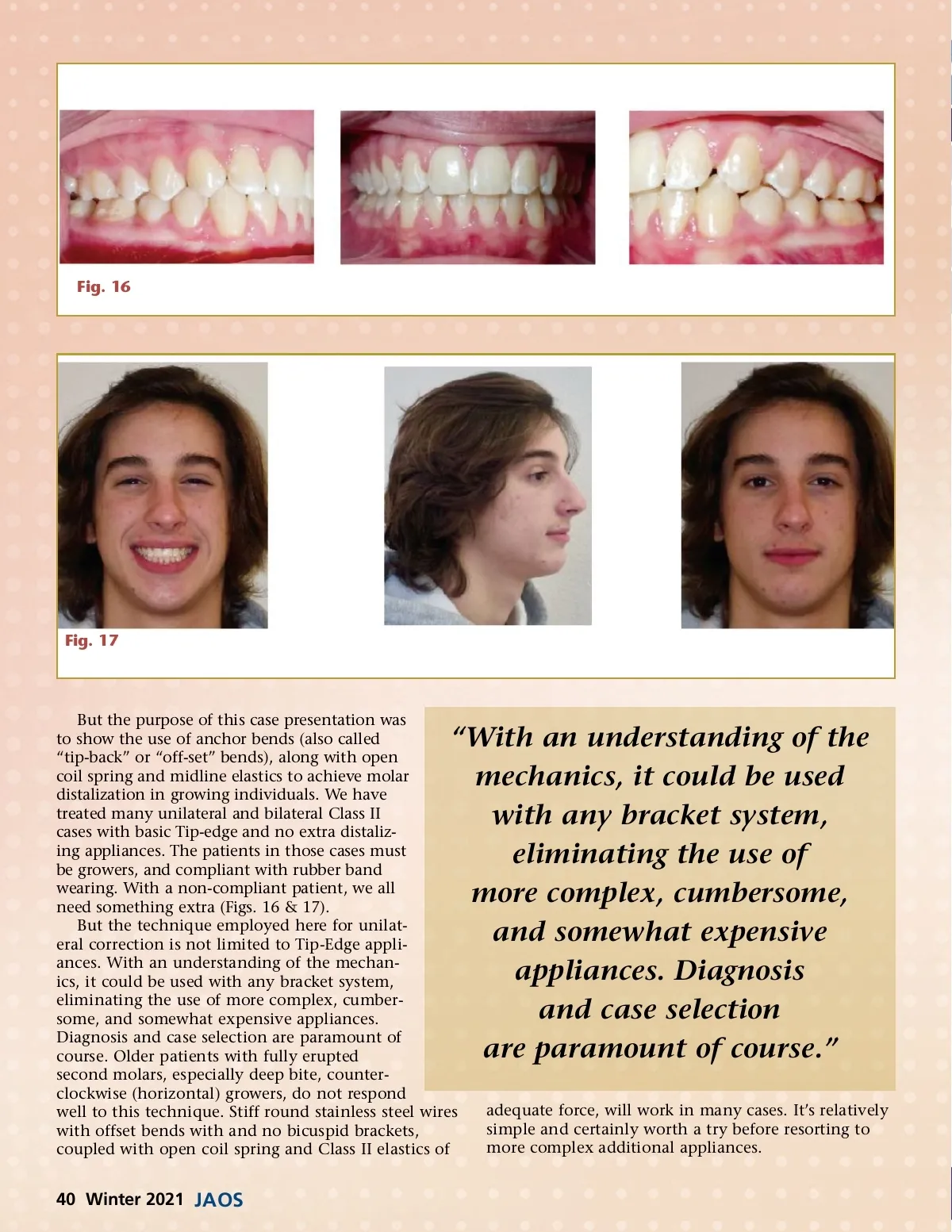
Fig. 16 Fig. 17 But the purpose of this case presentation was to show the use of anchor bends (also called “tip-back” or “off-set” bends), along with open coil spring and midline elastics to achieve molar distalization in growing individuals. We have treated many unilateral and bilateral Class II cases with basic Tip-edge and no extra distaliz-ing appliances. The patients in those cases must be growers, and compliant with rubber band wearing. With a non-compliant patient, we all need something extra (Figs. 16 & 17). But the technique employed here for unilat-eral correction is not limited to Tip-Edge appli-ances. With an understanding of the mechan-ics, it could be used with any bracket system, eliminating the use of more complex, cumber-some, and somewhat expensive appliances. Diagnosis and case selection are paramount of course. Older patients with fully erupted second molars, especially deep bite, counter-clockwise (horizontal) growers, do not respond well to this technique. Stiff round stainless steel wires with offset bends with and no bicuspid brackets, coupled with open coil spring and Class II elastics of “With an understanding of the mechanics, it could be used with any bracket system, eliminating the use of more complex, cumbersome, and somewhat expensive appliances. Diagnosis and case selection are paramount of course.” adequate force, will work in many cases. It’s relatively simple and certainly worth a try before resorting to more complex additional appliances. 40 Winter 2021 JAOS
Journal of the American Orthodontic Society Winter 2021: Page 40