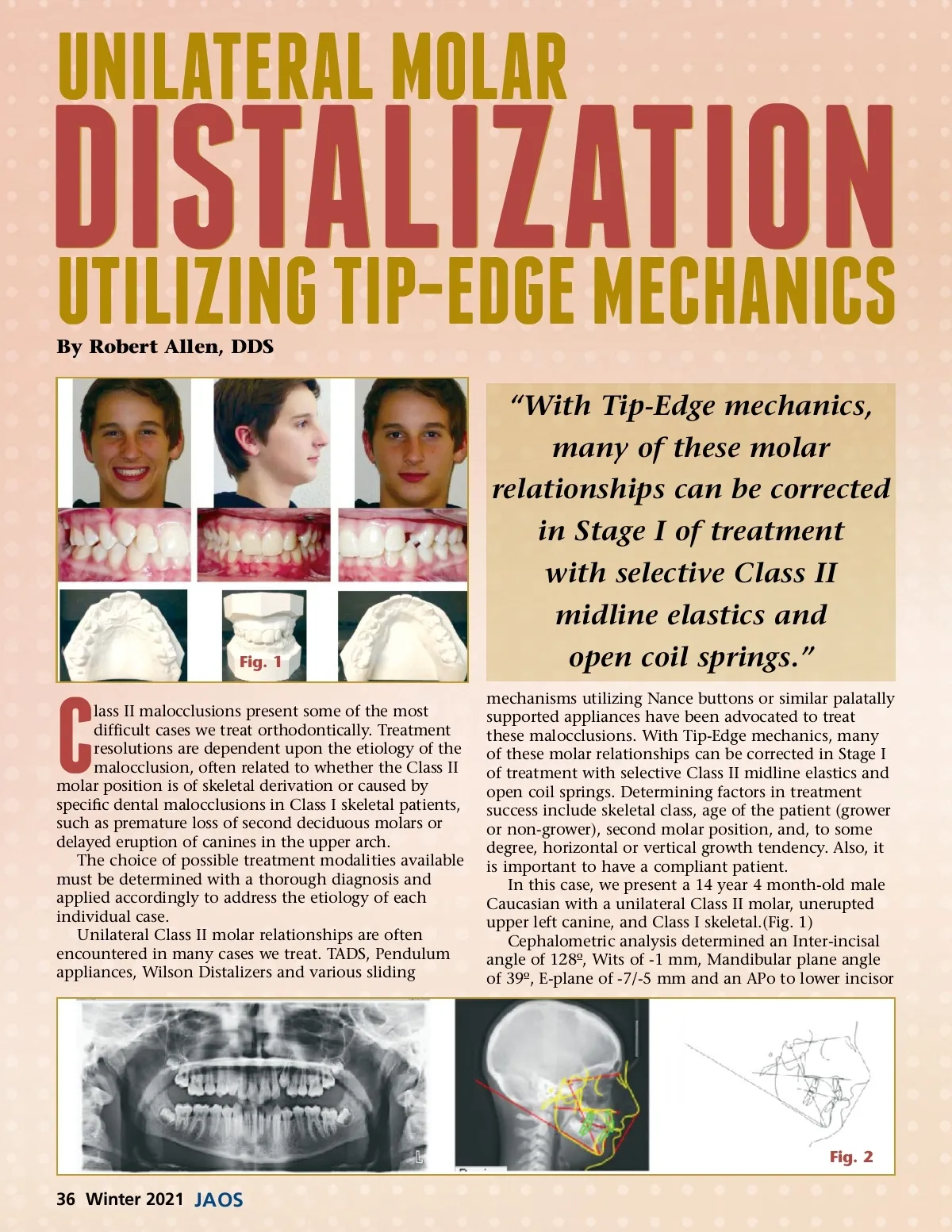
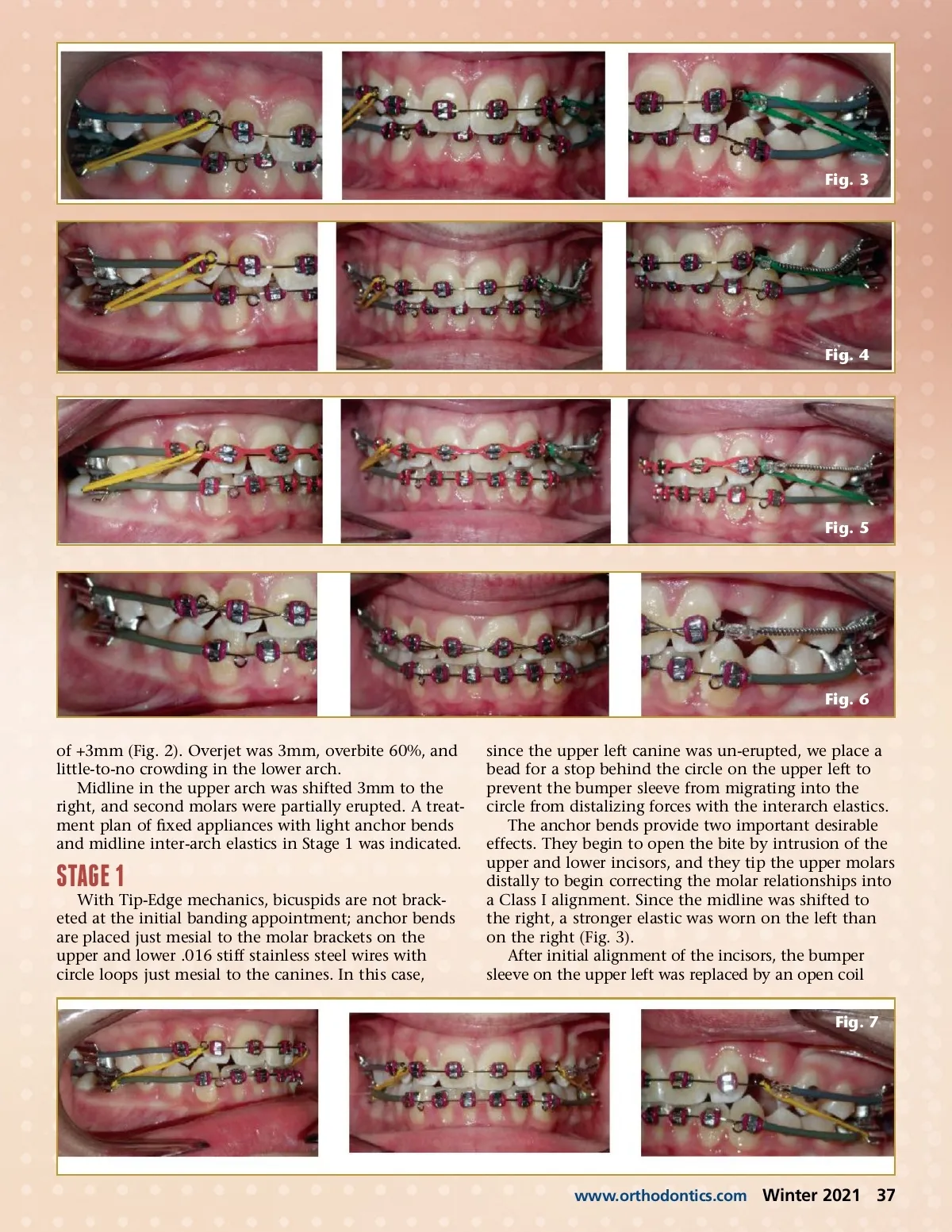
Fig. 3 Fig. 4 Fig. 5 Fig. 6 of +3mm (Fig. 2). Overjet was 3mm, overbite 60%, and little-to-no crowding in the lower arch. Midline in the upper arch was shifted 3mm to the right, and second molars were partially erupted. A treat-ment plan of fixed appliances with light anchor bends and midline inter-arch elastics in Stage 1 was indicated. since the upper left canine was un-erupted, we place a bead for a stop behind the circle on the upper left to prevent the bumper sleeve from migrating into the circle from distalizing forces with the interarch elastics. The anchor bends provide two important desirable effects. They begin to open the bite by intrusion of the upper and lower incisors, and they tip the upper molars distally to begin correcting the molar relationships into a Class I alignment. Since the midline was shifted to the right, a stronger elastic was worn on the left than on the right (Fig. 3). After initial alignment of the incisors, the bumper sleeve on the upper left was replaced by an open coil Fig. 7 stagE 1 With Tip-Edge mechanics, bicuspids are not brack-eted at the initial banding appointment; anchor bends are placed just mesial to the molar brackets on the upper and lower .016 stiff stainless steel wires with circle loops just mesial to the canines. In this case, www.orthodontics.com Winter 2021 37
Journal of the American Orthodontic Society Winter 2021: Page 37