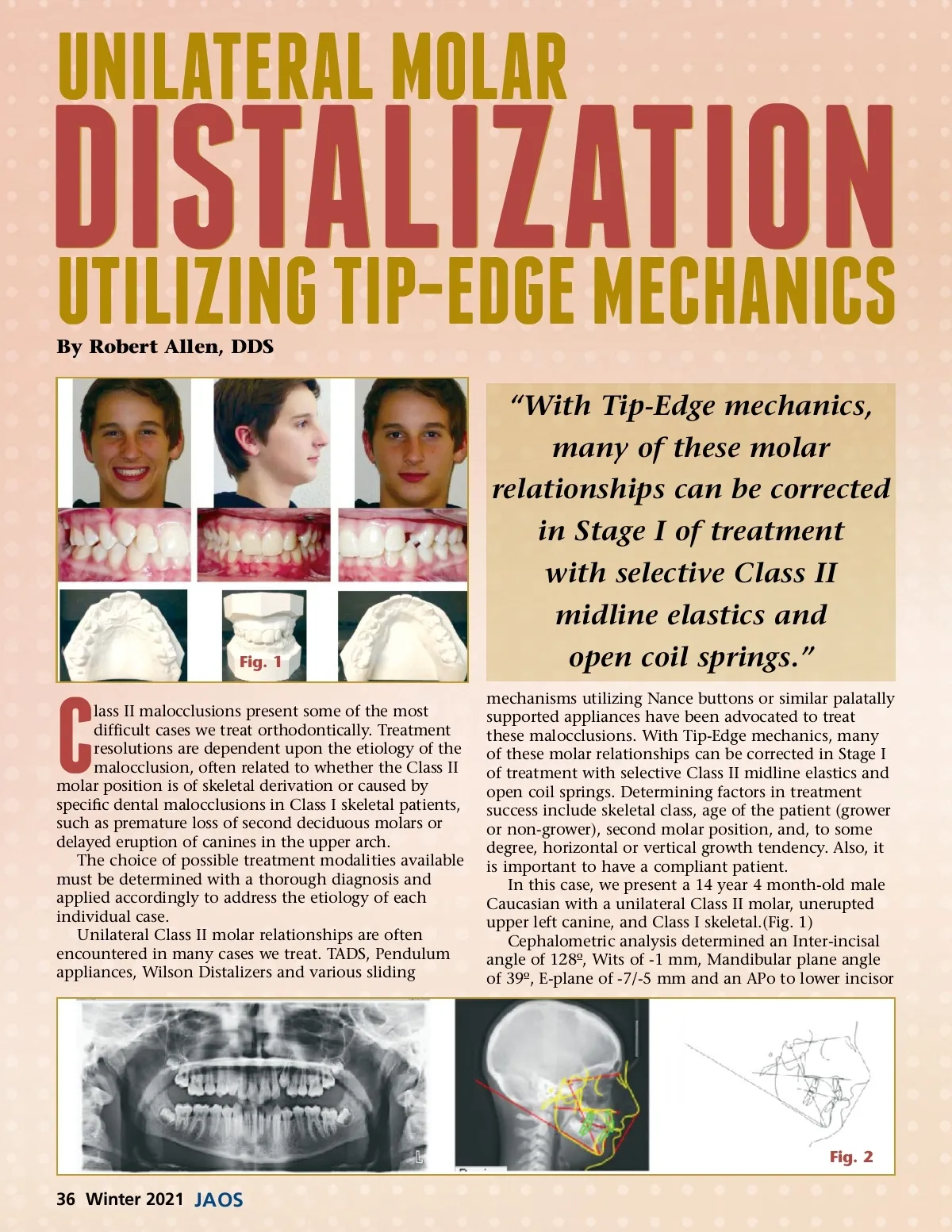
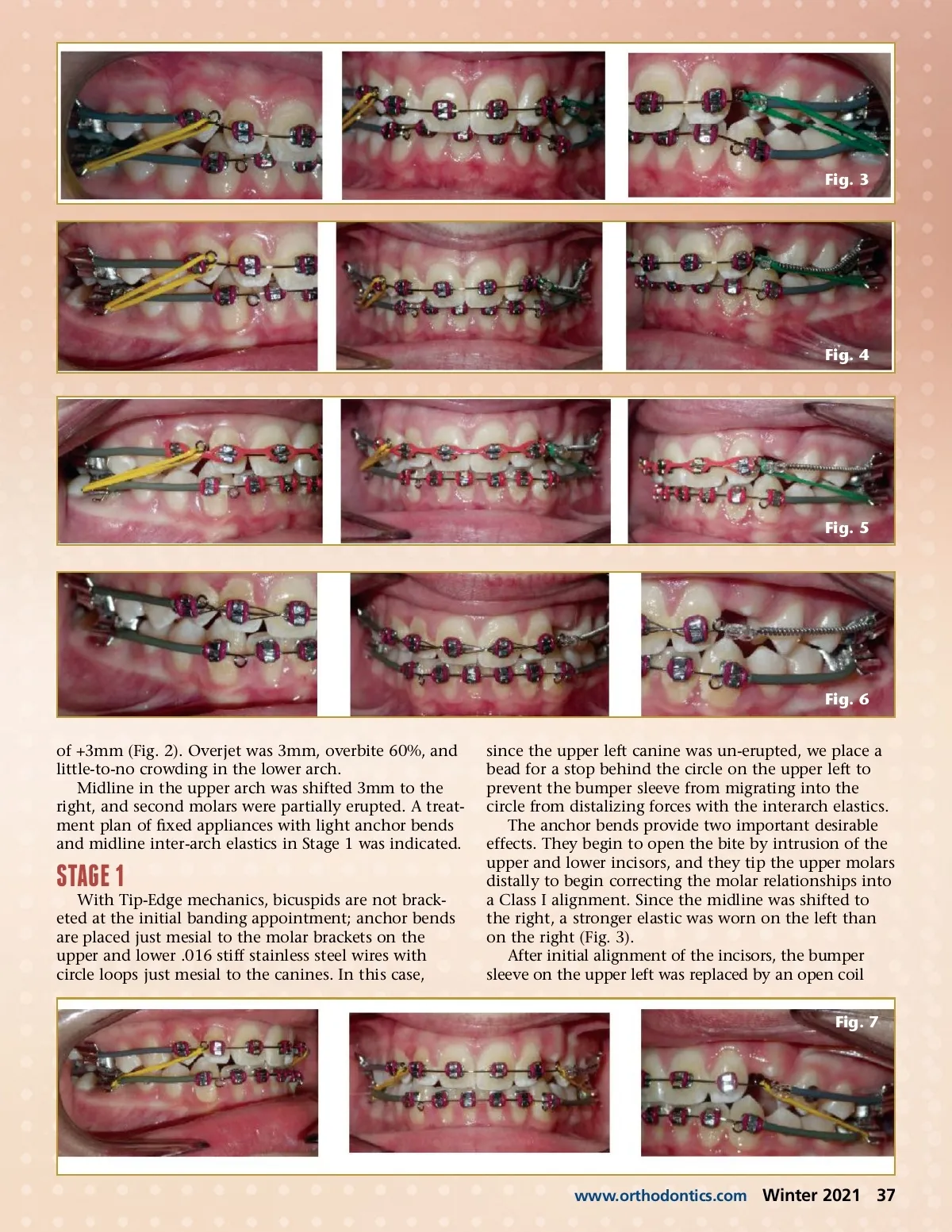
distalizatiOn Utilizing tip-EdgE MEChaniCs By Robert Allen, DDS UnilatEral MOlar “With Tip-Edge mechanics, many of these molar relationships can be corrected in Stage I of treatment with selective Class II midline elastics and Fig. 1 lass II malocclusions present some of the most difficult cases we treat orthodontically. Treatment resolutions are dependent upon the etiology of the malocclusion, often related to whether the Class II molar position is of skeletal derivation or caused by specific dental malocclusions in Class I skeletal patients, such as premature loss of second deciduous molars or delayed eruption of canines in the upper arch. The choice of possible treatment modalities available must be determined with a thorough diagnosis and applied accordingly to address the etiology of each individual case. Unilateral Class II molar relationships are often encountered in many cases we treat. TADS, Pendulum appliances, Wilson Distalizers and various sliding open coil springs.” mechanisms utilizing Nance buttons or similar palatally supported appliances have been advocated to treat these malocclusions. With Tip-Edge mechanics, many of these molar relationships can be corrected in Stage I of treatment with selective Class II midline elastics and open coil springs. Determining factors in treatment success include skeletal class, age of the patient (grower or non-grower), second molar position, and, to some degree, horizontal or vertical growth tendency. Also, it is important to have a compliant patient. In this case, we present a 14 year 4 month-old male Caucasian with a unilateral Class II molar, unerupted upper left canine, and Class I skeletal.(Fig. 1) Cephalometric analysis determined an Inter-incisal angle of 128º, Wits of -1 mm, Mandibular plane angle of 39º, E-plane of -7/-5 mm and an APo to lower incisor C Fig. 2 36 Winter 2021 JAOS
Journal of the American Orthodontic Society Winter 2021: Page 36