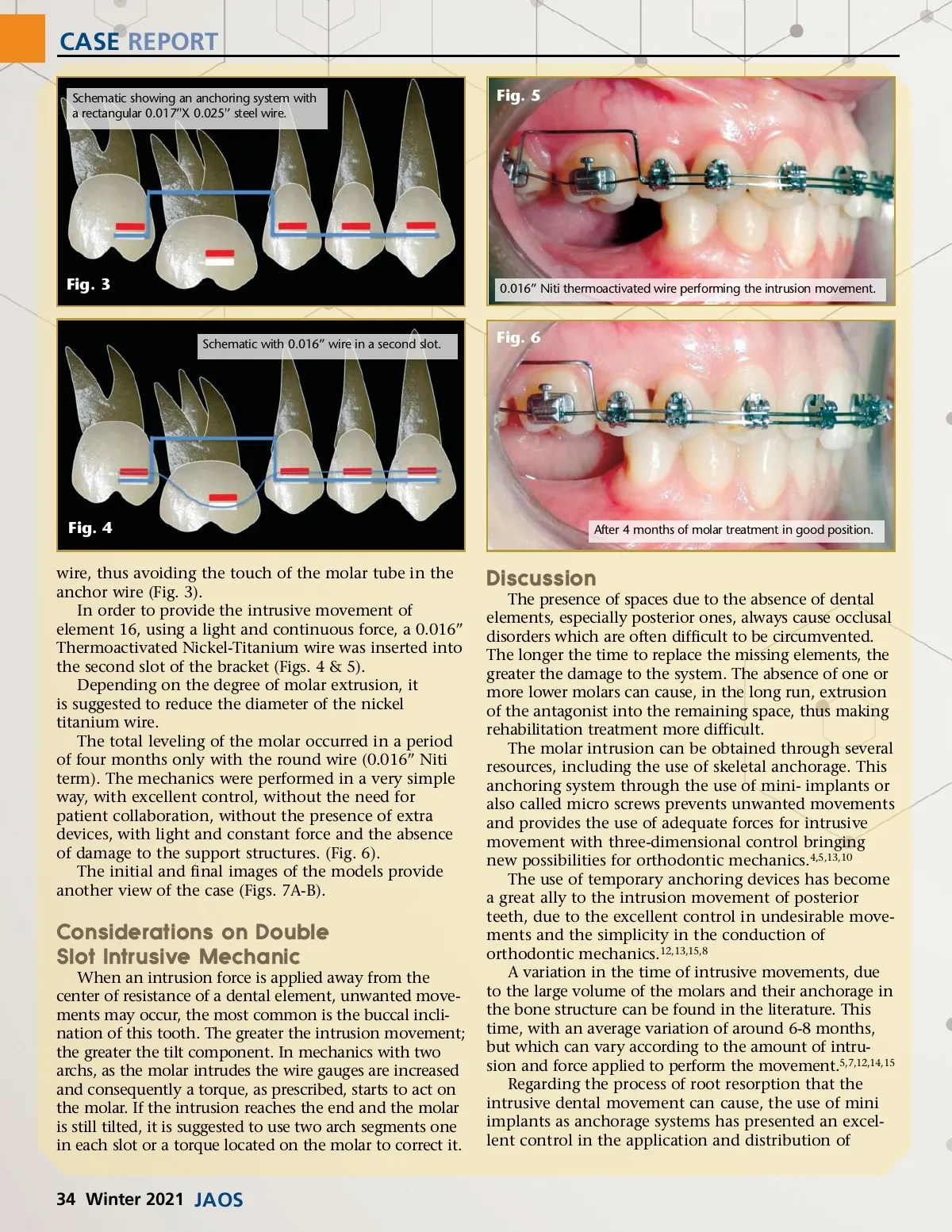
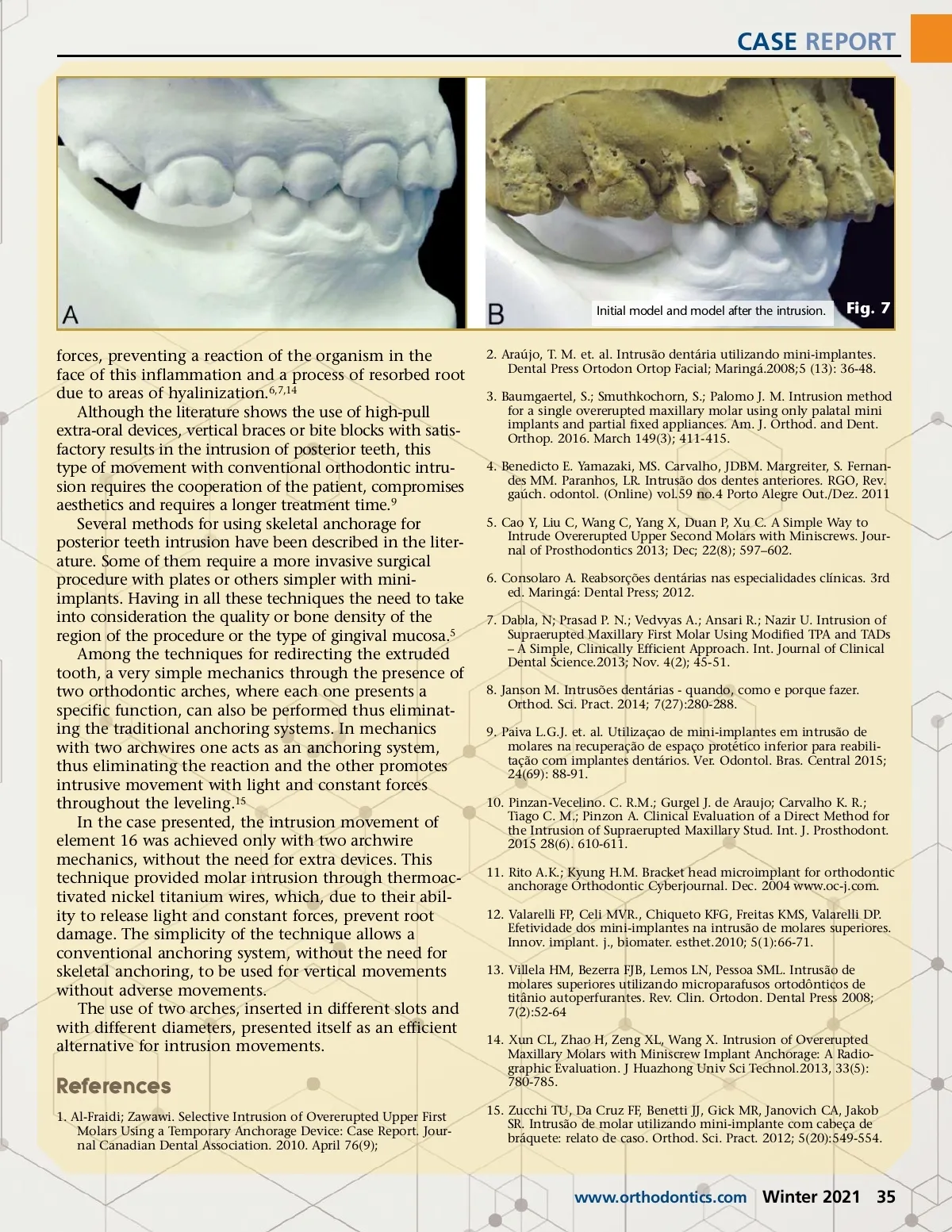
CASE REPORT Initial model and model after the intrusion. Fig. 7 forces, preventing a reaction of the organism in the face of this inflammation and a process of resorbed root due to areas of hyalinization. 6,7,14 Although the literature shows the use of high-pull extra-oral devices, vertical braces or bite blocks with satis-factory results in the intrusion of posterior teeth, this type of movement with conventional orthodontic intru-sion requires the cooperation of the patient, compromises aesthetics and requires a longer treatment time. 9 Several methods for using skeletal anchorage for posterior teeth intrusion have been described in the liter-ature. Some of them require a more invasive surgical procedure with plates or others simpler with mini-implants. Having in all these techniques the need to take into consideration the quality or bone density of the region of the procedure or the type of gingival mucosa. 5 Among the techniques for redirecting the extruded tooth, a very simple mechanics through the presence of two orthodontic arches, where each one presents a specific function, can also be performed thus eliminat-ing the traditional anchoring systems. In mechanics with two archwires one acts as an anchoring system, thus eliminating the reaction and the other promotes intrusive movement with light and constant forces throughout the leveling. 15 In the case presented, the intrusion movement of element 16 was achieved only with two archwire mechanics, without the need for extra devices. This technique provided molar intrusion through thermoac-tivated nickel titanium wires, which, due to their abil-ity to release light and constant forces, prevent root damage. The simplicity of the technique allows a conventional anchoring system, without the need for skeletal anchoring, to be used for vertical movements without adverse movements. The use of two arches, inserted in different slots and with different diameters, presented itself as an efficient alternative for intrusion movements. 2. Araújo, T. M. et. al. Intrusão dentária utilizando mini-implantes. Dental Press Ortodon Ortop Facial; Maringá.2008;5 (13): 36-48. 3. Baumgaertel, S.; Smuthkochorn, S.; Palomo J. M. Intrusion method for a single overerupted maxillary molar using only palatal mini implants and partial fixed appliances. Am. J. Orthod. and Dent. Orthop. 2016. March 149(3); 411-415. 4. Benedicto E. Yamazaki, MS. Carvalho, JDBM. Margreiter, S. Fernan-des MM. Paranhos, LR. Intrusão dos dentes anteriores. RGO, Rev. gaúch. odontol. (Online) vol.59 no.4 Porto Alegre Out./Dez. 2011 5. Cao Y, Liu C, Wang C, Yang X, Duan P, Xu C. A Simple Way to Intrude Overerupted Upper Second Molars with Miniscrews. Jour-nal of Prosthodontics 2013; Dec; 22(8); 597–602. 6. Consolaro A. Reabsorções dentárias nas especialidades clínicas. 3rd ed. Maringá: Dental Press; 2012. 7. Dabla, N; Prasad P. N.; Vedvyas A.; Ansari R.; Nazir U. Intrusion of Supraerupted Maxillary First Molar Using Modified TPA and TADs – A Simple, Clinically Efficient Approach. Int. Journal of Clinical Dental Science.2013; Nov. 4(2); 45-51. 8. Janson M. Intrusões dentárias -quando, como e porque fazer. Orthod. Sci. Pract. 2014; 7(27):280-288. 9. Paiva L.G.J. et. al. Utilizaçao de mini-implantes em intrusão de molares na recuperação de espaço protético inferior para reabili-tação com implantes dentários. Ver. Odontol. Bras. Central 2015; 24(69): 88-91. 10. Pinzan-Vecelino. C. R.M.; Gurgel J. de Araujo; Carvalho K. R.; Tiago C. M.; Pinzon A. Clinical Evaluation of a Direct Method for the Intrusion of Supraerupted Maxillary Stud. Int. J. Prosthodont. 2015 28(6). 610-611. 11. Rito A.K.; Kyung H.M. Bracket head microimplant for orthodontic anchorage Orthodontic Cyberjournal. Dec. 2004 www.oc-j.com. 12. Valarelli FP, Celi MVR., Chiqueto KFG, Freitas KMS, Valarelli DP. Efetividade dos mini-implantes na intrusão de molares superiores. Innov. implant. j., biomater. esthet.2010; 5(1):66-71. 13. Villela HM, Bezerra FJB, Lemos LN, Pessoa SML. Intrusão de molares superiores utilizando microparafusos ortodônticos de titânio autoperfurantes. Rev. Clin. Ortodon. Dental Press 2008; 7(2):52-64 14. Xun CL, Zhao H, Zeng XL, Wang X. Intrusion of Overerupted Maxillary Molars with Miniscrew Implant Anchorage: A Radio-graphic Evaluation. J Huazhong Univ Sci Technol.2013, 33(5): 780-785. 15. Zucchi TU, Da Cruz FF, Benetti JJ, Gick MR, Janovich CA, Jakob SR. Intrusão de molar utilizando mini-implante com cabeça de bráquete: relato de caso. Orthod. Sci. Pract. 2012; 5(20):549-554. References 1. Al-Fraidi; Zawawi. Selective Intrusion of Overerupted Upper First Molars Using a Temporary Anchorage Device: Case Report. Jour-nal Canadian Dental Association. 2010. April 76(9); www.orthodontics.com Winter 2021 35
Journal of the American Orthodontic Society Winter 2021: Page 35