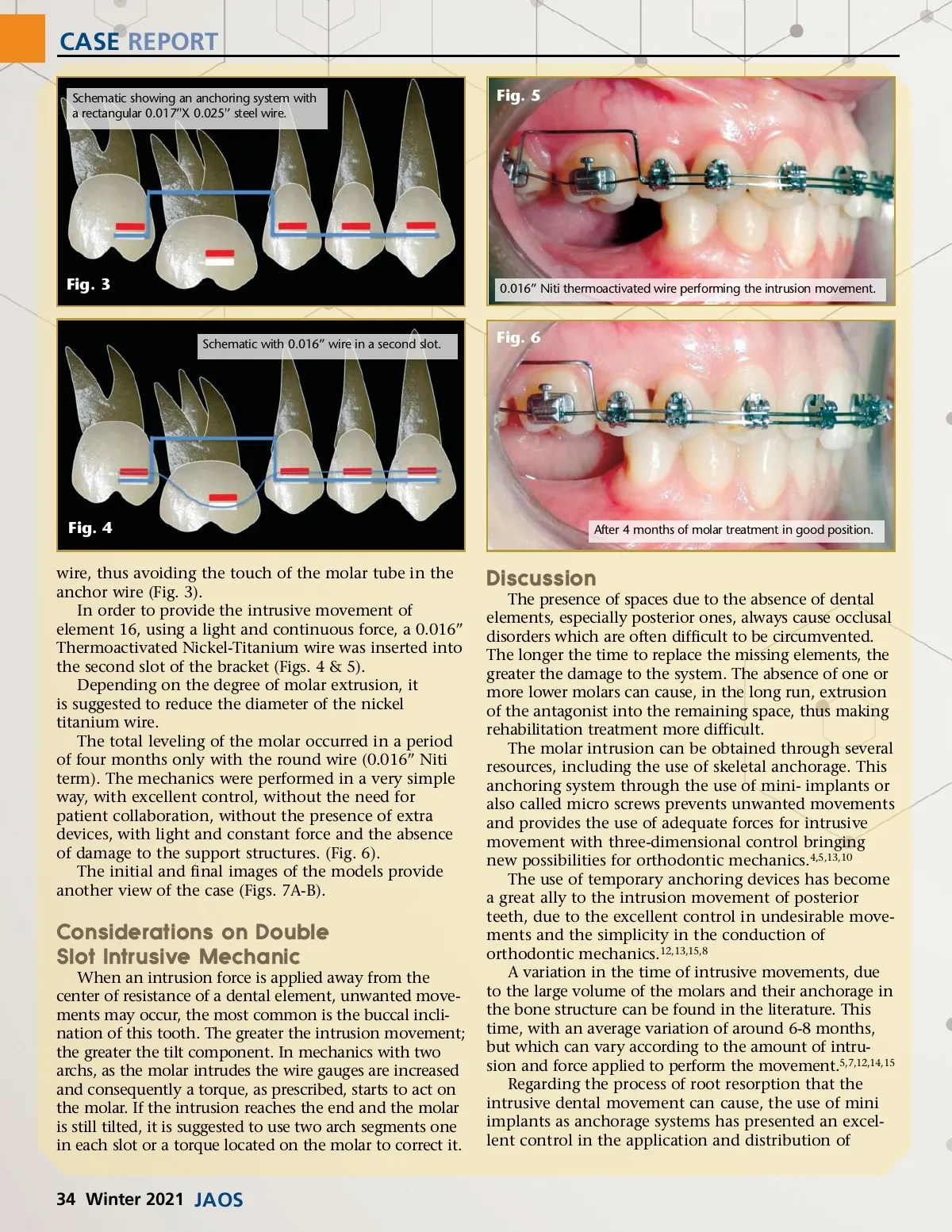
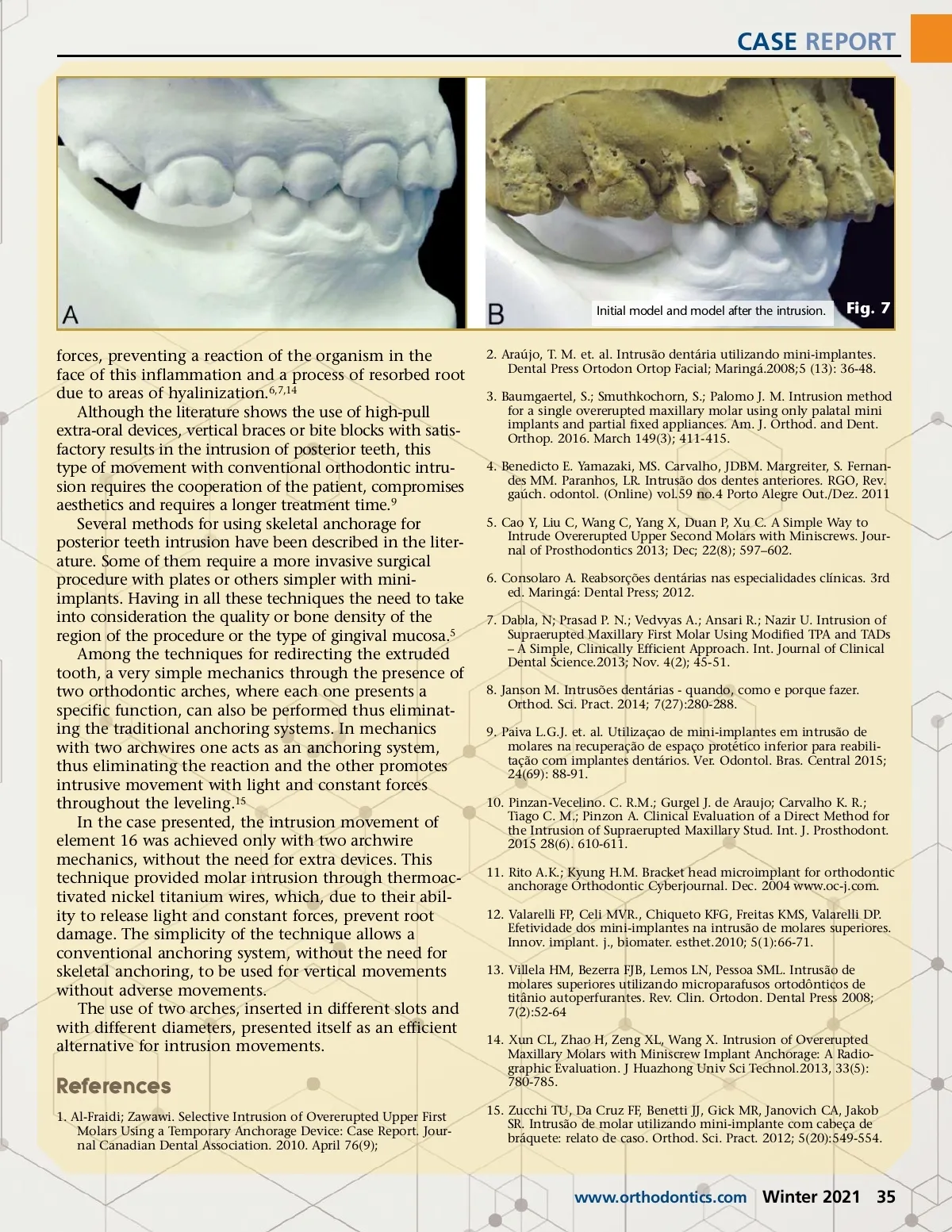
CASE REPORT Schematic showing an anchoring system with a rectangular 0.017’'X 0.025'’ steel wire. Fig. 5 Fig. 3 0.016” Niti thermoactivated wire performing the intrusion movement. Schematic with 0.016” wire in a second slot. Fig. 6 Fig. 4 wire, thus avoiding the touch of the molar tube in the anchor wire (Fig. 3). In order to provide the intrusive movement of element 16, using a light and continuous force, a 0.016” Thermoactivated Nickel-Titanium wire was inserted into the second slot of the bracket (Figs. 4 & 5). Depending on the degree of molar extrusion, it is suggested to reduce the diameter of the nickel titanium wire. The total leveling of the molar occurred in a period of four months only with the round wire (0.016” Niti term). The mechanics were performed in a very simple way, with excellent control, without the need for patient collaboration, without the presence of extra devices, with light and constant force and the absence of damage to the support structures. (Fig. 6). The initial and final images of the models provide another view of the case (Figs. 7A-B). After 4 months of molar treatment in good position. Discussion The presence of spaces due to the absence of dental elements, especially posterior ones, always cause occlusal disorders which are often difficult to be circumvented. The longer the time to replace the missing elements, the greater the damage to the system. The absence of one or more lower molars can cause, in the long run, extrusion of the antagonist into the remaining space, thus making rehabilitation treatment more difficult. The molar intrusion can be obtained through several resources, including the use of skeletal anchorage. This anchoring system through the use of mini-implants or also called micro screws prevents unwanted movements and provides the use of adequate forces for intrusive movement with three-dimensional control bringing new possibilities for orthodontic mechanics. 4,5,13,10 The use of temporary anchoring devices has become a great ally to the intrusion movement of posterior teeth, due to the excellent control in undesirable move-ments and the simplicity in the conduction of orthodontic mechanics. 12,13,15,8 A variation in the time of intrusive movements, due to the large volume of the molars and their anchorage in the bone structure can be found in the literature. This time, with an average variation of around 6-8 months, but which can vary according to the amount of intru-sion and force applied to perform the movement. 5,7,12,14,15 Regarding the process of root resorption that the intrusive dental movement can cause, the use of mini implants as anchorage systems has presented an excel-lent control in the application and distribution of Considerations on Double Slot Intrusive Mechanic When an intrusion force is applied away from the center of resistance of a dental element, unwanted move-ments may occur, the most common is the buccal incli-nation of this tooth. The greater the intrusion movement; the greater the tilt component. In mechanics with two archs, as the molar intrudes the wire gauges are increased and consequently a torque, as prescribed, starts to act on the molar. If the intrusion reaches the end and the molar is still tilted, it is suggested to use two arch segments one in each slot or a torque located on the molar to correct it. 34 Winter 2021 JAOS
Journal of the American Orthodontic Society Winter 2021: Page 34