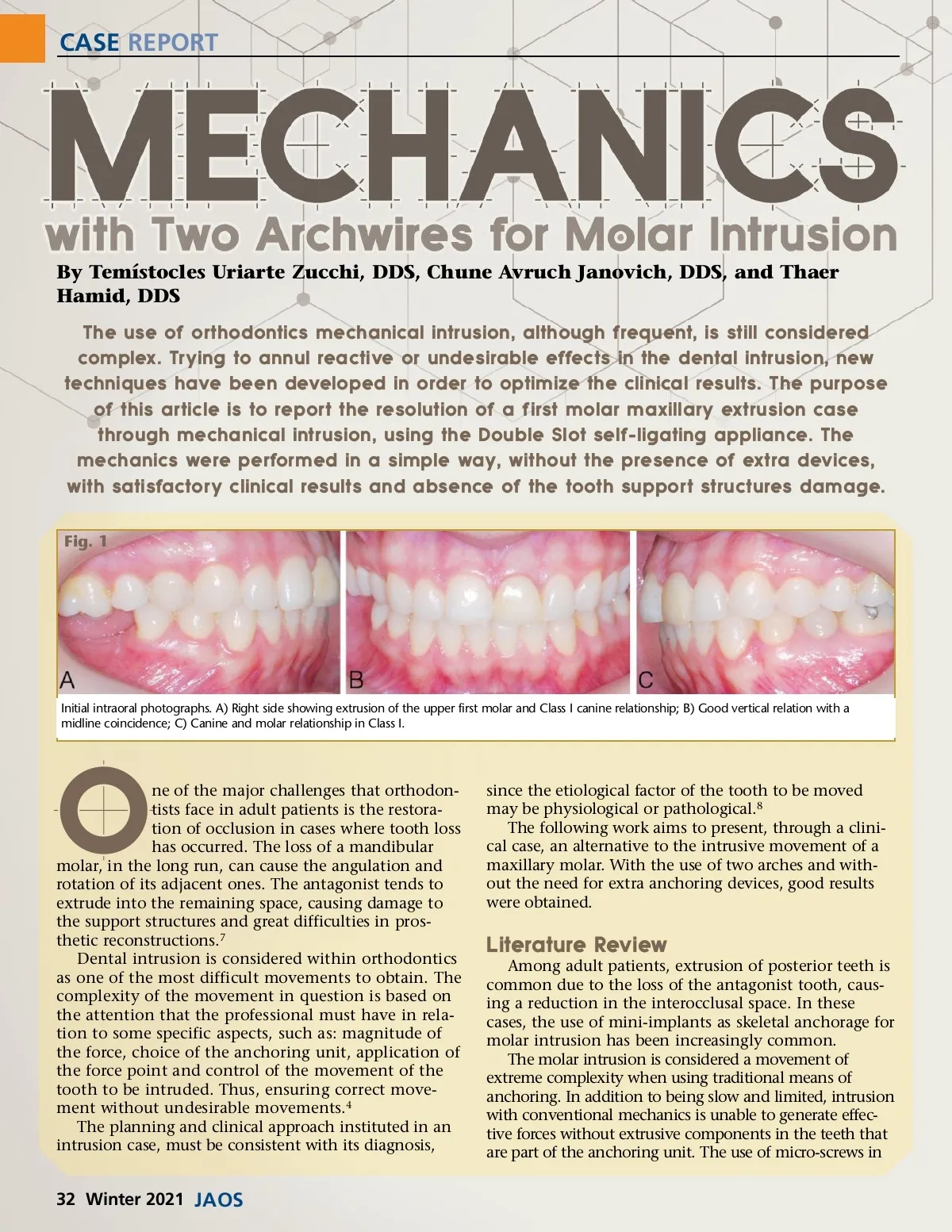
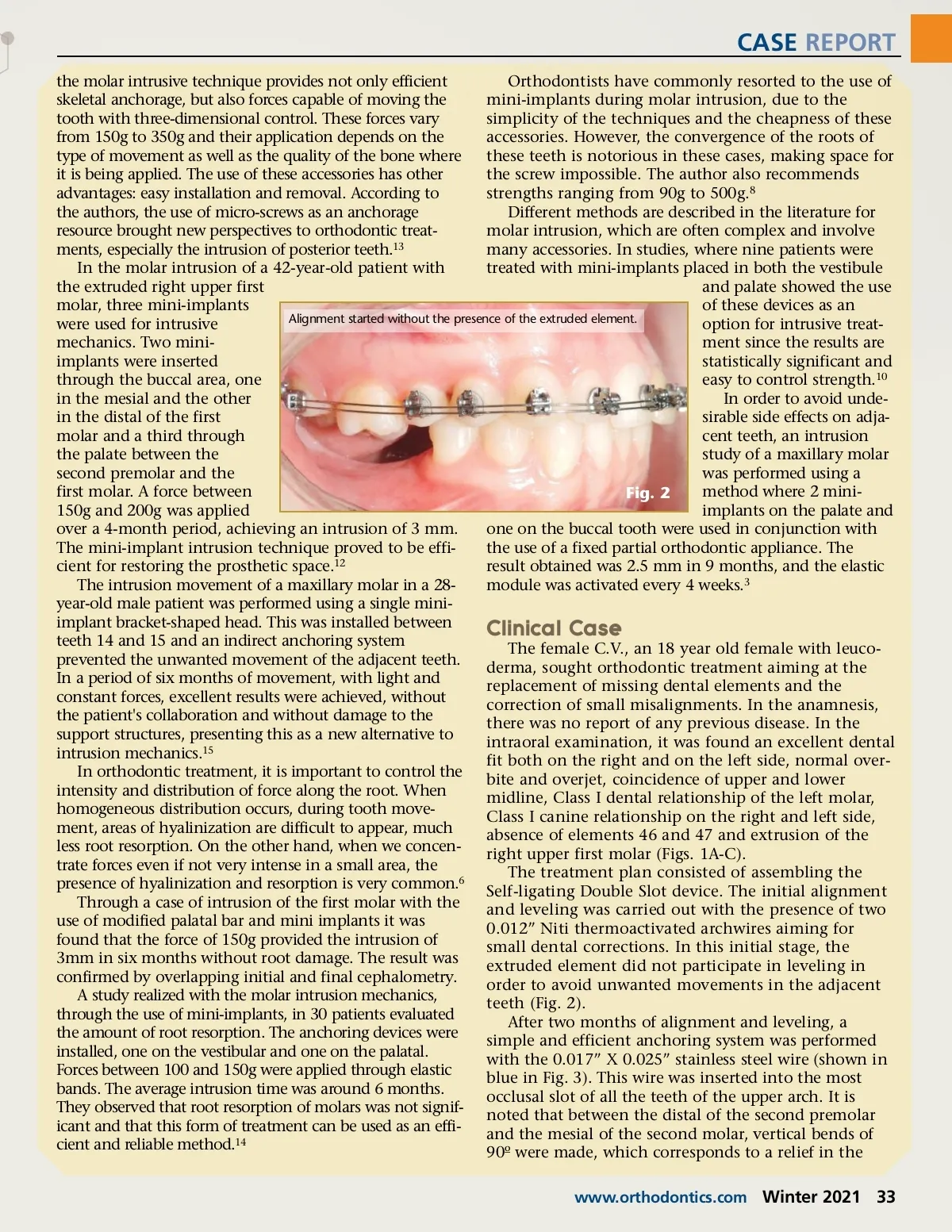
CASE REPORT the molar intrusive technique provides not only efficient Orthodontists have commonly resorted to the use of skeletal anchorage, but also forces capable of moving the mini-implants during molar intrusion, due to the tooth with three-dimensional control. These forces vary simplicity of the techniques and the cheapness of these from 150g to 350g and their application depends on the accessories. However, the convergence of the roots of type of movement as well as the quality of the bone where these teeth is notorious in these cases, making space for it is being applied. The use of these accessories has other the screw impossible. The author also recommends advantages: easy installation and removal. According to strengths ranging from 90g to 500g. 8 the authors, the use of micro-screws as an anchorage Different methods are described in the literature for resource brought new perspectives to orthodontic treat-molar intrusion, which are often complex and involve ments, especially the intrusion of posterior teeth. 13 many accessories. In studies, where nine patients were In the molar intrusion of a 42-year-old patient with treated with mini-implants placed in both the vestibule the extruded right upper first and palate showed the use molar, three mini-implants of these devices as an Alignment started without the presence of the extruded element. were used for intrusive option for intrusive treat-mechanics. Two mini-ment since the results are implants were inserted statistically significant and through the buccal area, one easy to control strength. 10 in the mesial and the other In order to avoid unde-in the distal of the first sirable side effects on adja-molar and a third through cent teeth, an intrusion the palate between the study of a maxillary molar second premolar and the was performed using a first molar. A force between method where 2 mini-Fig. 2 150g and 200g was applied implants on the palate and over a 4-month period, achieving an intrusion of 3 mm. one on the buccal tooth were used in conjunction with The mini-implant intrusion technique proved to be effi-the use of a fixed partial orthodontic appliance. The cient for restoring the prosthetic space. 12 result obtained was 2.5 mm in 9 months, and the elastic The intrusion movement of a maxillary molar in a 28-module was activated every 4 weeks. 3 year-old male patient was performed using a single mini-implant bracket-shaped head. This was installed between teeth 14 and 15 and an indirect anchoring system The female C.V., an 18 year old female with leuco-prevented the unwanted movement of the adjacent teeth. derma, sought orthodontic treatment aiming at the In a period of six months of movement, with light and replacement of missing dental elements and the constant forces, excellent results were achieved, without correction of small misalignments. In the anamnesis, the patient's collaboration and without damage to the there was no report of any previous disease. In the support structures, presenting this as a new alternative to intraoral examination, it was found an excellent dental intrusion mechanics. 15 fit both on the right and on the left side, normal over-In orthodontic treatment, it is important to control the bite and overjet, coincidence of upper and lower intensity and distribution of force along the root. When midline, Class I dental relationship of the left molar, homogeneous distribution occurs, during tooth move-Class I canine relationship on the right and left side, ment, areas of hyalinization are difficult to appear, much absence of elements 46 and 47 and extrusion of the less root resorption. On the other hand, when we concen-right upper first molar (Figs. 1A-C). trate forces even if not very intense in a small area, the The treatment plan consisted of assembling the presence of hyalinization and resorption is very common. 6 Self-ligating Double Slot device. The initial alignment Through a case of intrusion of the first molar with the and leveling was carried out with the presence of two use of modified palatal bar and mini implants it was 0.012” Niti thermoactivated archwires aiming for found that the force of 150g provided the intrusion of small dental corrections. In this initial stage, the 3mm in six months without root damage. The result was extruded element did not participate in leveling in confirmed by overlapping initial and final cephalometry. order to avoid unwanted movements in the adjacent A study realized with the molar intrusion mechanics, teeth (Fig. 2). through the use of mini-implants, in 30 patients evaluated After two months of alignment and leveling, a the amount of root resorption. The anchoring devices were simple and efficient anchoring system was performed installed, one on the vestibular and one on the palatal. with the 0.017” X 0.025” stainless steel wire (shown in Forces between 100 and 150g were applied through elastic blue in Fig. 3). This wire was inserted into the most bands. The average intrusion time was around 6 months. occlusal slot of all the teeth of the upper arch. It is They observed that root resorption of molars was not signif-noted that between the distal of the second premolar icant and that this form of treatment can be used as an effi-and the mesial of the second molar, vertical bends of cient and reliable method. 14 90º were made, which corresponds to a relief in the Clinical Case www.orthodontics.com Winter 2021 33
Journal of the American Orthodontic Society Winter 2021: Page 33