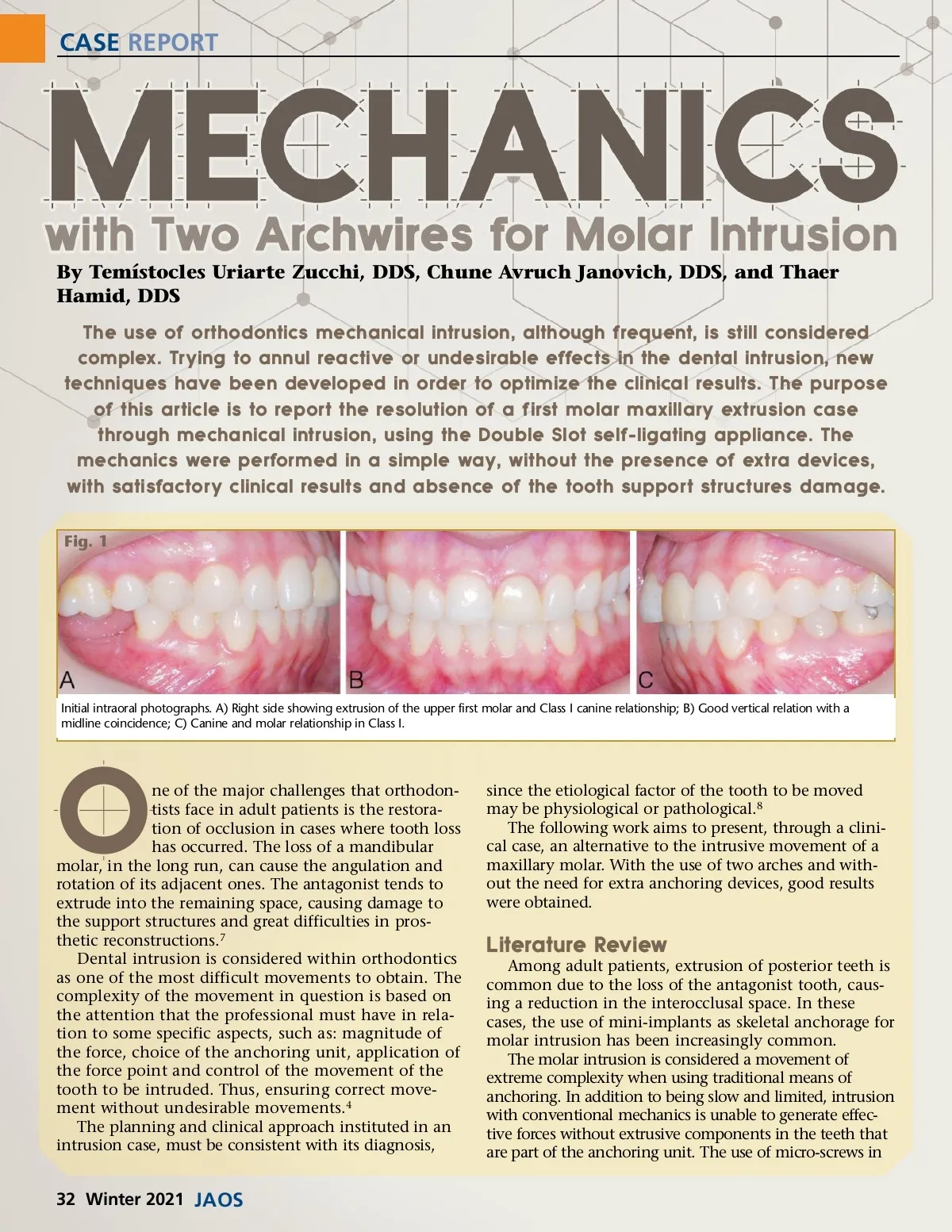
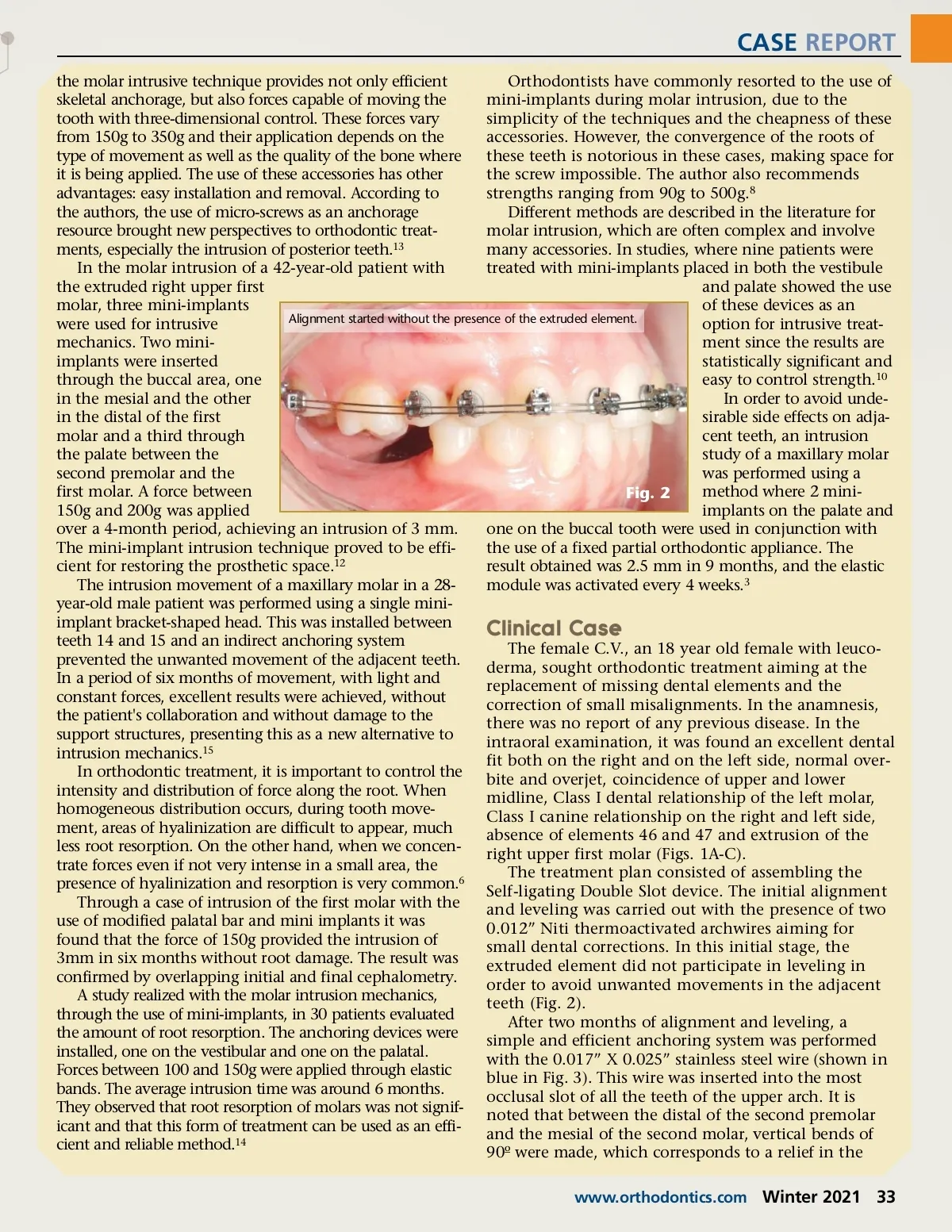
CASE REPORT By Temístocles Uriarte Zucchi, DDS, Chune Avruch Janovich, DDS, and Thaer Hamid, DDS The use of orthodontics mechanical intrusion, although frequent, is still considered complex. Trying to annul reactive or undesirable effects in the dental intrusion, new techniques have been developed in order to optimize the clinical results. The purpose of this article is to report the resolution of a first molar maxillary extrusion case through mechanical intrusion, using the Double Slot self-ligating appliance. The mechanics were performed in a simple way, without the presence of extra devices, with satisfactory clinical results and absence of the tooth support structures damage. Fig. 1 Initial intraoral photographs. A) Right side showing extrusion of the upper first molar and Class I canine relationship; B) Good vertical relation with a midline coincidence; C) Canine and molar relationship in Class I. ne of the major challenges that orthodon-tists face in adult patients is the restora-tion of occlusion in cases where tooth loss has occurred. The loss of a mandibular molar, in the long run, can cause the angulation and rotation of its adjacent ones. The antagonist tends to extrude into the remaining space, causing damage to the support structures and great difficulties in pros-thetic reconstructions. 7 Dental intrusion is considered within orthodontics as one of the most difficult movements to obtain. The complexity of the movement in question is based on the attention that the professional must have in rela-tion to some specific aspects, such as: magnitude of the force, choice of the anchoring unit, application of the force point and control of the movement of the tooth to be intruded. Thus, ensuring correct move-ment without undesirable movements. 4 The planning and clinical approach instituted in an intrusion case, must be consistent with its diagnosis, O since the etiological factor of the tooth to be moved may be physiological or pathological. 8 The following work aims to present, through a clini-cal case, an alternative to the intrusive movement of a maxillary molar. With the use of two arches and with-out the need for extra anchoring devices, good results were obtained. Literature Review Among adult patients, extrusion of posterior teeth is common due to the loss of the antagonist tooth, caus-ing a reduction in the interocclusal space. In these cases, the use of mini-implants as skeletal anchorage for molar intrusion has been increasingly common. The molar intrusion is considered a movement of extreme complexity when using traditional means of anchoring. In addition to being slow and limited, intrusion with conventional mechanics is unable to generate effec-tive forces without extrusive components in the teeth that are part of the anchoring unit. The use of micro-screws in 32 Winter 2021 JAOS
Journal of the American Orthodontic Society Winter 2021: Page 32