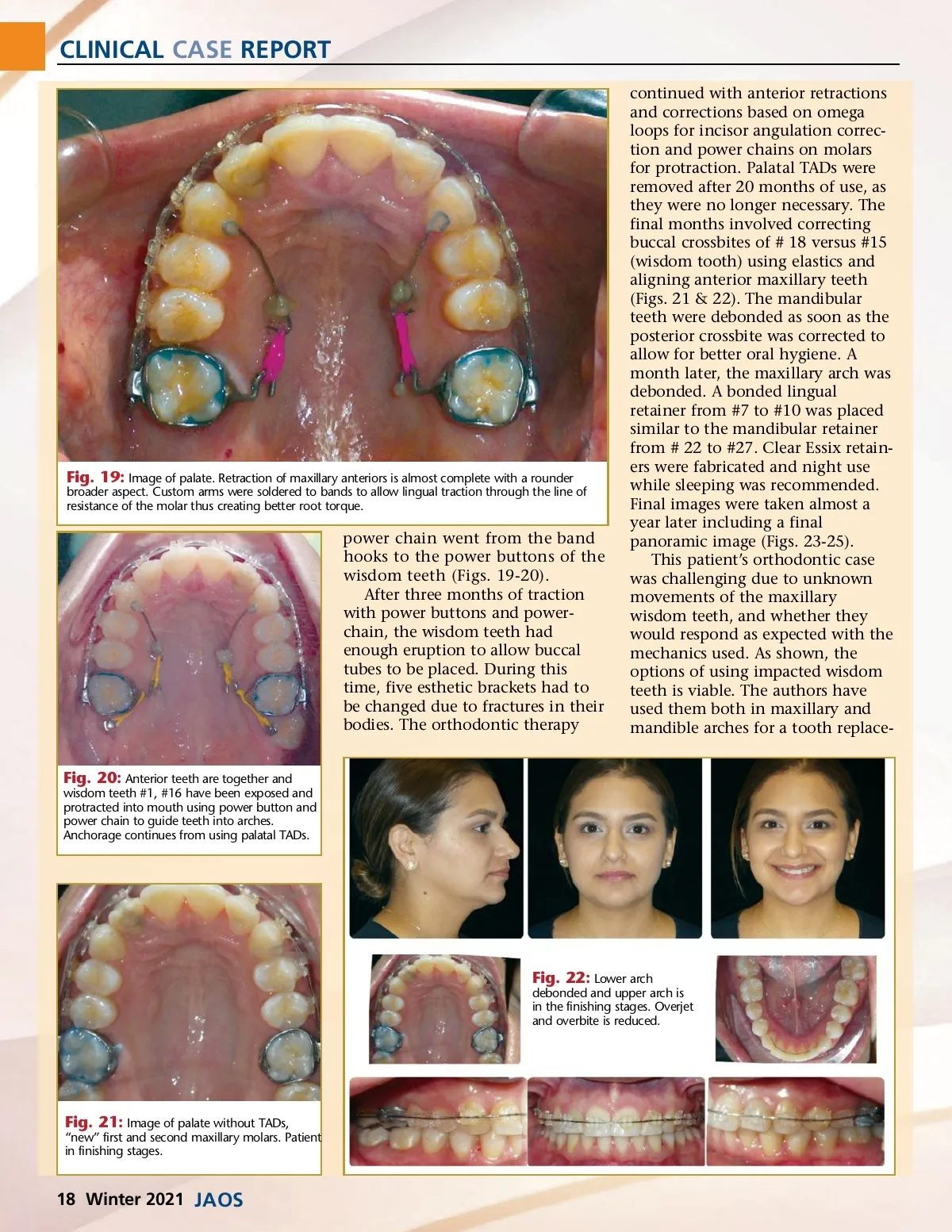
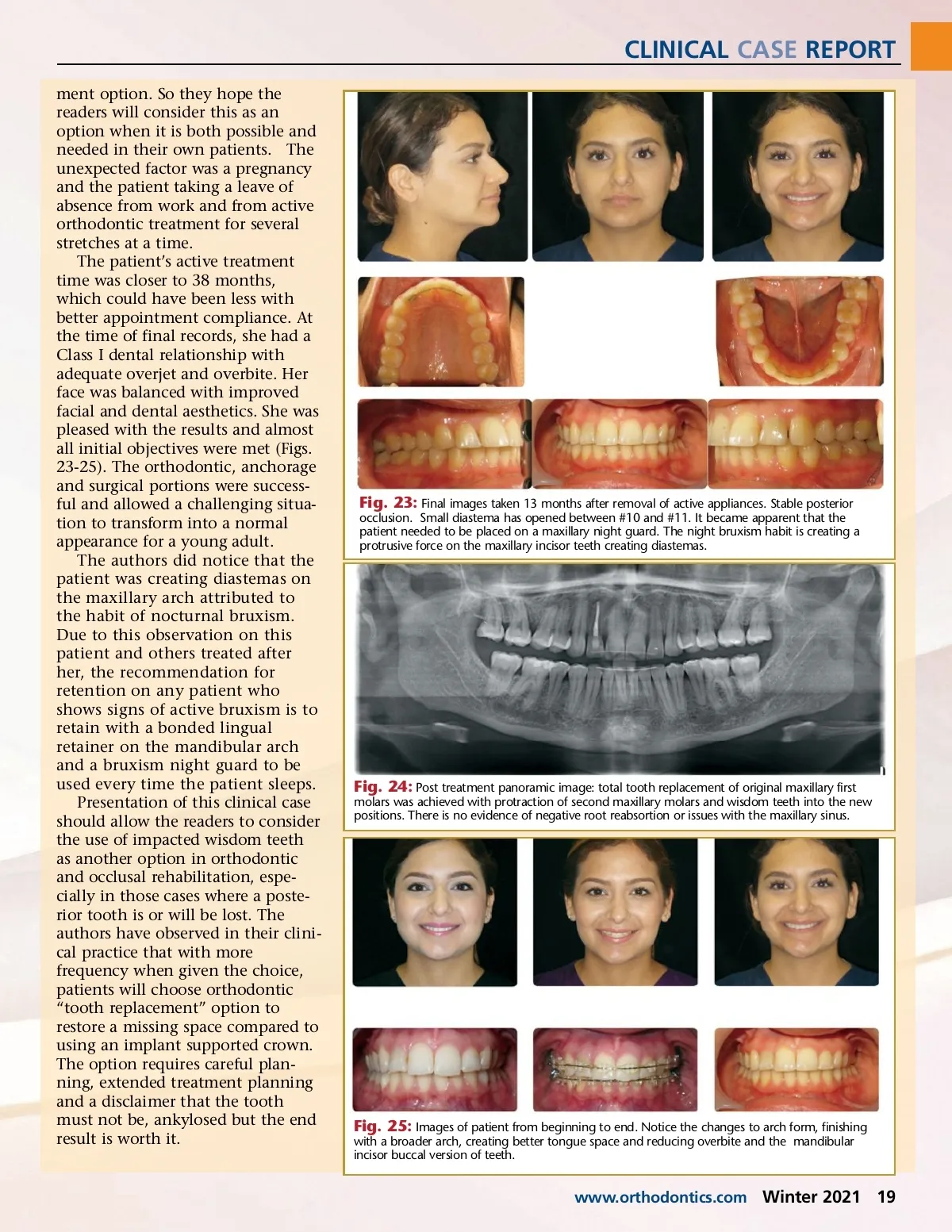
CLINICAL CASE REPORT continued with anterior retractions and corrections based on omega loops for incisor angulation correc-tion and power chains on molars for protraction. Palatal TADs were removed after 20 months of use, as they were no longer necessary. The final months involved correcting buccal crossbites of # 18 versus #15 (wisdom tooth) using elastics and aligning anterior maxillary teeth (Figs. 21 & 22). The mandibular teeth were debonded as soon as the posterior crossbite was corrected to allow for better oral hygiene. A month later, the maxillary arch was debonded. A bonded lingual retainer from #7 to #10 was placed similar to the mandibular retainer from # 22 to #27. Clear Essix retain-ers were fabricated and night use while sleeping was recommended. Final images were taken almost a year later including a final panoramic image (Figs. 23-25). This patient’s orthodontic case was challenging due to unknown movements of the maxillary wisdom teeth, and whether they would respond as expected with the mechanics used. As shown, the options of using impacted wisdom teeth is viable. The authors have used them both in maxillary and mandible arches for a tooth replace-Fig. 19: Image of palate. Retraction of maxillary anteriors is almost complete with a rounder broader aspect. Custom arms were soldered to bands to allow lingual traction through the line of resistance of the molar thus creating better root torque. power chain went from the band hooks to the power buttons of the wisdom teeth (Figs. 19-20). After three months of traction with power buttons and power-chain, the wisdom teeth had enough eruption to allow buccal tubes to be placed. During this time, five esthetic brackets had to be changed due to fractures in their bodies. The orthodontic therapy Fig. 20: Anterior teeth are together and wisdom teeth #1, #16 have been exposed and protracted into mouth using power button and power chain to guide teeth into arches. Anchorage continues from using palatal TADs. Fig. 22: Lower arch debonded and upper arch is in the finishing stages. Overjet and overbite is reduced. Fig. 21: Image of palate without TADs, “new” first and second maxillary molars. Patient in finishing stages. 18 Winter 2021 JAOS
Journal of the American Orthodontic Society Winter 2021: Page 18