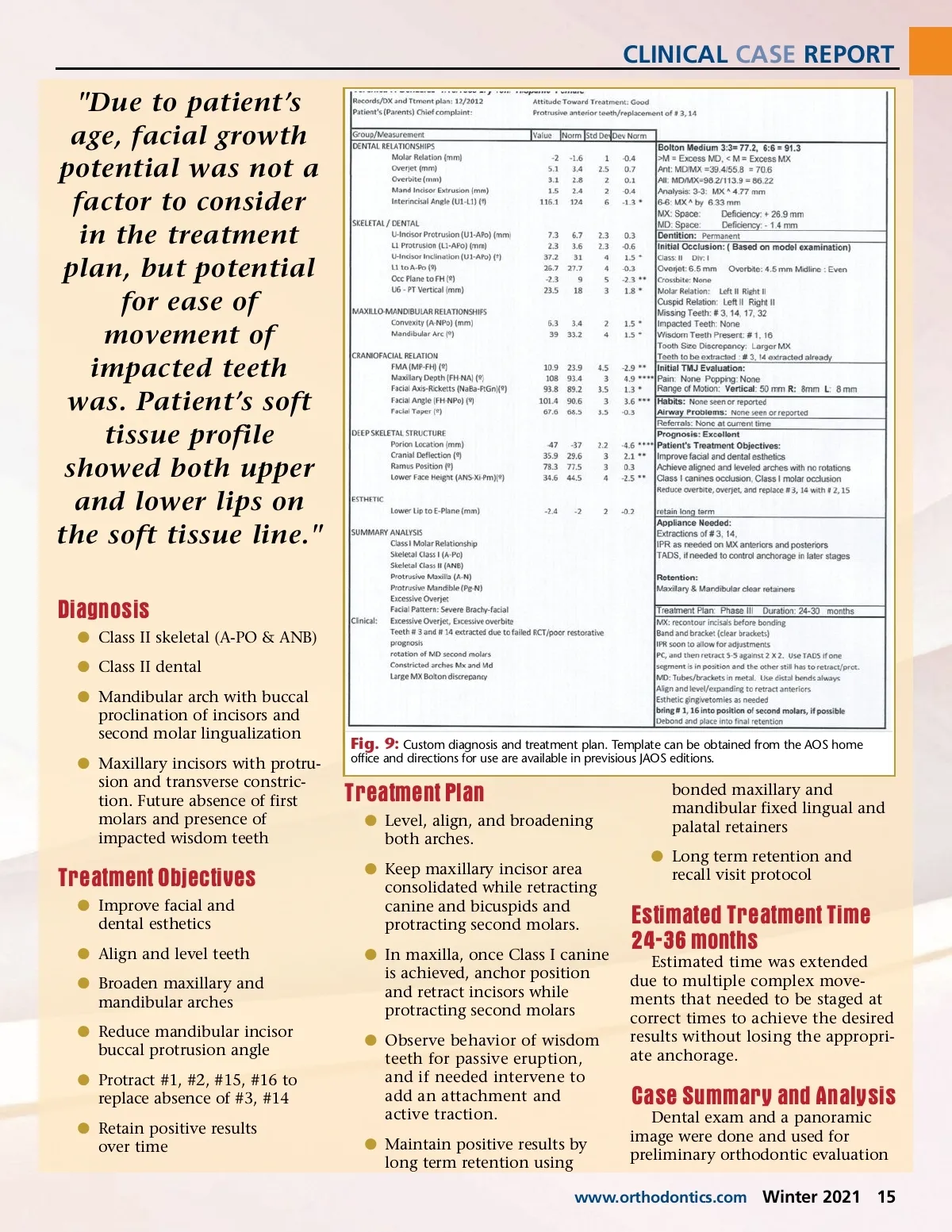
CLINICAL CASE REPORT "Due to patient’s age, facial growth potential was not a factor to consider in the treatment plan, but potential for ease of movement of impacted teeth was. Patient’s soft tissue profile showed both upper and lower lips on the soft tissue line." Diagnosis b Class II skeletal (A-PO & ANB) b Class II dental b Mandibular arch with buccal proclination of incisors and second molar lingualization b Maxillary incisors with protru-sion and transverse constric-tion. Future absence of first molars and presence of impacted wisdom teeth Fig. 9: Custom diagnosis and treatment plan. Template can be obtained from the AOS home office and directions for use are available in previsious JAOS editions. Treatment Plan b Level, align, and broadening both arches. b Keep maxillary incisor area consolidated while retracting canine and bicuspids and protracting second molars. b In maxilla, once Class I canine is achieved, anchor position and retract incisors while protracting second molars b Observe behavior of wisdom teeth for passive eruption, and if needed intervene to add an attachment and active traction. b Maintain positive results by long term retention using bonded maxillary and mandibular fixed lingual and palatal retainers b Long term retention and recall visit protocol Treatment Objectives b Improve facial and dental esthetics b Align and level teeth b Broaden maxillary and mandibular arches b Reduce mandibular incisor buccal protrusion angle b Protract #1, #2, #15, #16 to replace absence of #3, #14 b Retain positive results over time Estimated Treatment Time 24-36 months Estimated time was extended due to multiple complex move-ments that needed to be staged at correct times to achieve the desired results without losing the appropri-ate anchorage. Case Summary and Analysis Dental exam and a panoramic image were done and used for preliminary orthodontic evaluation www.orthodontics.com Winter 2021 15
Journal of the American Orthodontic Society Winter 2021: Page 15