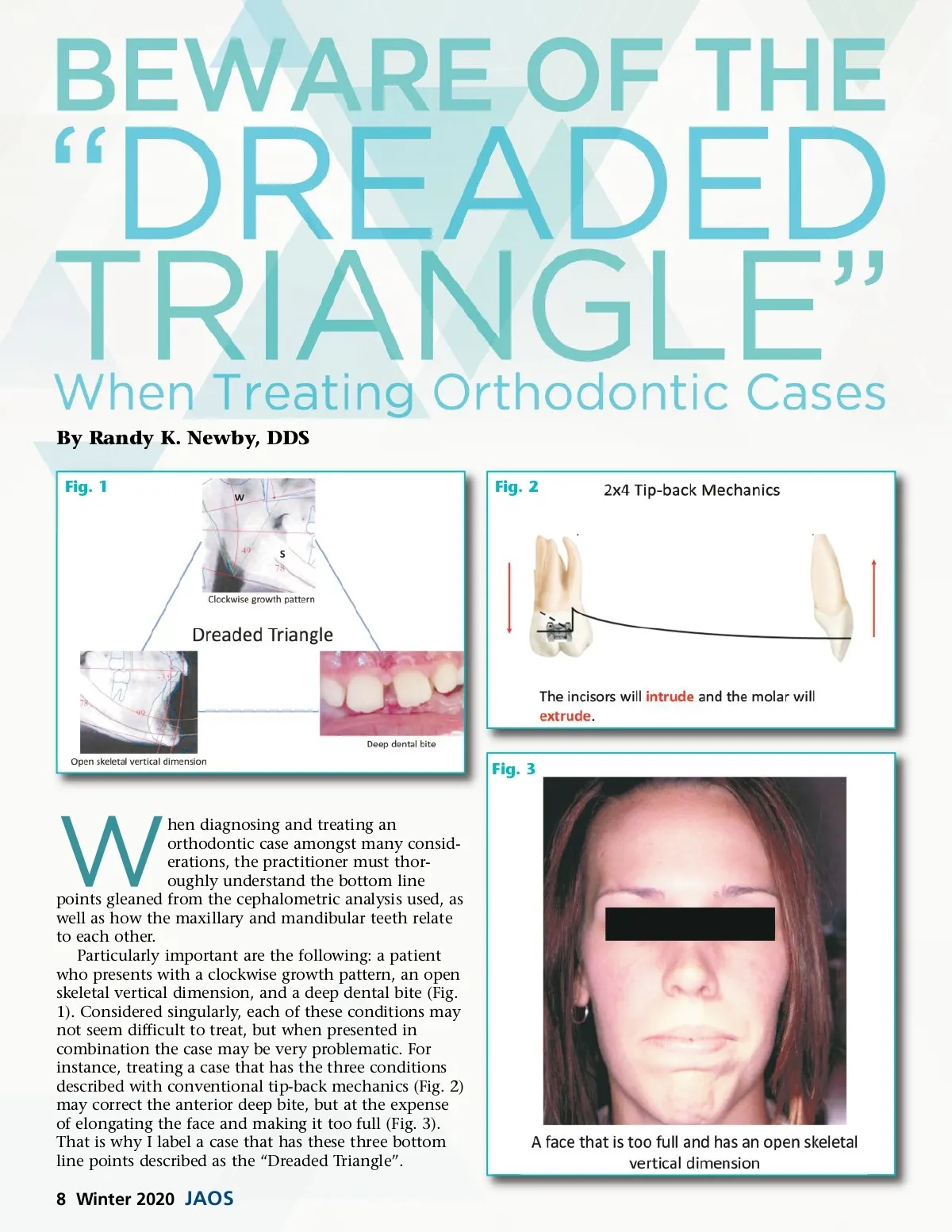
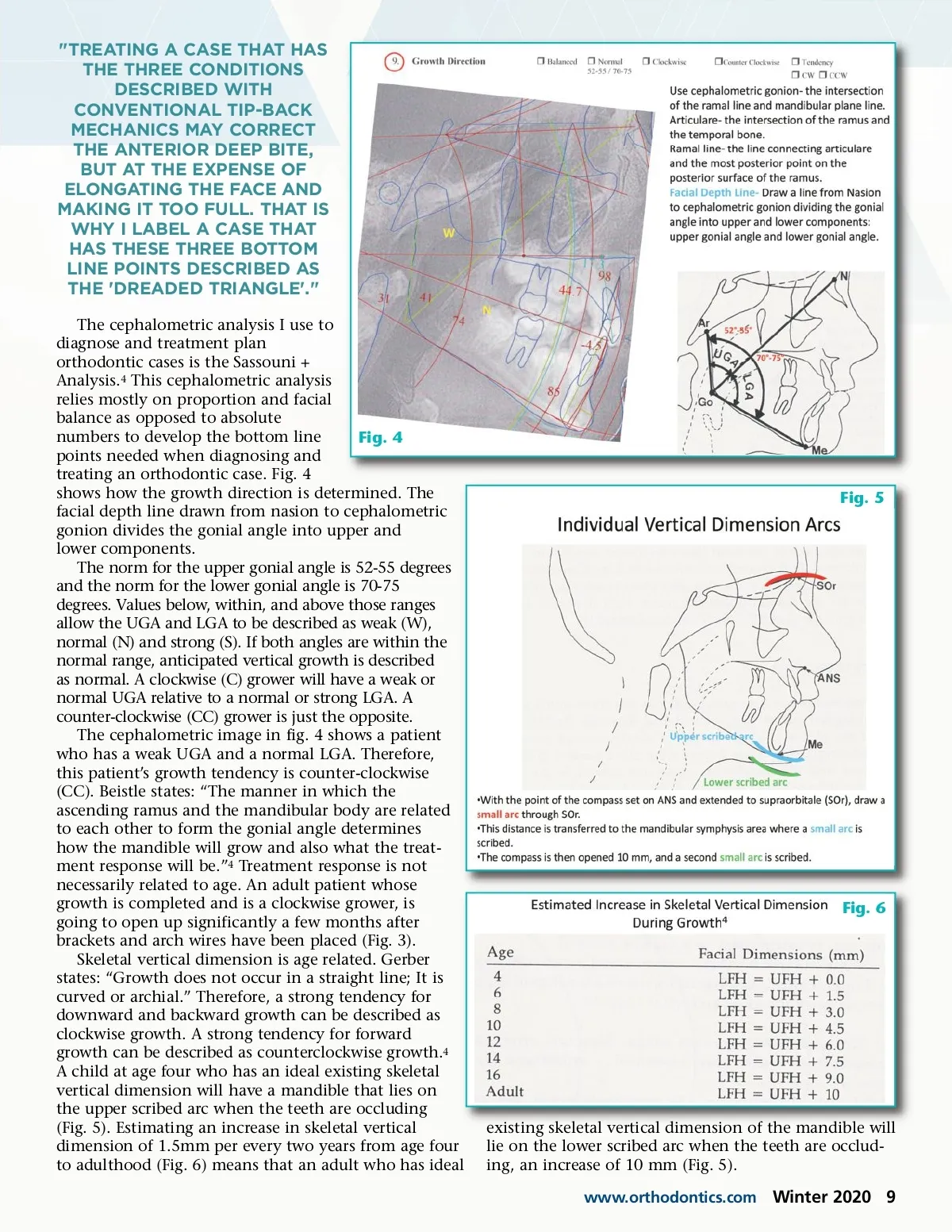
"TREATING A CASE THAT HAS THE THREE CONDITIONS DESCRIBED WITH CONVENTIONAL TIP-BACK MECHANICS MAY CORRECT THE ANTERIOR DEEP BITE, BUT AT THE EXPENSE OF ELONGATING THE FACE AND MAKING IT TOO FULL. THAT IS WHY I LABEL A CASE THAT HAS THESE THREE BOTTOM LINE POINTS DESCRIBED AS THE 'DREADED TRIANGLE'." The cephalometric analysis I use to diagnose and treatment plan orthodontic cases is the Sassouni + Analysis. 4 This cephalometric analysis relies mostly on proportion and facial balance as opposed to absolute numbers to develop the bottom line Fig. 4 points needed when diagnosing and treating an orthodontic case. Fig. 4 shows how the growth direction is determined. The facial depth line drawn from nasion to cephalometric gonion divides the gonial angle into upper and lower components. The norm for the upper gonial angle is 52-55 degrees and the norm for the lower gonial angle is 70-75 degrees. Values below, within, and above those ranges allow the UGA and LGA to be described as weak (W), normal (N) and strong (S). If both angles are within the normal range, anticipated vertical growth is described as normal. A clockwise (C) grower will have a weak or normal UGA relative to a normal or strong LGA. A counter-clockwise (CC) grower is just the opposite. The cephalometric image in fig. 4 shows a patient who has a weak UGA and a normal LGA. Therefore, this patient’s growth tendency is counter-clockwise (CC). Beistle states: “The manner in which the ascending ramus and the mandibular body are related to each other to form the gonial angle determines how the mandible will grow and also what the treat-ment response will be.” 4 Treatment response is not necessarily related to age. An adult patient whose growth is completed and is a clockwise grower, is going to open up significantly a few months after brackets and arch wires have been placed (Fig. 3). Skeletal vertical dimension is age related. Gerber states: “Growth does not occur in a straight line; It is curved or archial.” Therefore, a strong tendency for downward and backward growth can be described as clockwise growth. A strong tendency for forward growth can be described as counterclockwise growth. 4 A child at age four who has an ideal existing skeletal vertical dimension will have a mandible that lies on the upper scribed arc when the teeth are occluding (Fig. 5). Estimating an increase in skeletal vertical dimension of 1.5mm per every two years from age four to adulthood (Fig. 6) means that an adult who has ideal Fig. 5 Fig. 6 existing skeletal vertical dimension of the mandible will lie on the lower scribed arc when the teeth are occlud-ing, an increase of 10 mm (Fig. 5). www.orthodontics.com Winter 2020 9
Journal of the American Orthodontic Society Winter 2020: Page 9