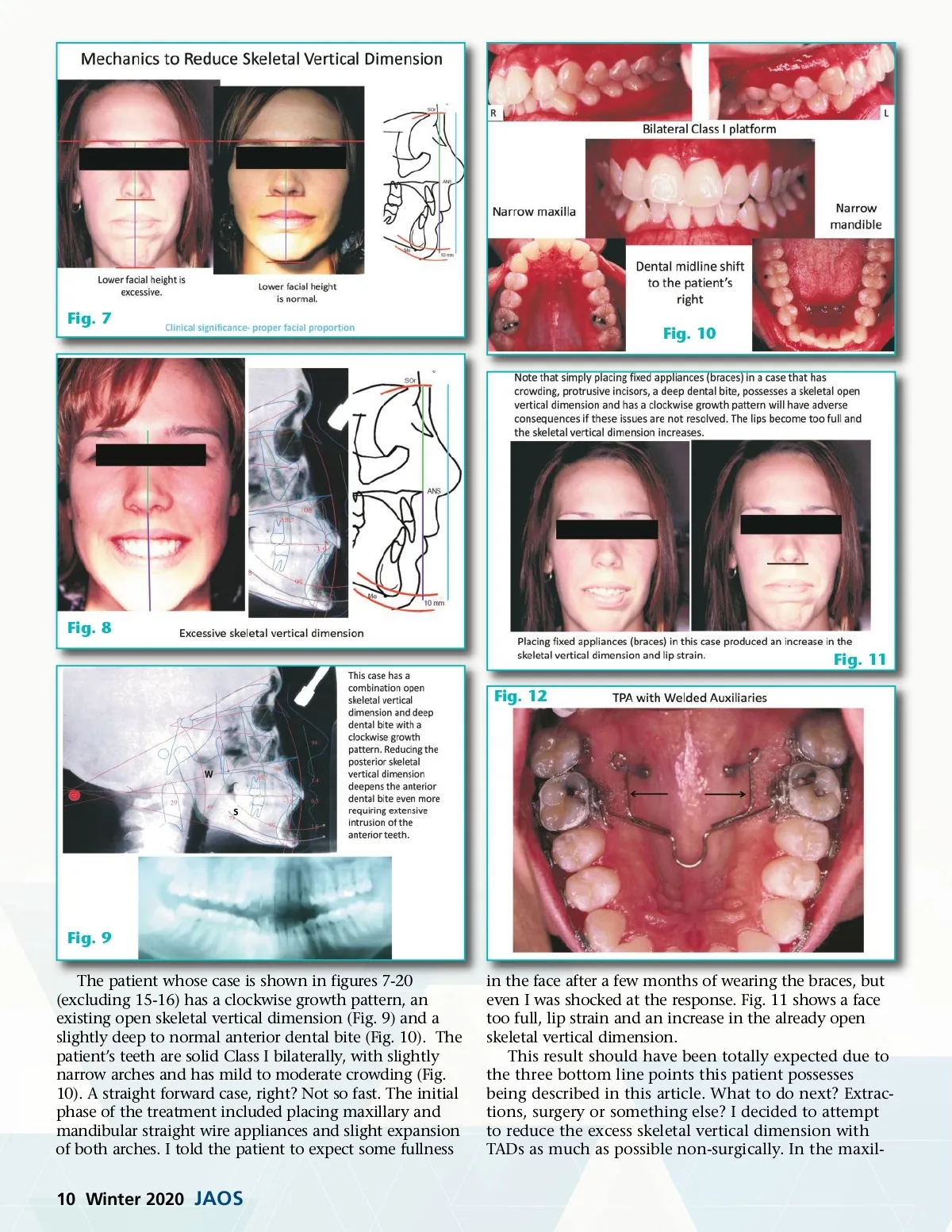
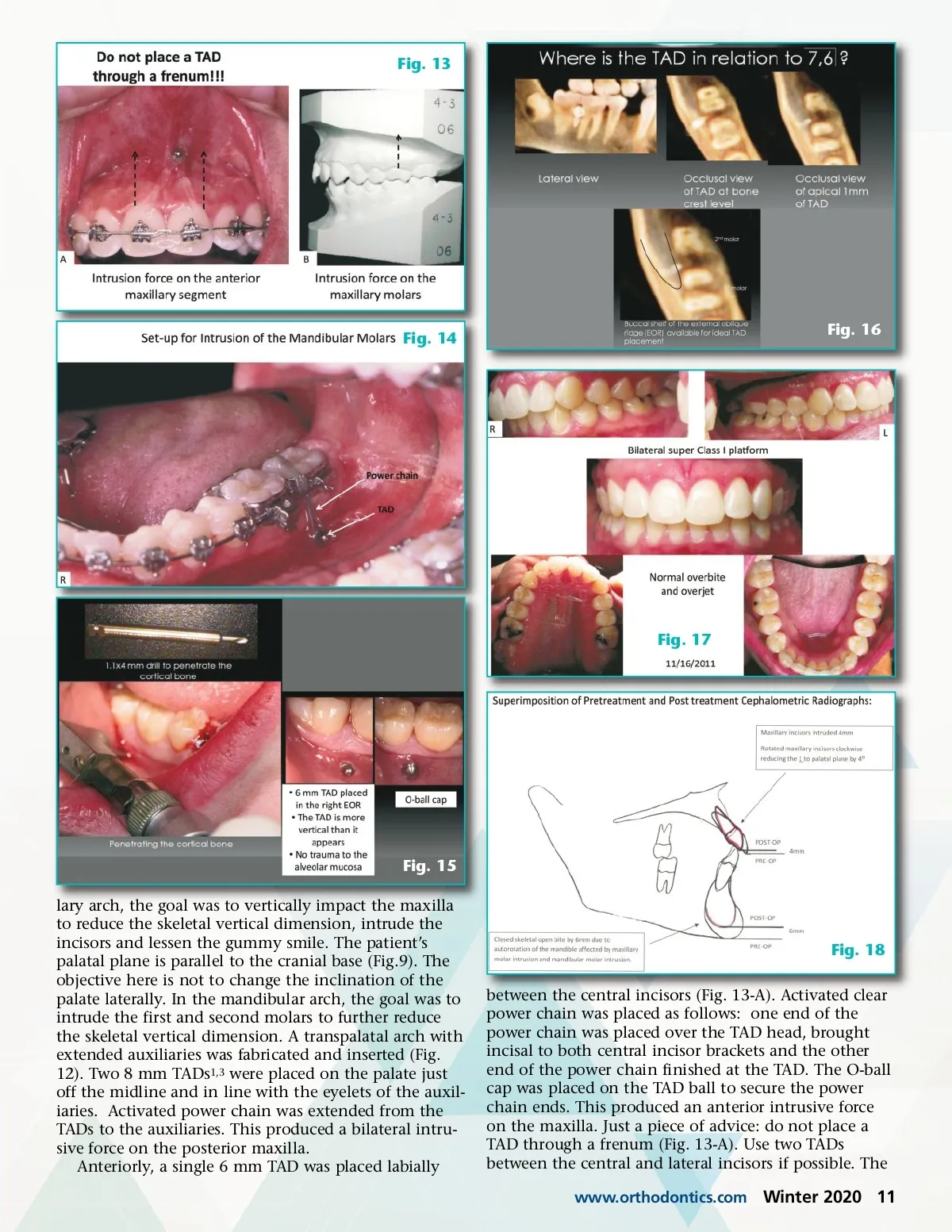
Fig. 7 Fig. 10 Fig. 8 Fig. 11 Fig. 12 Fig. 9 The patient whose case is shown in figures 7-20 (excluding 15-16) has a clockwise growth pattern, an existing open skeletal vertical dimension (Fig. 9) and a slightly deep to normal anterior dental bite (Fig. 10). The patient’s teeth are solid Class I bilaterally, with slightly narrow arches and has mild to moderate crowding (Fig. 10). A straight forward case, right? Not so fast. The initial phase of the treatment included placing maxillary and mandibular straight wire appliances and slight expansion of both arches. I told the patient to expect some fullness in the face after a few months of wearing the braces, but even I was shocked at the response. Fig. 11 shows a face too full, lip strain and an increase in the already open skeletal vertical dimension. This result should have been totally expected due to the three bottom line points this patient possesses being described in this article. What to do next? Extrac-tions, surgery or something else? I decided to attempt to reduce the excess skeletal vertical dimension with TADs as much as possible non-surgically. In the maxil-10 Winter 2020 JAOS
Journal of the American Orthodontic Society Winter 2020: Page 10