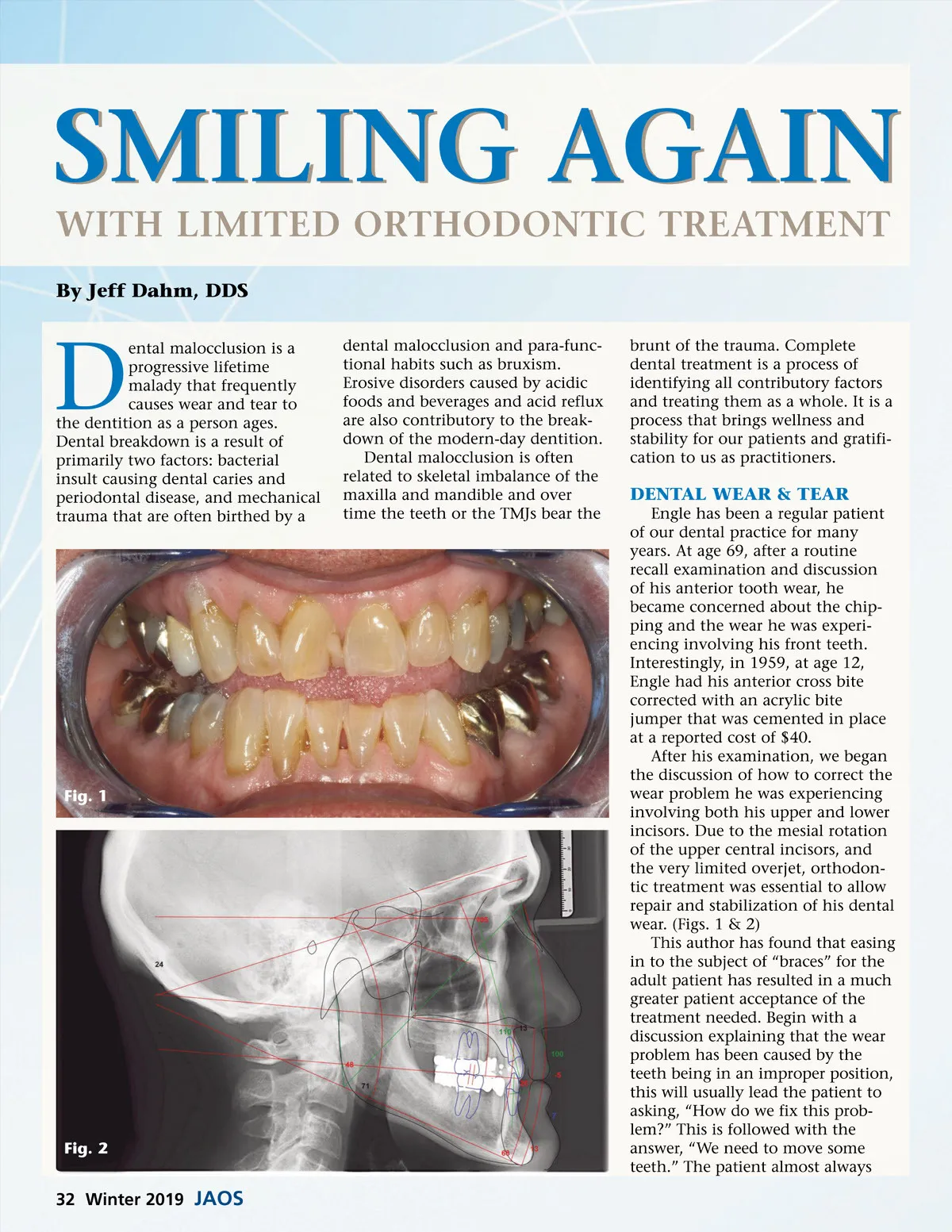
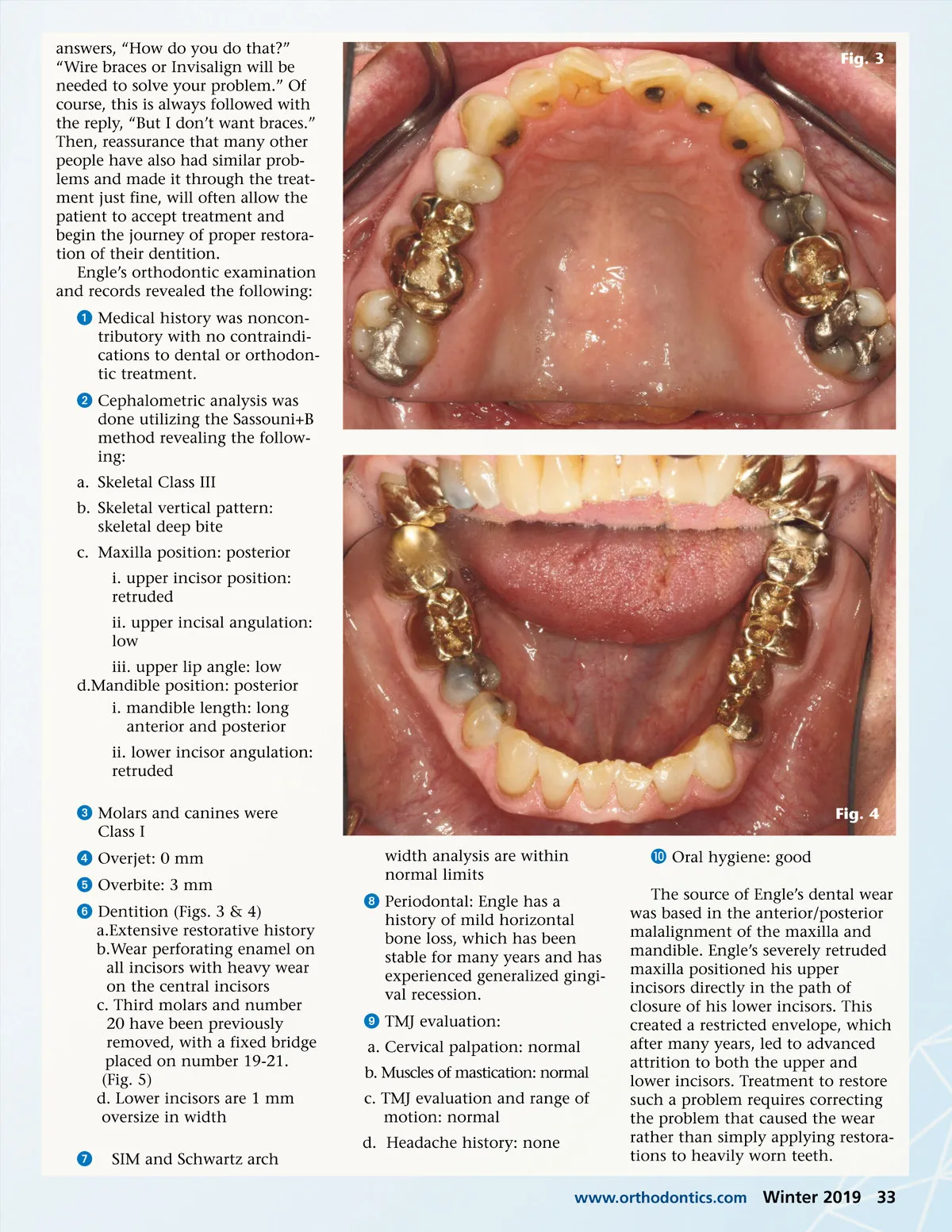
SMILING AGAIN WITH LIMITED ORTHODONTIC TREATMENT By Jeff Dahm, DDS D ental malocclusion is a progressive lifetime malady that frequently causes wear and tear to the dentition as a person ages. Dental breakdown is a result of primarily two factors: bacterial insult causing dental caries and periodontal disease, and mechanical trauma that are often birthed by a dental malocclusion and para-func-tional habits such as bruxism. Erosive disorders caused by acidic foods and beverages and acid reflux are also contributory to the break-down of the modern-day dentition. Dental malocclusion is often related to skeletal imbalance of the maxilla and mandible and over time the teeth or the TMJs bear the brunt of the trauma. Complete dental treatment is a process of identifying all contributory factors and treating them as a whole. It is a process that brings wellness and stability for our patients and gratifi-cation to us as practitioners. DENTAL WEAR & TEAR Engle has been a regular patient of our dental practice for many years. At age 69, after a routine recall examination and discussion of his anterior tooth wear, he became concerned about the chip-ping and the wear he was experi-encing involving his front teeth. Interestingly, in 1959, at age 12, Engle had his anterior cross bite corrected with an acrylic bite jumper that was cemented in place at a reported cost of $40. After his examination, we began the discussion of how to correct the wear problem he was experiencing involving both his upper and lower incisors. Due to the mesial rotation of the upper central incisors, and the very limited overjet, orthodon-tic treatment was essential to allow repair and stabilization of his dental wear. (Figs. 1 & 2) This author has found that easing in to the subject of “braces” for the adult patient has resulted in a much greater patient acceptance of the treatment needed. Begin with a discussion explaining that the wear problem has been caused by the teeth being in an improper position, this will usually lead the patient to asking, “How do we fix this prob-lem?” This is followed with the answer, “We need to move some teeth.” The patient almost always Fig. 1 Fig. 2 32 Winter 2019 JAOS
Journal of the American Orthodontic Society Winter 2019: Page 32