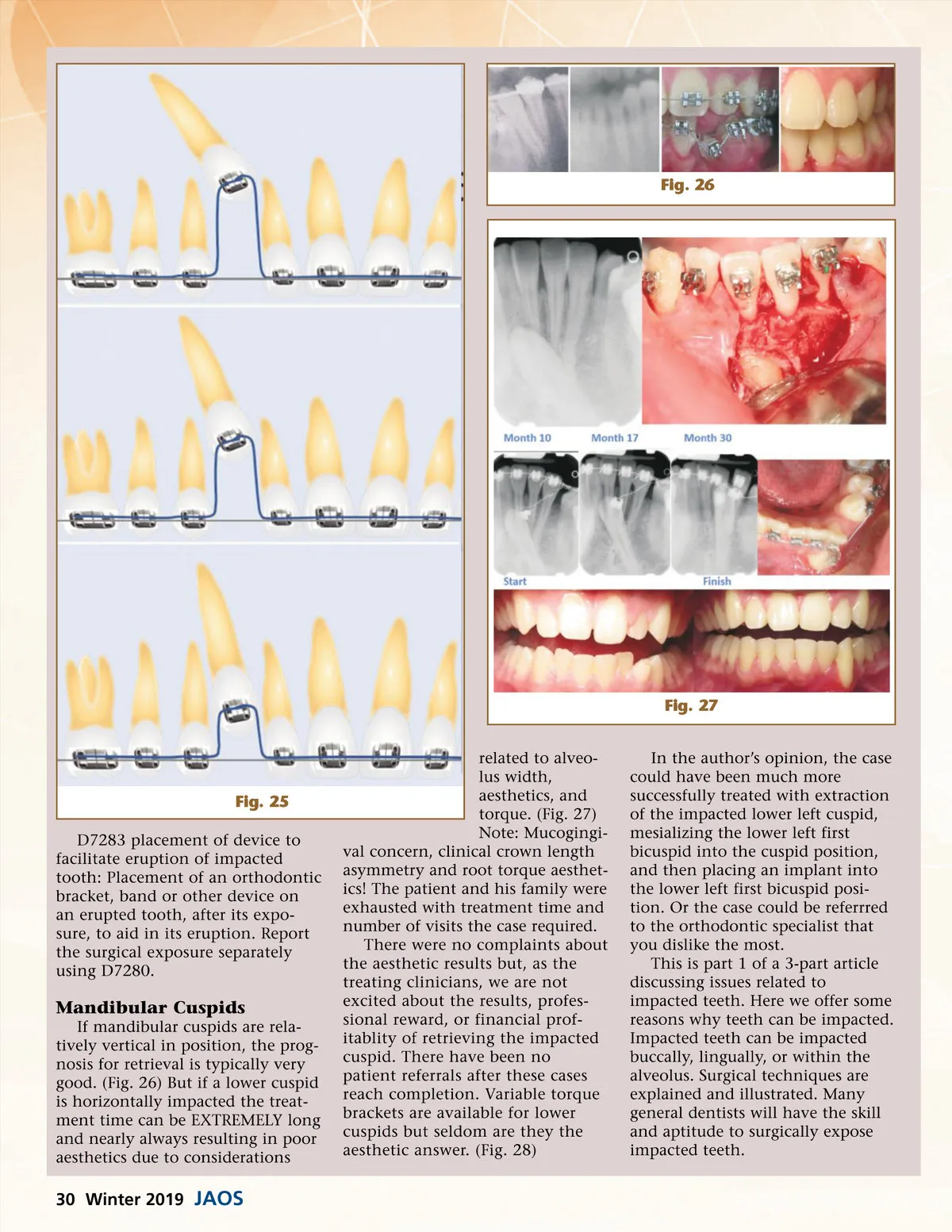
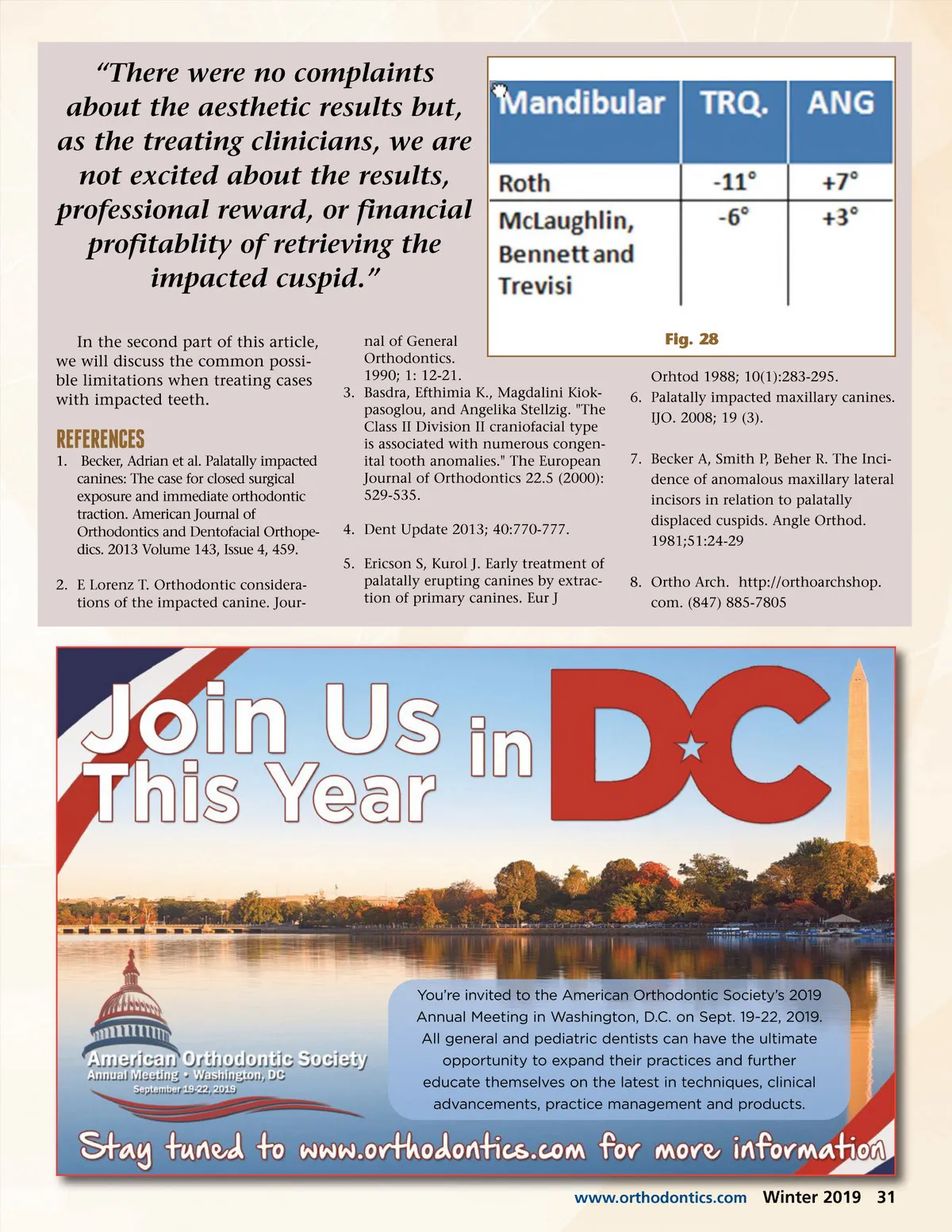
Fig. 26 Fig. 27 related to alveo-lus width, aesthetics, and torque. (Fig. 27) Note: Mucogingi-val concern, clinical crown length asymmetry and root torque aesthet-ics! The patient and his family were exhausted with treatment time and number of visits the case required. There were no complaints about the aesthetic results but, as the treating clinicians, we are not excited about the results, profes-sional reward, or financial prof-itablity of retrieving the impacted cuspid. There have been no patient referrals after these cases reach completion. Variable torque brackets are available for lower cuspids but seldom are they the aesthetic answer. (Fig. 28) In the author’s opinion, the case could have been much more successfully treated with extraction of the impacted lower left cuspid, mesializing the lower left first bicuspid into the cuspid position, and then placing an implant into the lower left first bicuspid posi-tion. Or the case could be referrred to the orthodontic specialist that you dislike the most. This is part 1 of a 3-part article discussing issues related to impacted teeth. Here we offer some reasons why teeth can be impacted. Impacted teeth can be impacted buccally, lingually, or within the alveolus. Surgical techniques are explained and illustrated. Many general dentists will have the skill and aptitude to surgically expose impacted teeth. Fig. 25 D7283 placement of device to facilitate eruption of impacted tooth: Placement of an orthodontic bracket, band or other device on an erupted tooth, after its expo-sure, to aid in its eruption. Report the surgical exposure separately using D7280. Mandibular Cuspids If mandibular cuspids are rela-tively vertical in position, the prog-nosis for retrieval is typically very good. (Fig. 26) But if a lower cuspid is horizontally impacted the treat-ment time can be EXTREMELY long and nearly always resulting in poor aesthetics due to considerations 30 Winter 2019 JAOS
Journal of the American Orthodontic Society Winter 2019: Page 30