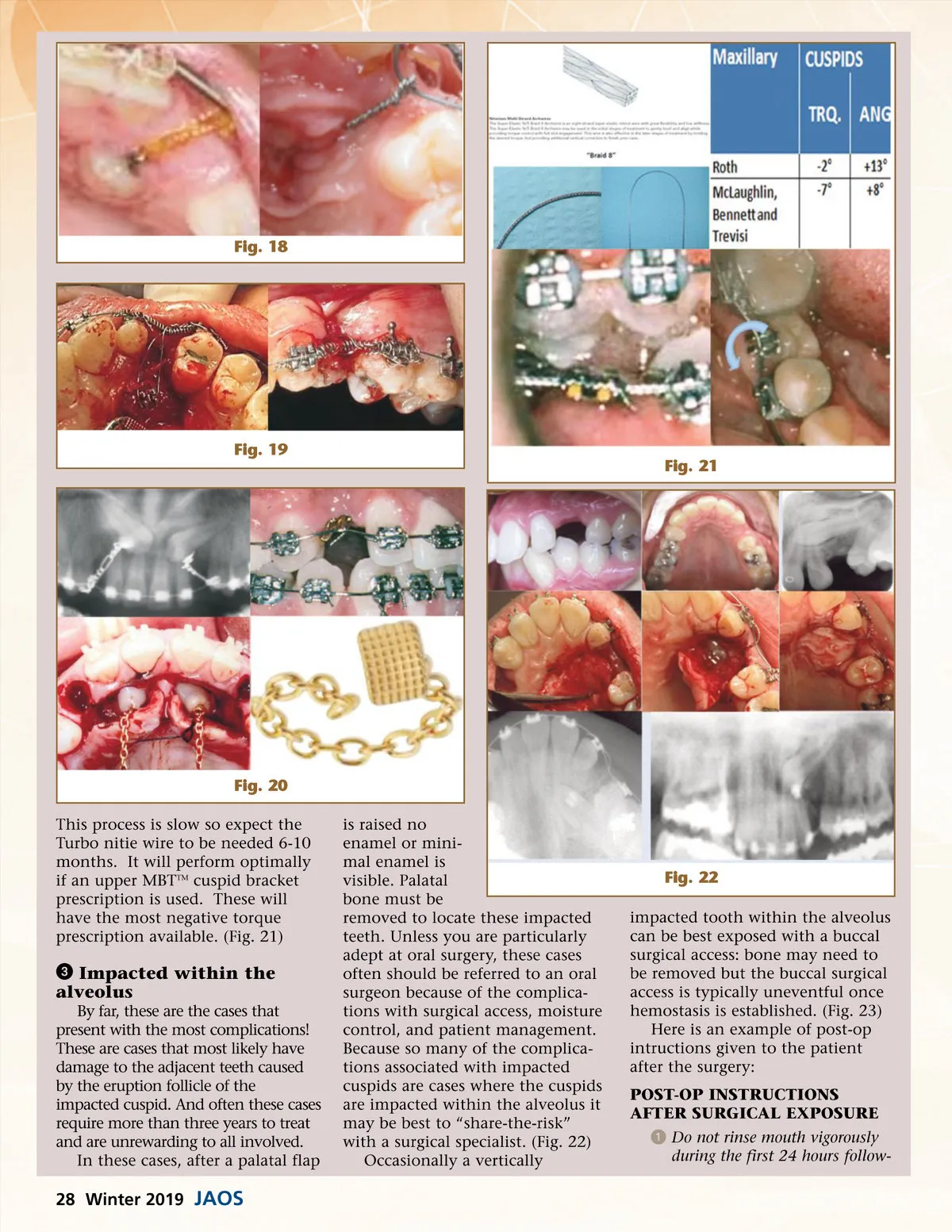
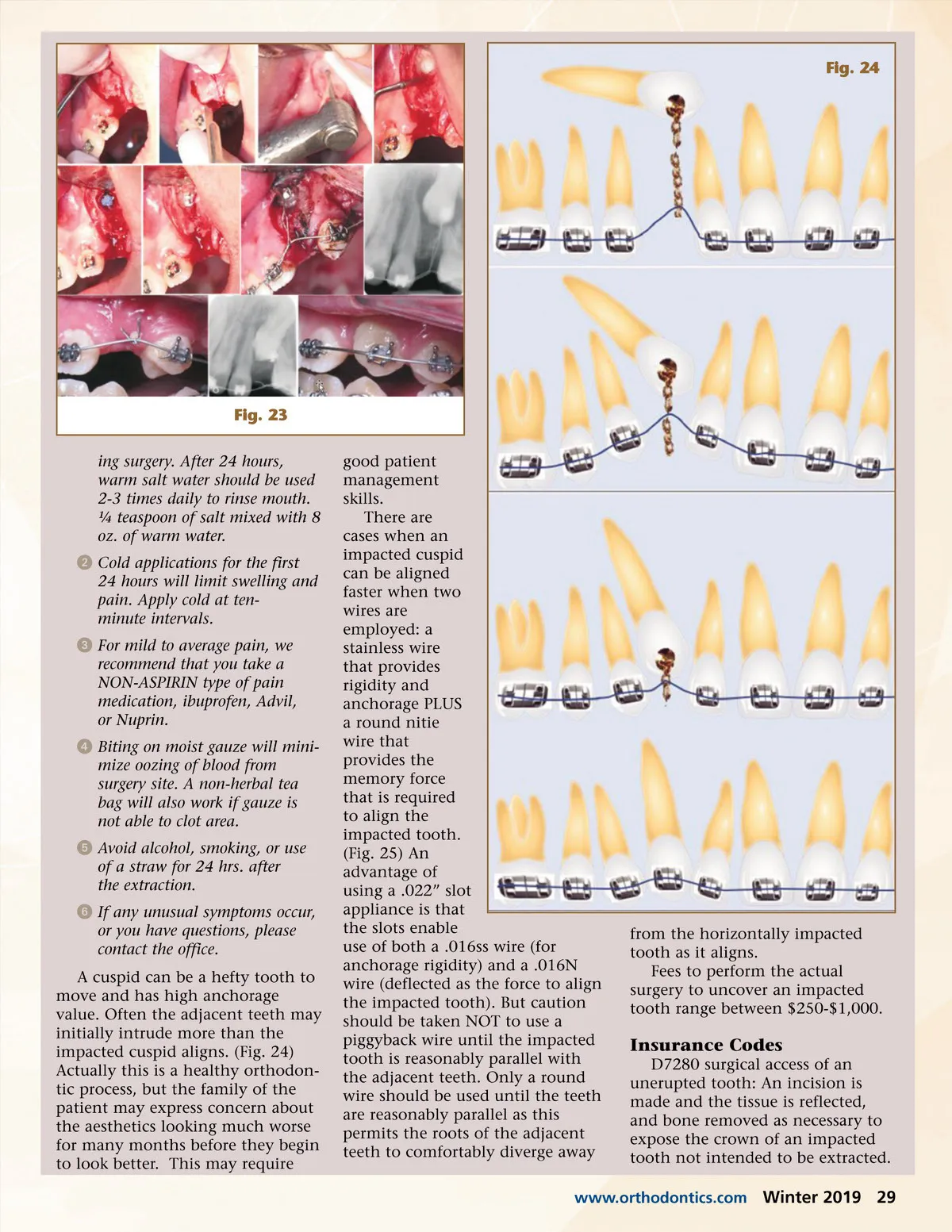
Fig. 24 Fig. 23 ing surgery. After 24 hours, warm salt water should be used 2-3 times daily to rinse mouth. ¼ teaspoon of salt mixed with 8 oz. of warm water. ᕢ Cold applications for the first 24 hours will limit swelling and pain. Apply cold at ten-minute intervals. ᕣ For mild to average pain, we recommend that you take a NON-ASPIRIN type of pain medication, ibuprofen, Advil, or Nuprin. ᕤ Biting on moist gauze will mini-mize oozing of blood from surgery site. A non-herbal tea bag will also work if gauze is not able to clot area. ᕥ Avoid alcohol, smoking, or use of a straw for 24 hrs. after the extraction. ᕦ If any unusual symptoms occur, or you have questions, please contact the office. A cuspid can be a hefty tooth to move and has high anchorage value. Often the adjacent teeth may initially intrude more than the impacted cuspid aligns. (Fig. 24) Actually this is a healthy orthodon-tic process, but the family of the patient may express concern about the aesthetics looking much worse for many months before they begin to look better. This may require good patient management skills. There are cases when an impacted cuspid can be aligned faster when two wires are employed: a stainless wire that provides rigidity and anchorage PLUS a round nitie wire that provides the memory force that is required to align the impacted tooth. (Fig. 25) An advantage of using a .022” slot appliance is that the slots enable use of both a .016ss wire (for anchorage rigidity) and a .016N wire (deflected as the force to align the impacted tooth). But caution should be taken NOT to use a piggyback wire until the impacted tooth is reasonably parallel with the adjacent teeth. Only a round wire should be used until the teeth are reasonably parallel as this permits the roots of the adjacent teeth to comfortably diverge away from the horizontally impacted tooth as it aligns. Fees to perform the actual surgery to uncover an impacted tooth range between $250-$1,000. Insurance Codes D7280 surgical access of an unerupted tooth: An incision is made and the tissue is reflected, and bone removed as necessary to expose the crown of an impacted tooth not intended to be extracted. www.orthodontics.com Winter 2019 29
Journal of the American Orthodontic Society Winter 2019: Page 29