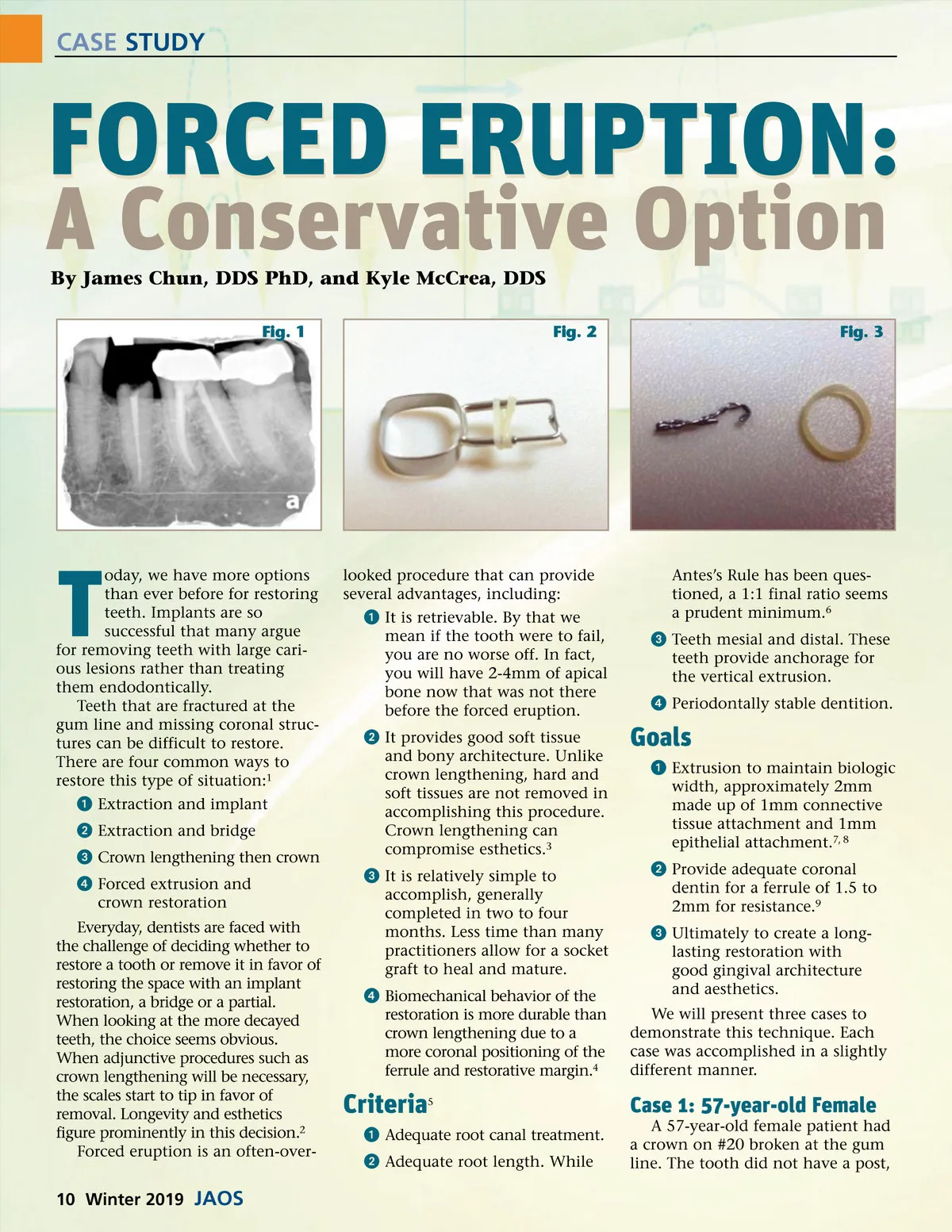
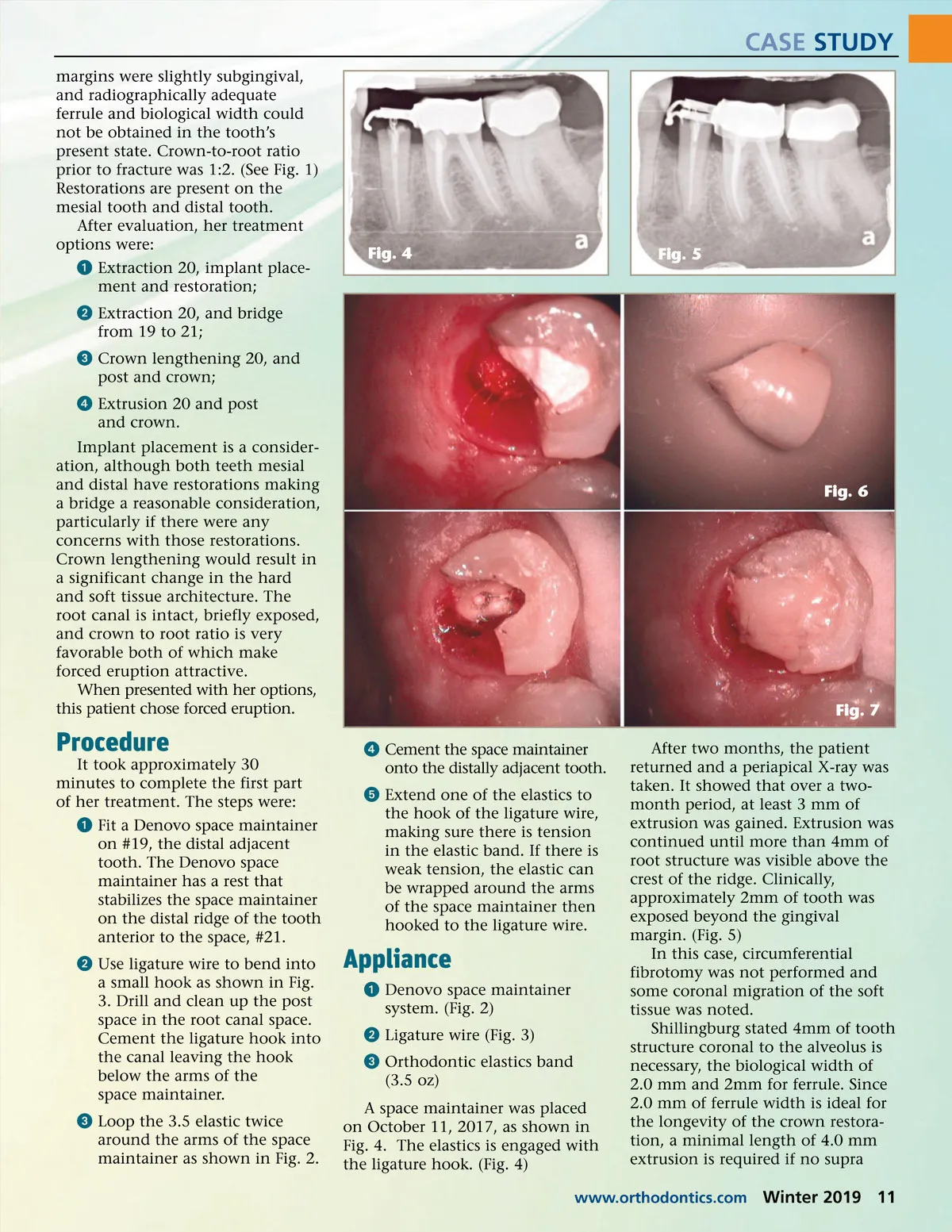
CASE STUDY margins were slightly subgingival, and radiographically adequate ferrule and biological width could not be obtained in the tooth’s present state. Crown-to-root ratio prior to fracture was 1:2. (See Fig. 1) Restorations are present on the mesial tooth and distal tooth. After evaluation, her treatment options were: ᕡ Extraction 20, implant place-ment and restoration; ᕢ Extraction 20, and bridge from 19 to 21; ᕣ Crown lengthening 20, and post and crown; ᕤ Extrusion 20 and post and crown. Implant placement is a consider-ation, although both teeth mesial and distal have restorations making a bridge a reasonable consideration, particularly if there were any concerns with those restorations. Crown lengthening would result in a significant change in the hard and soft tissue architecture. The root canal is intact, briefly exposed, and crown to root ratio is very favorable both of which make forced eruption attractive. When presented with her options, this patient chose forced eruption. Fig. 4 Fig. 5 Fig. 6 Fig. 7 ᕤ Cement the space maintainer onto the distally adjacent tooth. ᕥ Extend one of the elastics to the hook of the ligature wire, making sure there is tension in the elastic band. If there is weak tension, the elastic can be wrapped around the arms of the space maintainer then hooked to the ligature wire. After two months, the patient returned and a periapical X-ray was taken. It showed that over a two-month period, at least 3 mm of extrusion was gained. Extrusion was continued until more than 4mm of root structure was visible above the crest of the ridge. Clinically, approximately 2mm of tooth was exposed beyond the gingival margin. (Fig. 5) In this case, circumferential fibrotomy was not performed and some coronal migration of the soft tissue was noted. Shillingburg stated 4mm of tooth structure coronal to the alveolus is necessary, the biological width of 2.0 mm and 2mm for ferrule. Since 2.0 mm of ferrule width is ideal for the longevity of the crown restora-tion, a minimal length of 4.0 mm extrusion is required if no supra Procedure It took approximately 30 minutes to complete the first part of her treatment. The steps were: ᕡ Fit a Denovo space maintainer on #19, the distal adjacent tooth. The Denovo space maintainer has a rest that stabilizes the space maintainer on the distal ridge of the tooth anterior to the space, #21. ᕢ Use ligature wire to bend into a small hook as shown in Fig. 3. Drill and clean up the post space in the root canal space. Cement the ligature hook into the canal leaving the hook below the arms of the space maintainer. ᕣ Loop the 3.5 elastic twice around the arms of the space maintainer as shown in Fig. 2. Appliance ᕡ Denovo space maintainer system. (Fig. 2) ᕢ Ligature wire (Fig. 3) ᕣ Orthodontic elastics band (3.5 oz) A space maintainer was placed on October 11, 2017, as shown in Fig. 4. The elastics is engaged with the ligature hook. (Fig. 4) www.orthodontics.com Winter 2019 11
Journal of the American Orthodontic Society Winter 2019: Page 11