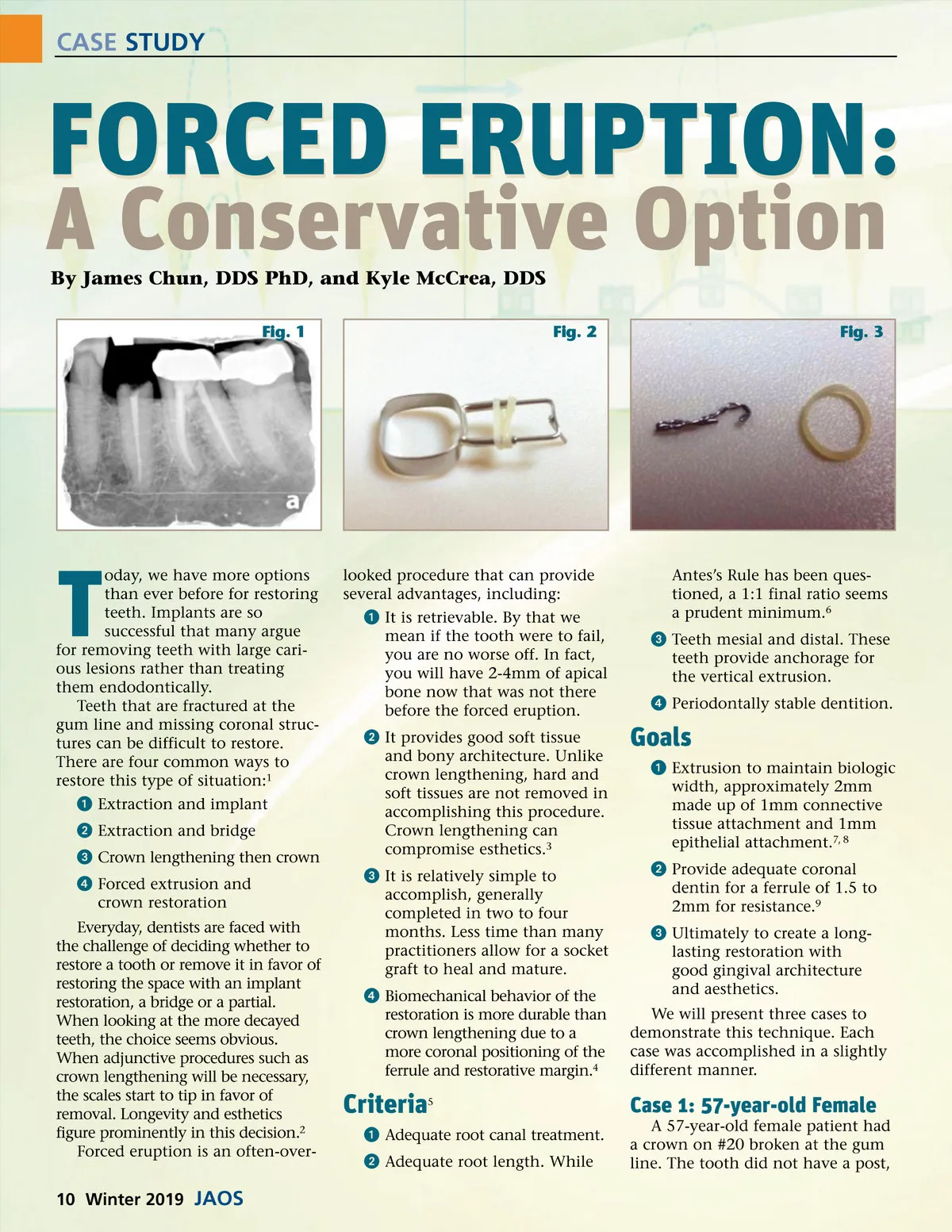
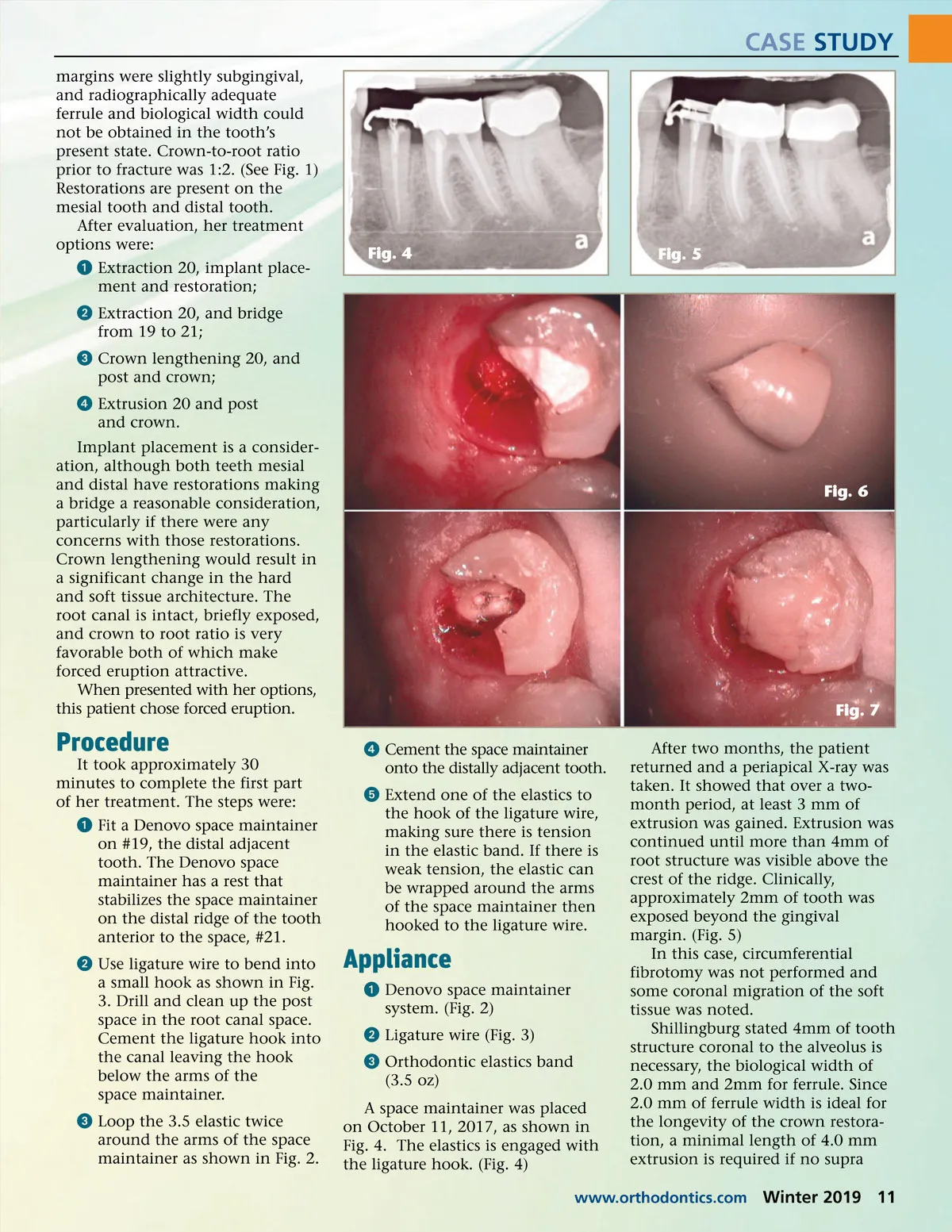
CASE STUDY A Conservative Option By James Chun, DDS PhD, and Kyle McCrea, DDS Fig. 1 Fig. 2 Fig. 3 FORCED ERUPTION: T oday, we have more options than ever before for restoring teeth. Implants are so successful that many argue for removing teeth with large cari-ous lesions rather than treating them endodontically. Teeth that are fractured at the gum line and missing coronal struc-tures can be difficult to restore. There are four common ways to restore this type of situation: 1 ᕡ Extraction and implant ᕢ Extraction and bridge ᕣ Crown lengthening then crown ᕤ Forced extrusion and crown restoration Everyday, dentists are faced with the challenge of deciding whether to restore a tooth or remove it in favor of restoring the space with an implant restoration, a bridge or a partial. When looking at the more decayed teeth, the choice seems obvious. When adjunctive procedures such as crown lengthening will be necessary, the scales start to tip in favor of removal. Longevity and esthetics figure prominently in this decision. 2 Forced eruption is an often-over-looked procedure that can provide several advantages, including: ᕡ It is retrievable. By that we mean if the tooth were to fail, you are no worse off. In fact, you will have 2-4mm of apical bone now that was not there before the forced eruption. ᕢ It provides good soft tissue and bony architecture. Unlike crown lengthening, hard and soft tissues are not removed in accomplishing this procedure. Crown lengthening can compromise esthetics. 3 ᕣ It is relatively simple to accomplish, generally completed in two to four months. Less time than many practitioners allow for a socket graft to heal and mature. ᕤ Biomechanical behavior of the restoration is more durable than crown lengthening due to a more coronal positioning of the ferrule and restorative margin. 4 Antes’s Rule has been ques-tioned, a 1:1 final ratio seems a prudent minimum. 6 ᕣ Teeth mesial and distal. These teeth provide anchorage for the vertical extrusion. ᕤ Periodontally stable dentition. Goals ᕡ Extrusion to maintain biologic width, approximately 2mm made up of 1mm connective tissue attachment and 1mm epithelial attachment. 7, 8 ᕢ Provide adequate coronal dentin for a ferrule of 1.5 to 2mm for resistance. 9 ᕣ Ultimately to create a long-lasting restoration with good gingival architecture and aesthetics. We will present three cases to demonstrate this technique. Each case was accomplished in a slightly different manner. Criteria 5 Case 1: 57-year-old Female A 57-year-old female patient had a crown on #20 broken at the gum line. The tooth did not have a post, ᕡ Adequate root canal treatment. ᕢ Adequate root length. While 10 Winter 2019 JAOS
Journal of the American Orthodontic Society Winter 2019: Page 10