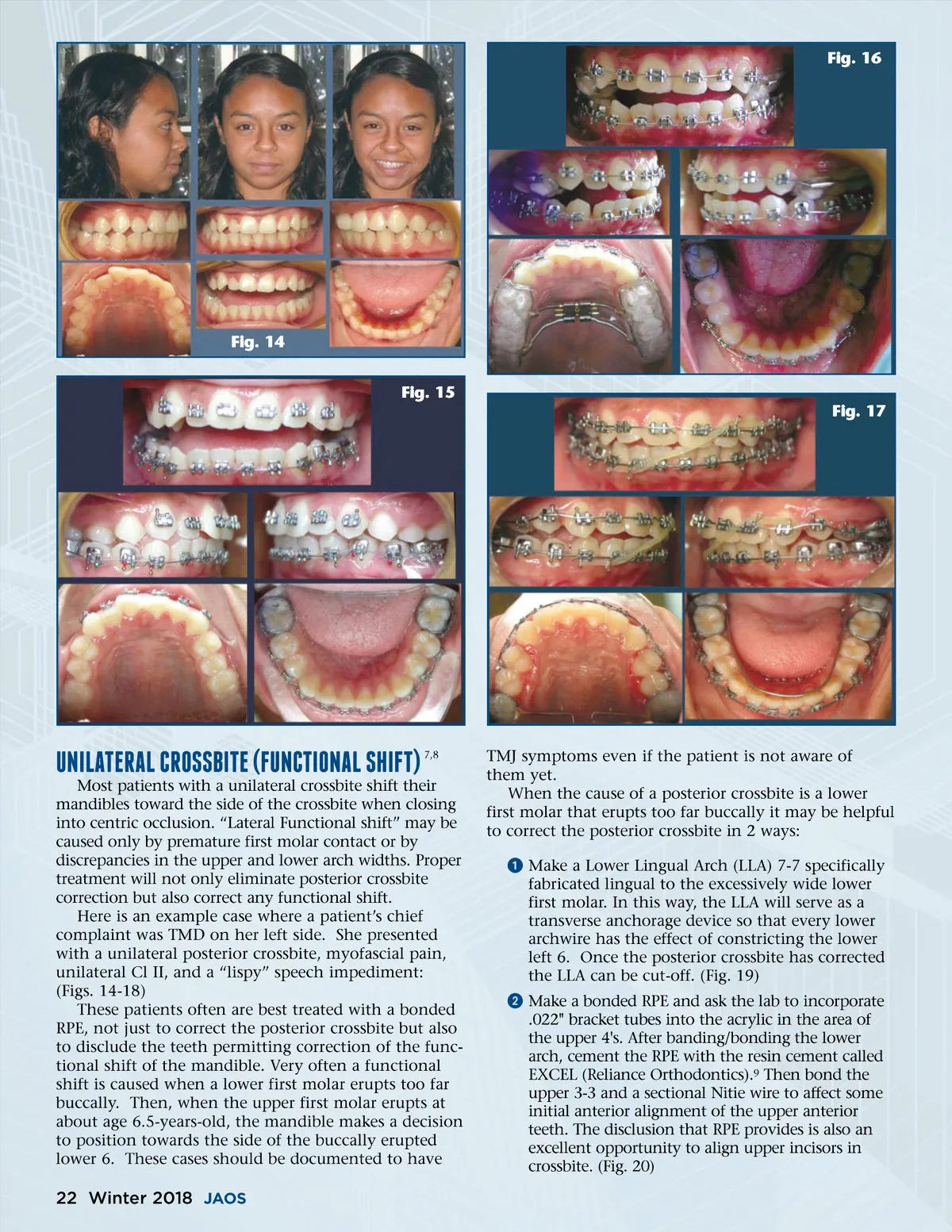
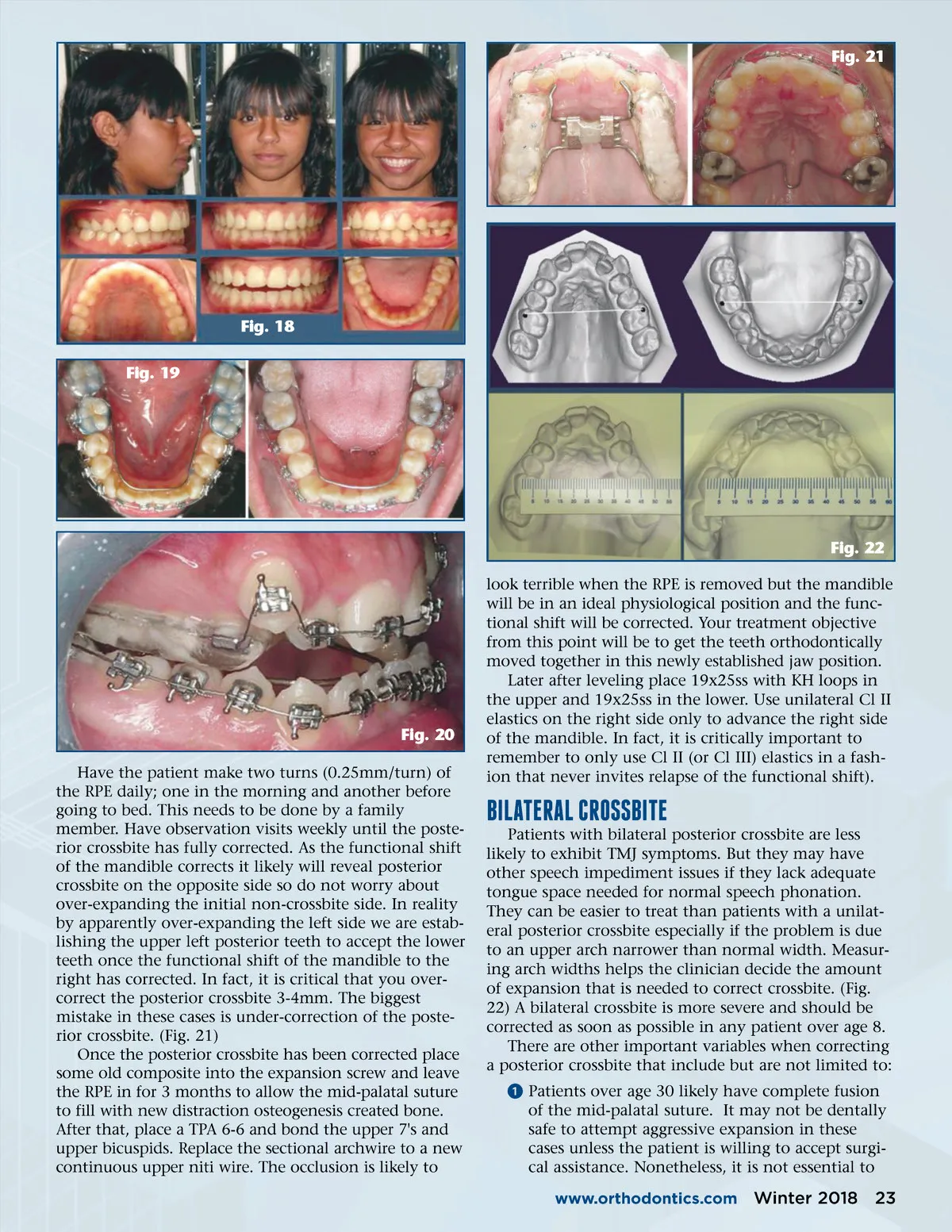
Fig. 16 Fig. 14 Fig. 15 Fig. 17 Most patients with a unilateral crossbite shift their mandibles toward the side of the crossbite when closing into centric occlusion. “Lateral Functional shift” may be caused only by premature first molar contact or by discrepancies in the upper and lower arch widths. Proper treatment will not only eliminate posterior crossbite correction but also correct any functional shift. Here is an example case where a patient’s chief complaint was TMD on her left side. She presented with a unilateral posterior crossbite, myofascial pain, unilateral Cl II, and a “lispy” speech impediment: (Figs. 14-18) These patients often are best treated with a bonded RPE, not just to correct the posterior crossbite but also to disclude the teeth permitting correction of the func-tional shift of the mandible. Very often a functional shift is caused when a lower first molar erupts too far buccally. Then, when the upper first molar erupts at about age 6.5-years-old, the mandible makes a decision to position towards the side of the buccally erupted lower 6. These cases should be documented to have UNIlATERAl CRossbITE (FUNCTIoNAl shIFT) 7,8 TMJ symptoms even if the patient is not aware of them yet. When the cause of a posterior crossbite is a lower first molar that erupts too far buccally it may be helpful to correct the posterior crossbite in 2 ways: ᕡ Make a Lower Lingual Arch (LLA) 7-7 specifically fabricated lingual to the excessively wide lower first molar. In this way, the LLA will serve as a transverse anchorage device so that every lower archwire has the effect of constricting the lower left 6. Once the posterior crossbite has corrected the LLA can be cut-off. (Fig. 19) ᕢ Make a bonded RPE and ask the lab to incorporate .022" bracket tubes into the acrylic in the area of the upper 4's. After banding/bonding the lower arch, cement the RPE with the resin cement called EXCEL (Reliance Orthodontics). 9 Then bond the upper 3-3 and a sectional Nitie wire to affect some initial anterior alignment of the upper anterior teeth. The disclusion that RPE provides is also an excellent opportunity to align upper incisors in crossbite. (Fig. 20) 22 Winter 2018 JAOS
Journal of the American Orthodontic Society Winter 2018: Page 22