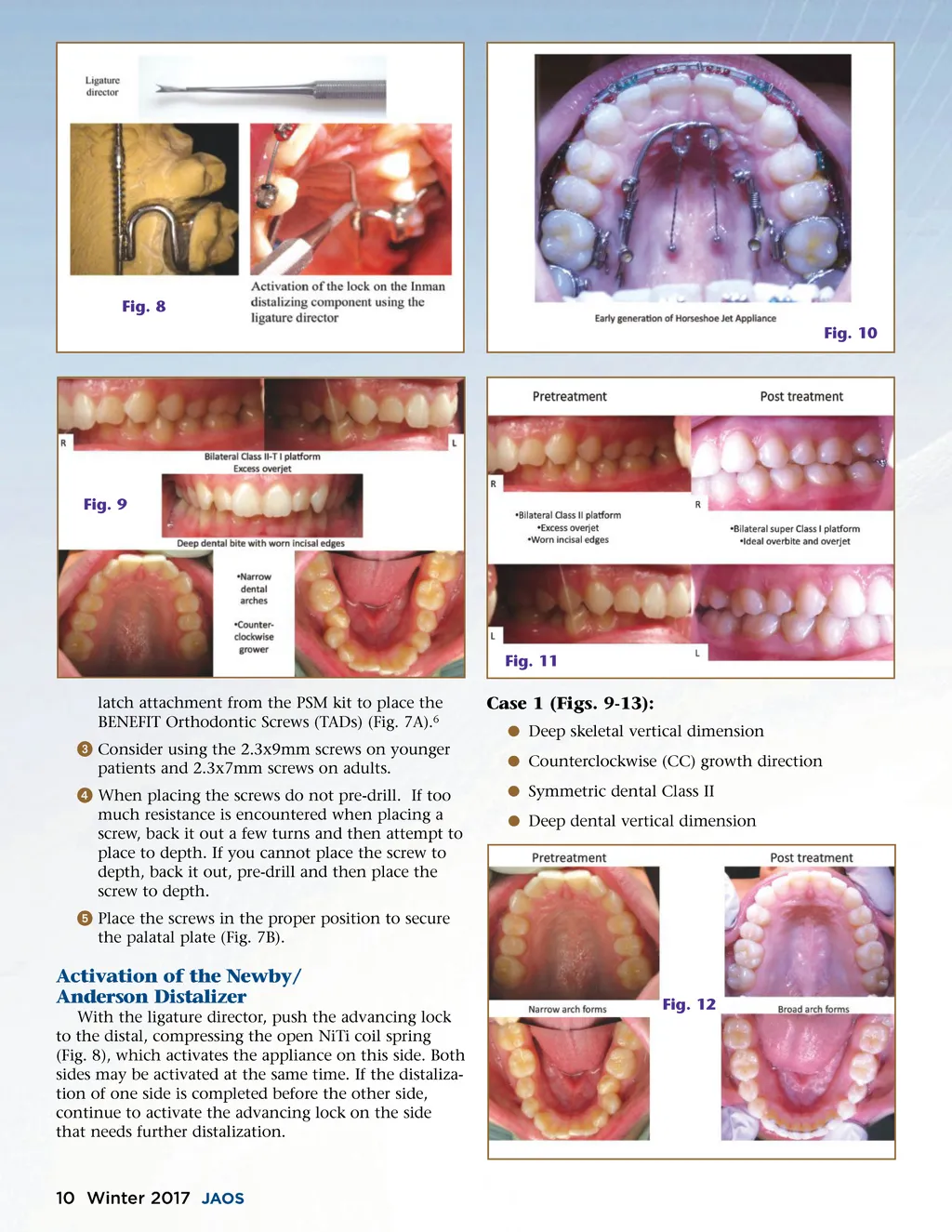
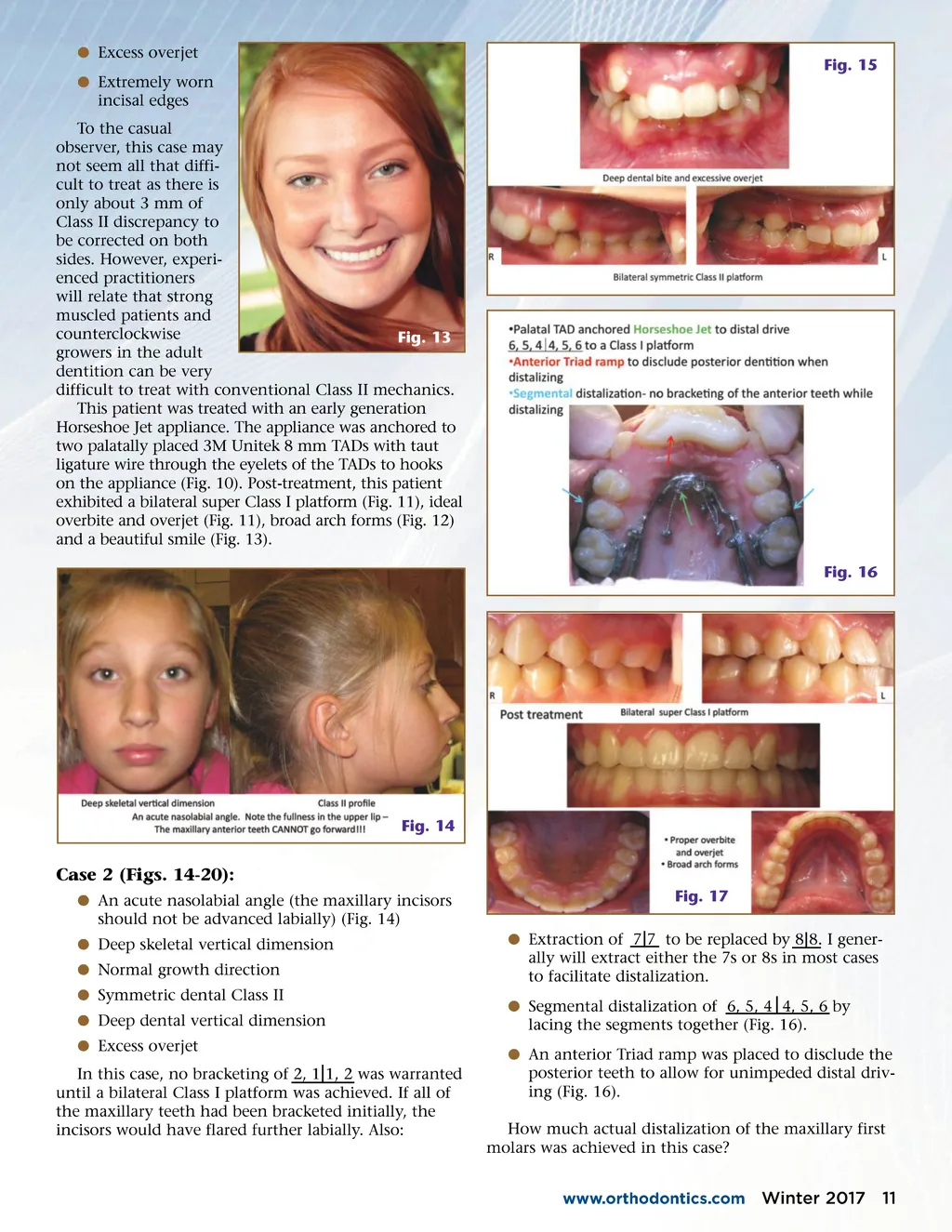
b Excess overjet b Extremely worn incisal edges To the casual observer, this case may not seem all that diffi-cult to treat as there is only about 3 mm of Class II discrepancy to be corrected on both sides. However, experi-enced practitioners will relate that strong muscled patients and counterclockwise Fig. 13 growers in the adult dentition can be very difficult to treat with conventional Class II mechanics. This patient was treated with an early generation Horseshoe Jet appliance. The appliance was anchored to two palatally placed 3M Unitek 8 mm TADs with taut ligature wire through the eyelets of the TADs to hooks on the appliance (Fig. 10). Post-treatment, this patient exhibited a bilateral super Class I platform (Fig. 11), ideal overbite and overjet (Fig. 11), broad arch forms (Fig. 12) and a beautiful smile (Fig. 13). Fig. 15 Fig. 16 Fig. 14 Case 2 (Figs. 14-20): b An acute nasolabial angle (the maxillary incisors should not be advanced labially) (Fig. 14) b Deep skeletal vertical dimension b Normal growth direction b Symmetric dental Class II b Deep dental vertical dimension b Excess overjet In this case, no bracketing of 2, 1 1, 2 was warranted until a bilateral Class I platform was achieved. If all of the maxillary teeth had been bracketed initially, the incisors would have flared further labially. Also: Fig. 17 b Extraction of 7 7 to be replaced by 8 8. I gener-ally will extract either the 7s or 8s in most cases to facilitate distalization. b Segmental distalization of 6, 5, 4 4, 5, 6 by lacing the segments together (Fig. 16). b An anterior Triad ramp was placed to disclude the posterior teeth to allow for unimpeded distal driv-ing (Fig. 16). How much actual distalization of the maxillary first molars was achieved in this case? www.orthodontics.com Winter 2017 11
Journal of the American Orthodontic Society Winter 2017: Page 11