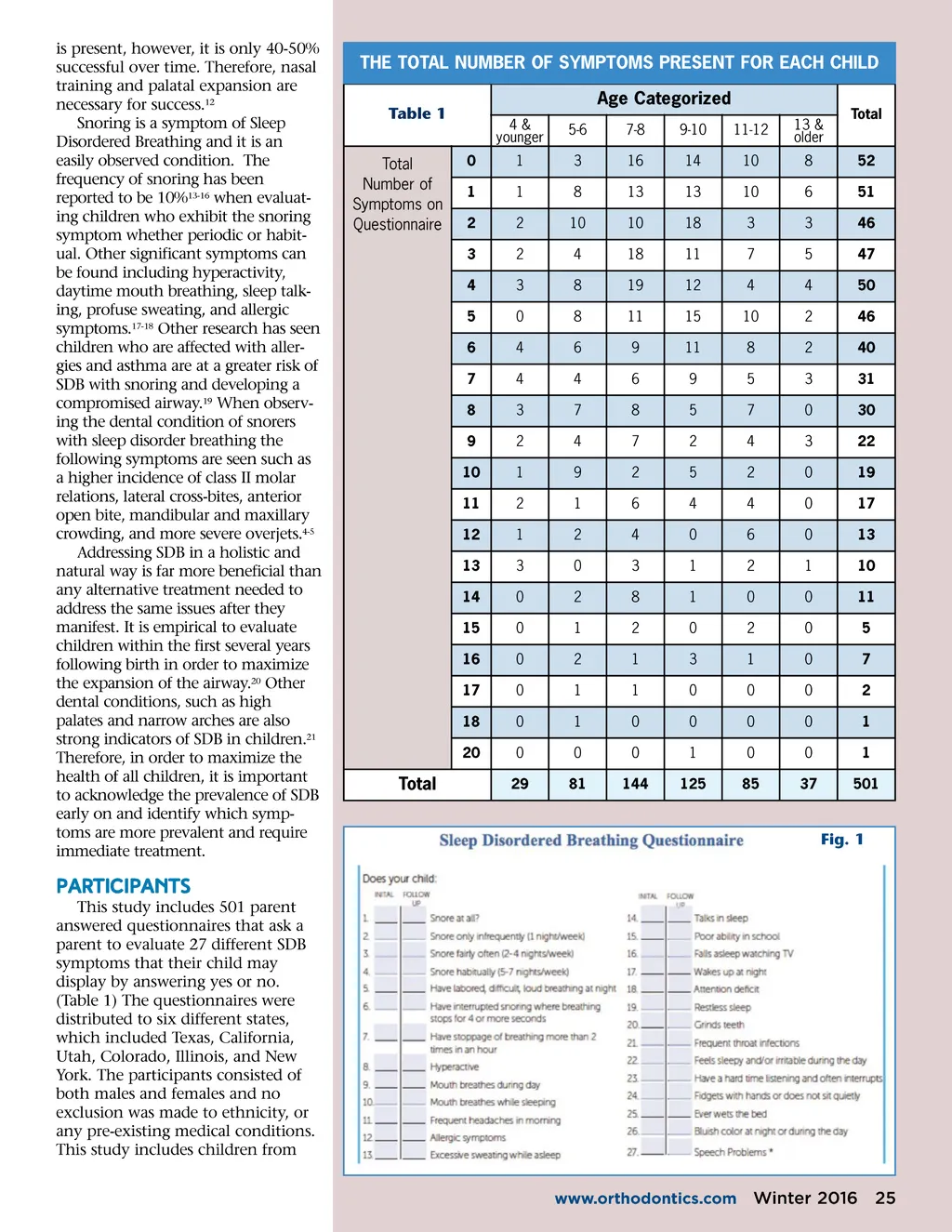
is present, however, it is only 40-50% successful over time. Therefore, nasal training and palatal expansion are necessary for success. 12 Snoring is a symptom of Sleep Disordered Breathing and it is an easily observed condition. The frequency of snoring has been reported to be 10% 13-16 when evaluat-ing children who exhibit the snoring symptom whether periodic or habit-ual. Other significant symptoms can be found including hyperactivity, daytime mouth breathing, sleep talk-ing, profuse sweating, and allergic symptoms. 17-18 Other research has seen children who are affected with aller-gies and asthma are at a greater risk of SDB with snoring and developing a compromised airway. 19 When observ-ing the dental condition of snorers with sleep disorder breathing the following symptoms are seen such as a higher incidence of class II molar relations, lateral cross-bites, anterior open bite, mandibular and maxillary crowding, and more severe overjets. 4-5 Addressing SDB in a holistic and natural way is far more beneficial than any alternative treatment needed to address the same issues after they manifest. It is empirical to evaluate children within the first several years following birth in order to maximize the expansion of the airway. 20 Other dental conditions, such as high palates and narrow arches are also strong indicators of SDB in children. 21 Therefore, in order to maximize the health of all children, it is important to acknowledge the prevalence of SDB early on and identify which symp-toms are more prevalent and require immediate treatment. THE TOTAL NUMBER OF SYMPTOMS PRESENT FOR EACH CHILD Age Categorized Table 1 Total Number of Symptoms on Questionnaire 0 1 2 3 4 5 6 7 8 9 10 11 12 13 14 15 16 17 18 20 4 & younger 1 1 2 2 3 0 4 4 3 2 1 2 1 3 0 0 0 0 0 0 29 5-6 3 8 10 4 8 8 6 4 7 4 9 1 2 0 2 1 2 1 1 0 81 7-8 16 13 10 18 19 11 9 6 8 7 2 6 4 3 8 2 1 1 0 0 144 9-10 14 13 18 11 12 15 11 9 5 2 5 4 0 1 1 0 3 0 0 1 125 11-12 10 10 3 7 4 10 8 5 7 4 2 4 6 2 0 2 1 0 0 0 85 13 & older 8 6 3 5 4 2 2 3 0 3 0 0 0 1 0 0 0 0 0 0 37 Total 52 51 46 47 50 46 40 31 30 22 19 17 13 10 11 5 7 2 1 1 501 Total Fig. 1 Participants This study includes 501 parent answered questionnaires that ask a parent to evaluate 27 different SDB symptoms that their child may display by answering yes or no. (Table 1) The questionnaires were distributed to six different states, which included Texas, California, Utah, Colorado, Illinois, and New York. The participants consisted of both males and females and no exclusion was made to ethnicity, or any pre-existing medical conditions. This study includes children from www.orthodontics.com Winter 2016 25
Journal of the American Orthodontic Society Winter 2016: Page 25