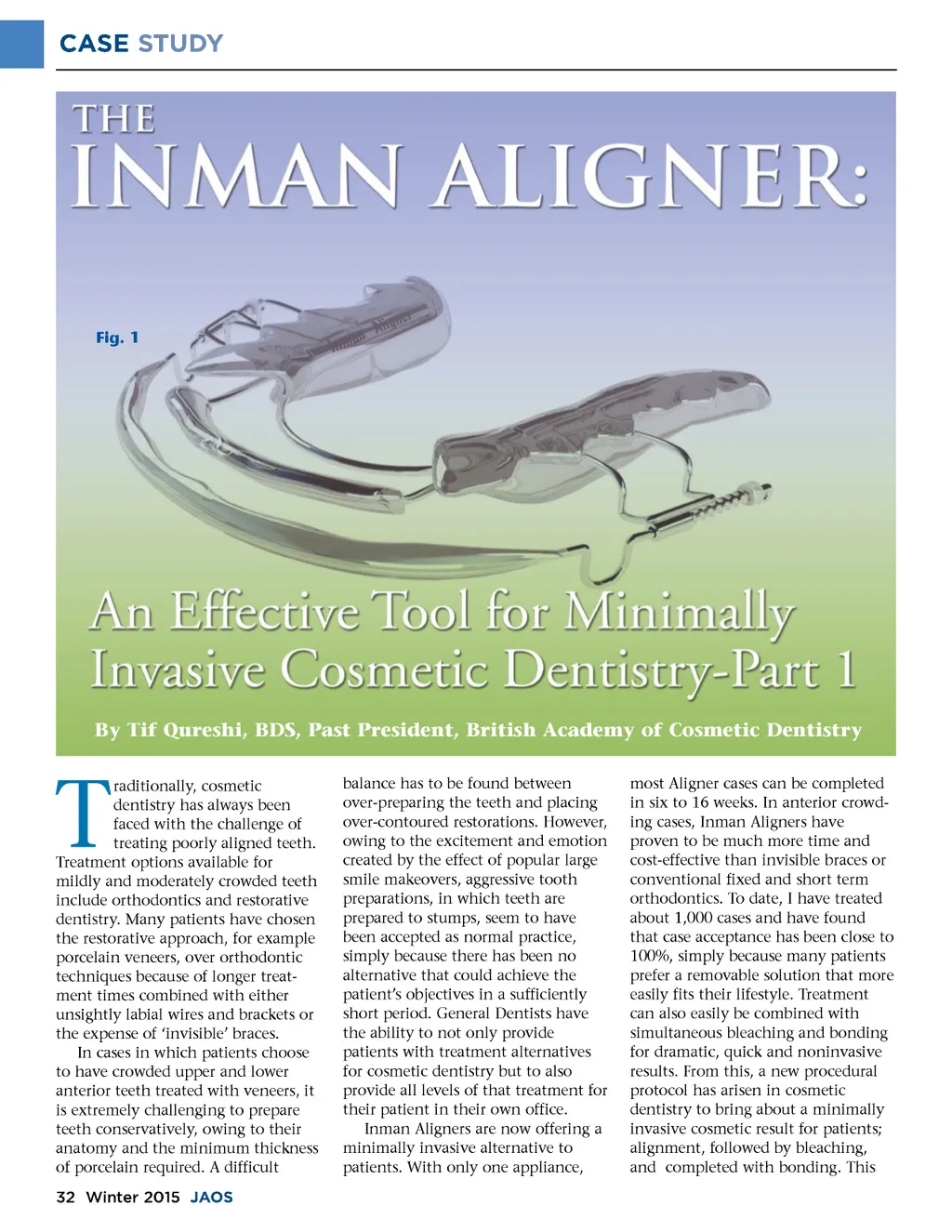
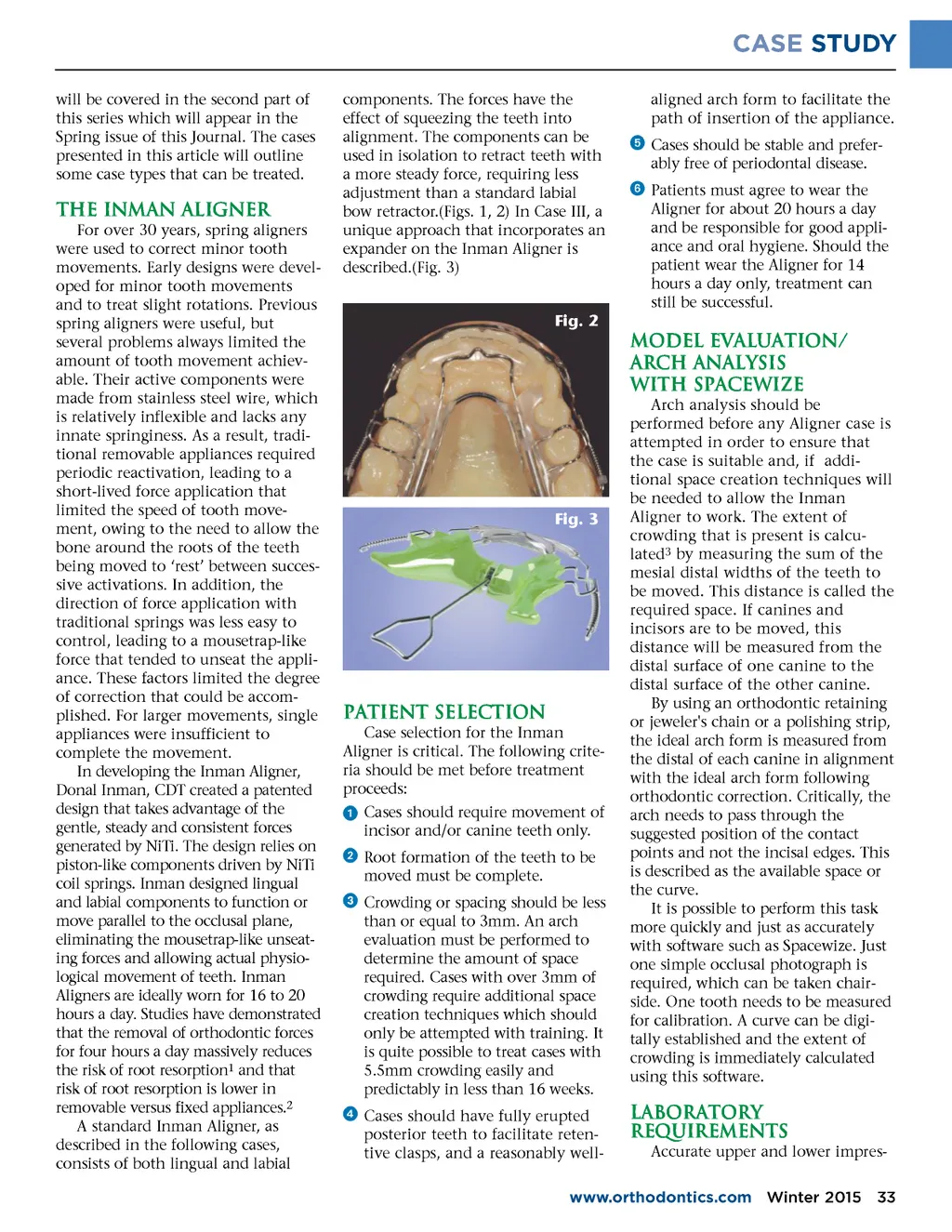
CASE STUDY will be covered in the second part of this series which will appear in the Spring issue of this Journal. The cases presented in this article will outline some case types that can be treated. components. The forces have the effect of squeezing the teeth into alignment. The components can be used in isolation to retract teeth with a more steady force, requiring less adjustment than a standard labial bow retractor.(Figs. 1, 2) In Case III, a unique approach that incorporates an expander on the Inman Aligner is described.(Fig. 3) Fig. 2 aligned arch form to facilitate the path of insertion of the appliance. ᕥ Cases should be stable and prefer-ably free of periodontal disease. ᕦ Patients must agree to wear the Aligner for about 20 hours a day and be responsible for good appli-ance and oral hygiene. Should the patient wear the Aligner for 14 hours a day only, treatment can still be successful. T he Inman Aligner For over 30 years, spring aligners were used to correct minor tooth movements. Early designs were devel-oped for minor tooth movements and to treat slight rotations. Previous spring aligners were useful, but several problems always limited the amount of tooth movement achiev-able. Their active components were made from stainless steel wire, which is relatively inflexible and lacks any innate springiness. As a result, tradi-tional removable appliances required periodic reactivation, leading to a short-lived force application that limited the speed of tooth move-ment, owing to the need to allow the bone around the roots of the teeth being moved to ‘rest’ between succes-sive activations. In addition, the direction of force application with traditional springs was less easy to control, leading to a mousetrap-like force that tended to unseat the appli-ance. These factors limited the degree of correction that could be accom-plished. For larger movements, single appliances were insufficient to complete the movement. In developing the Inman Aligner, Donal Inman, CDT created a patented design that takes advantage of the gentle, steady and consistent forces generated by NiTi. The design relies on piston-like components driven by NiTi coil springs. Inman designed lingual and labial components to function or move parallel to the occlusal plane, eliminating the mousetrap-like unseat-ing forces and allowing actual physio-logical movement of teeth. Inman Aligners are ideally worn for 16 to 20 hours a day. Studies have demonstrated that the removal of orthodontic forces for four hours a day massively reduces the risk of root resorption 1 and that risk of root resorption is lower in removable versus fixed appliances. 2 A standard Inman Aligner, as described in the following cases, consists of both lingual and labial Model evaluation/ arch analysis with Spacewize Arch analysis should be performed before any Aligner case is attempted in order to ensure that the case is suitable and, if addi-tional space creation techniques will be needed to allow the Inman Aligner to work. The extent of crowding that is present is calcu-lated 3 by measuring the sum of the mesial distal widths of the teeth to be moved. This distance is called the required space. If canines and incisors are to be moved, this distance will be measured from the distal surface of one canine to the distal surface of the other canine. By using an orthodontic retaining or jeweler's chain or a polishing strip, the ideal arch form is measured from the distal of each canine in alignment with the ideal arch form following orthodontic correction. Critically, the arch needs to pass through the suggested position of the contact points and not the incisal edges. This is described as the available space or the curve. It is possible to perform this task more quickly and just as accurately with software such as Spacewize. Just one simple occlusal photograph is required, which can be taken chair-side. One tooth needs to be measured for calibration. A curve can be digi-tally established and the extent of crowding is immediately calculated using this software. Fig. 3 Patient selection Case selection for the Inman Aligner is critical. The following crite-ria should be met before treatment proceeds: ᕡ Cases should require movement of incisor and/or canine teeth only. ᕢ Root formation of the teeth to be moved must be complete. ᕣ Crowding or spacing should be less than or equal to 3mm. An arch evaluation must be performed to determine the amount of space required. Cases with over 3mm of crowding require additional space creation techniques which should only be attempted with training. It is quite possible to treat cases with 5.5mm crowding easily and predictably in less than 16 weeks. ᕤ Cases should have fully erupted posterior teeth to facilitate reten-tive clasps, and a reasonably well-Laboratory Requirements Accurate upper and lower impres-www.orthodontics.com Winter 2015 33
Journal of the American Orthodontic Society Winter 2015: Page 33