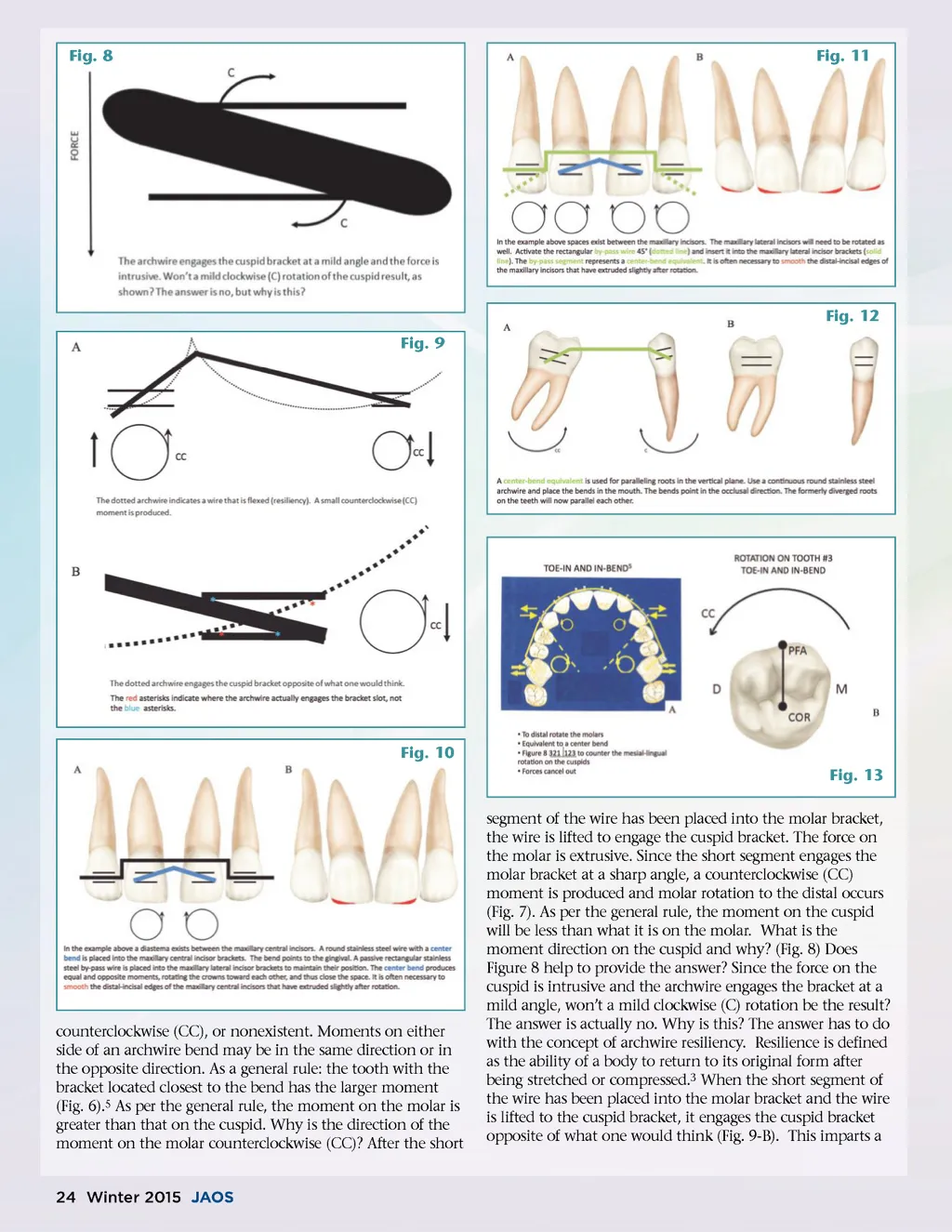
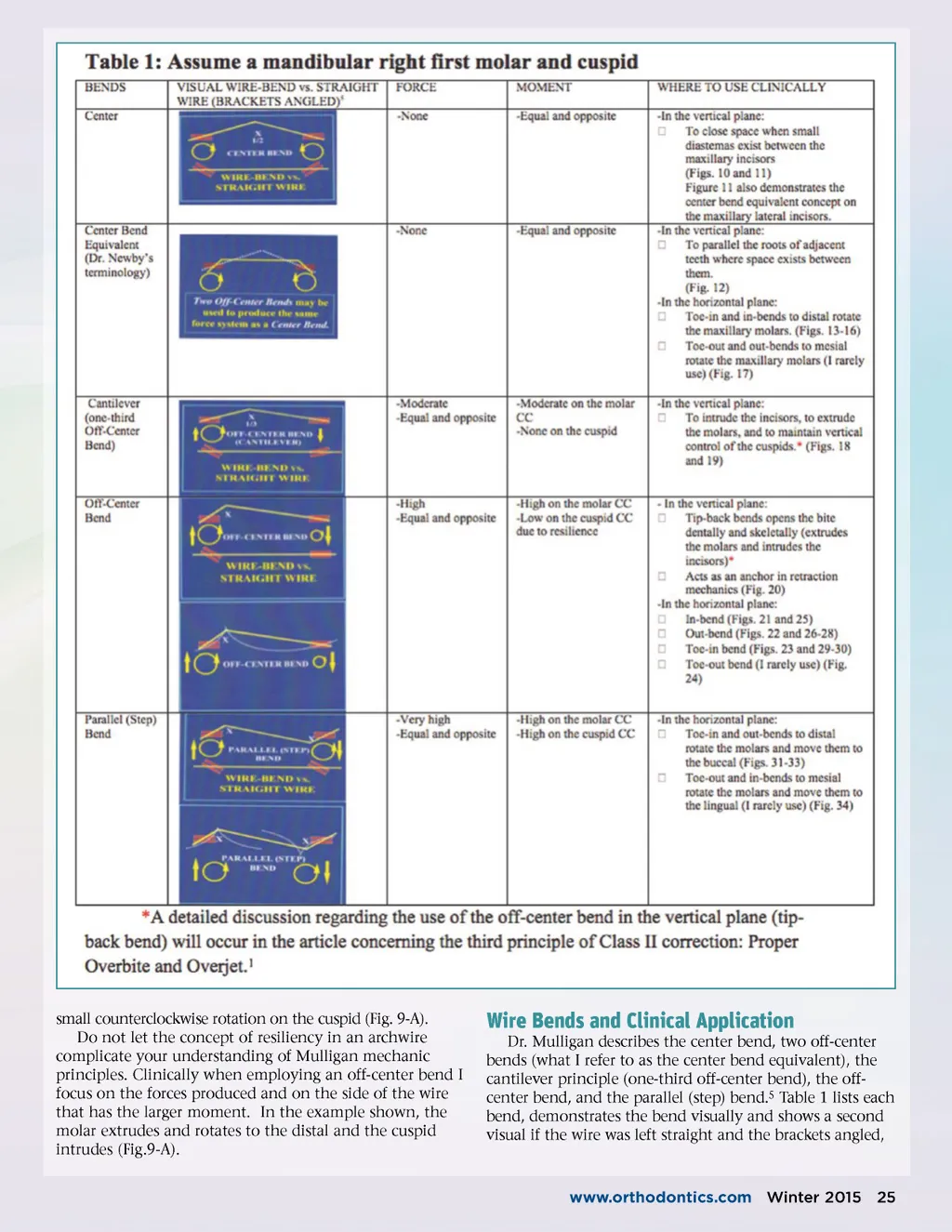
small counterclockwise rotation on the cuspid (Fig. 9-A). Do not let the concept of resiliency in an archwire complicate your understanding of Mulligan mechanic principles. Clinically when employing an off-center bend I focus on the forces produced and on the side of the wire that has the larger moment. In the example shown, the molar extrudes and rotates to the distal and the cuspid intrudes (Fig.9-A). Wire Bends and Clinical Application Dr. Mulligan describes the center bend, two off-center bends (what I refer to as the center bend equivalent), the cantilever principle (one-third off-center bend), the off-center bend, and the parallel (step) bend. 5 Table 1 lists each bend, demonstrates the bend visually and shows a second visual if the wire was left straight and the brackets angled, www.orthodontics.com Winter 2015 25
Journal of the American Orthodontic Society Winter 2015: Page 25