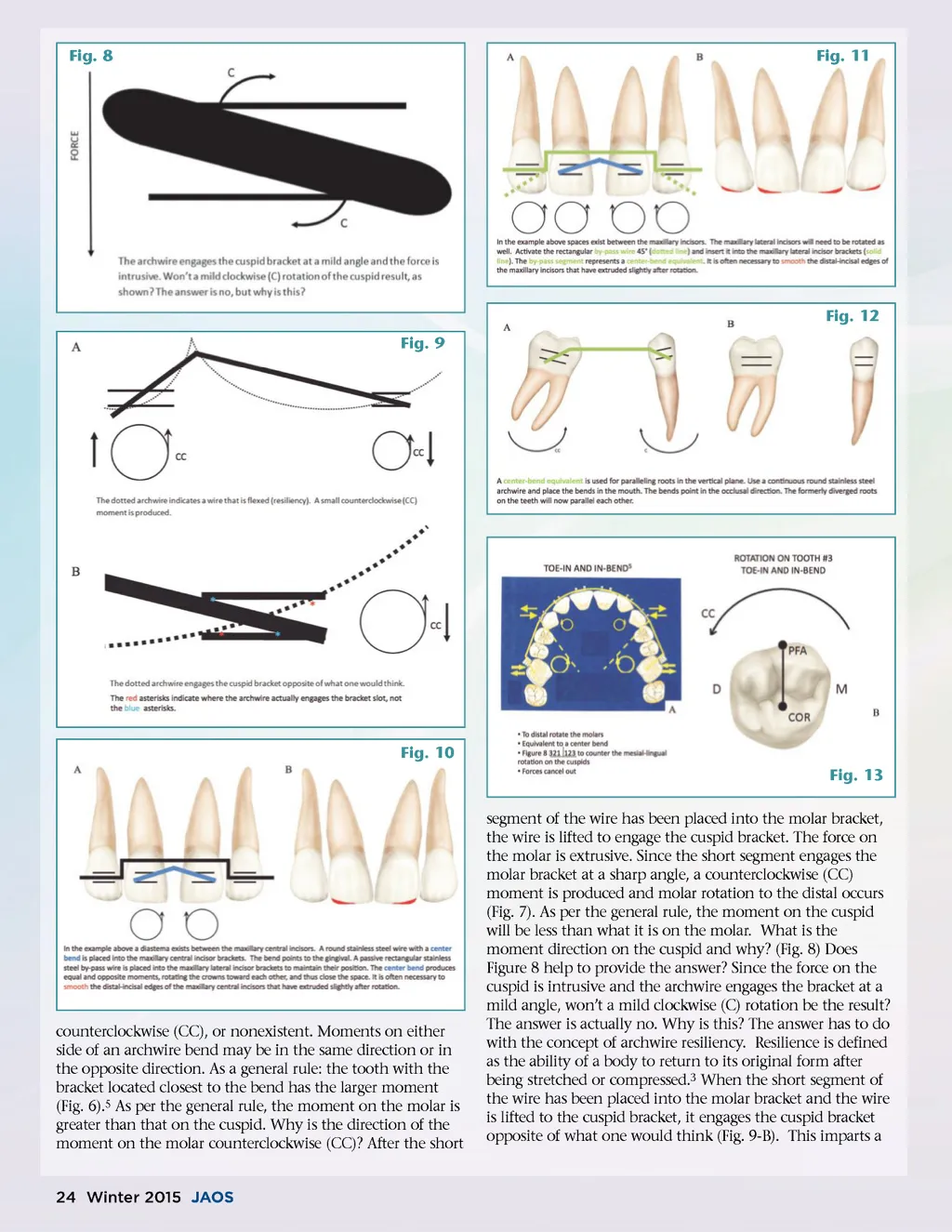
Fig. 8 Fig. 11 Fig. 12 Fig. 9 Fig. 10 Fig. 13 segment of the wire has been placed into the molar bracket, the wire is lifted to engage the cuspid bracket. The force on the molar is extrusive. Since the short segment engages the molar bracket at a sharp angle, a counterclockwise (CC) moment is produced and molar rotation to the distal occurs (Fig. 7). As per the general rule, the moment on the cuspid will be less than what it is on the molar. What is the moment direction on the cuspid and why? (Fig. 8) Does Figure 8 help to provide the answer? Since the force on the cuspid is intrusive and the archwire engages the bracket at a mild angle, won’t a mild clockwise (C) rotation be the result? The answer is actually no. Why is this? The answer has to do with the concept of archwire resiliency. Resilience is defined as the ability of a body to return to its original form after being stretched or compressed. 3 When the short segment of the wire has been placed into the molar bracket and the wire is lifted to the cuspid bracket, it engages the cuspid bracket opposite of what one would think (Fig. 9-B). This imparts a counterclockwise (CC), or nonexistent. Moments on either side of an archwire bend may be in the same direction or in the opposite direction. As a general rule: the tooth with the bracket located closest to the bend has the larger moment (Fig. 6). 5 As per the general rule, the moment on the molar is greater than that on the cuspid. Why is the direction of the moment on the molar counterclockwise (CC)? After the short 24 Winter 2015 JAOS
Journal of the American Orthodontic Society Winter 2015: Page 24