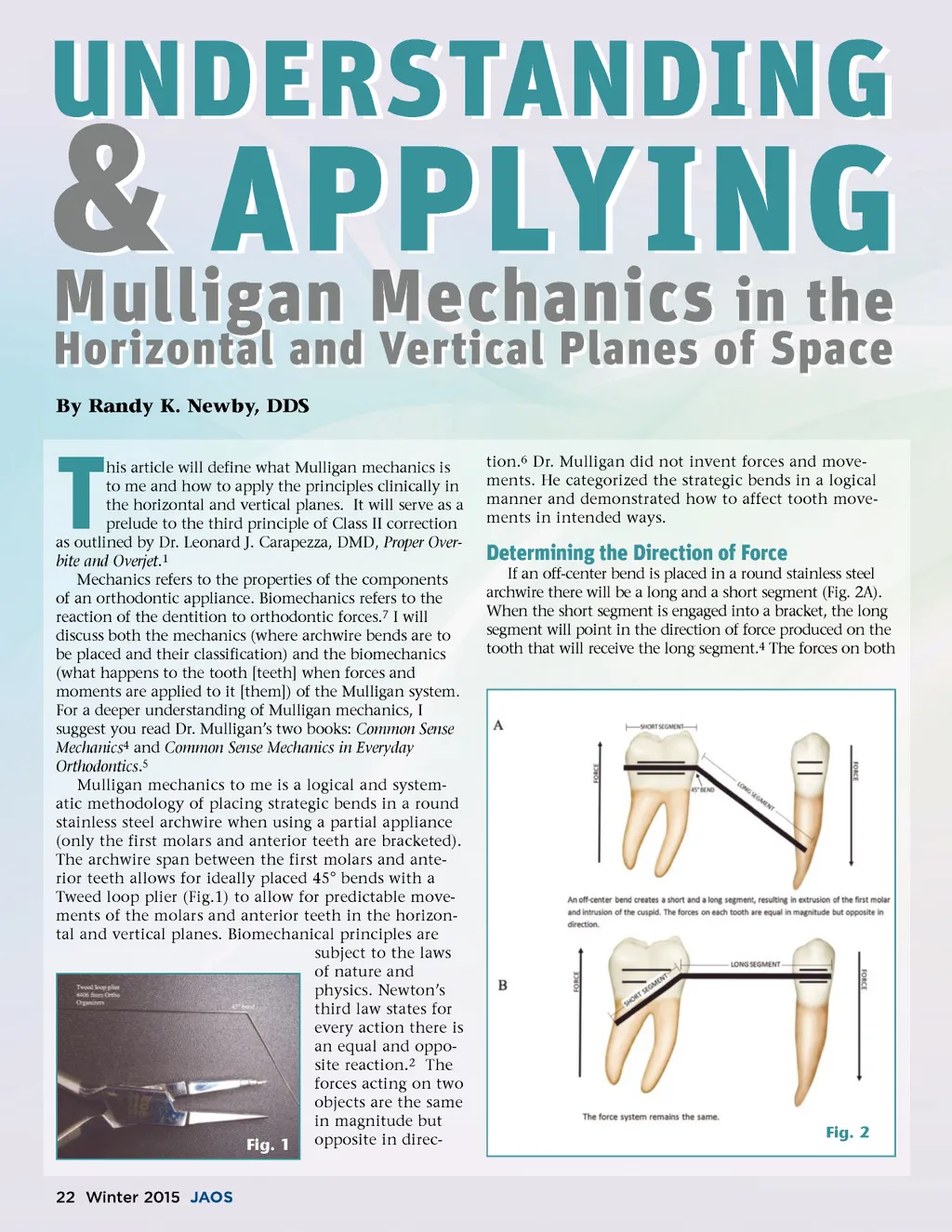
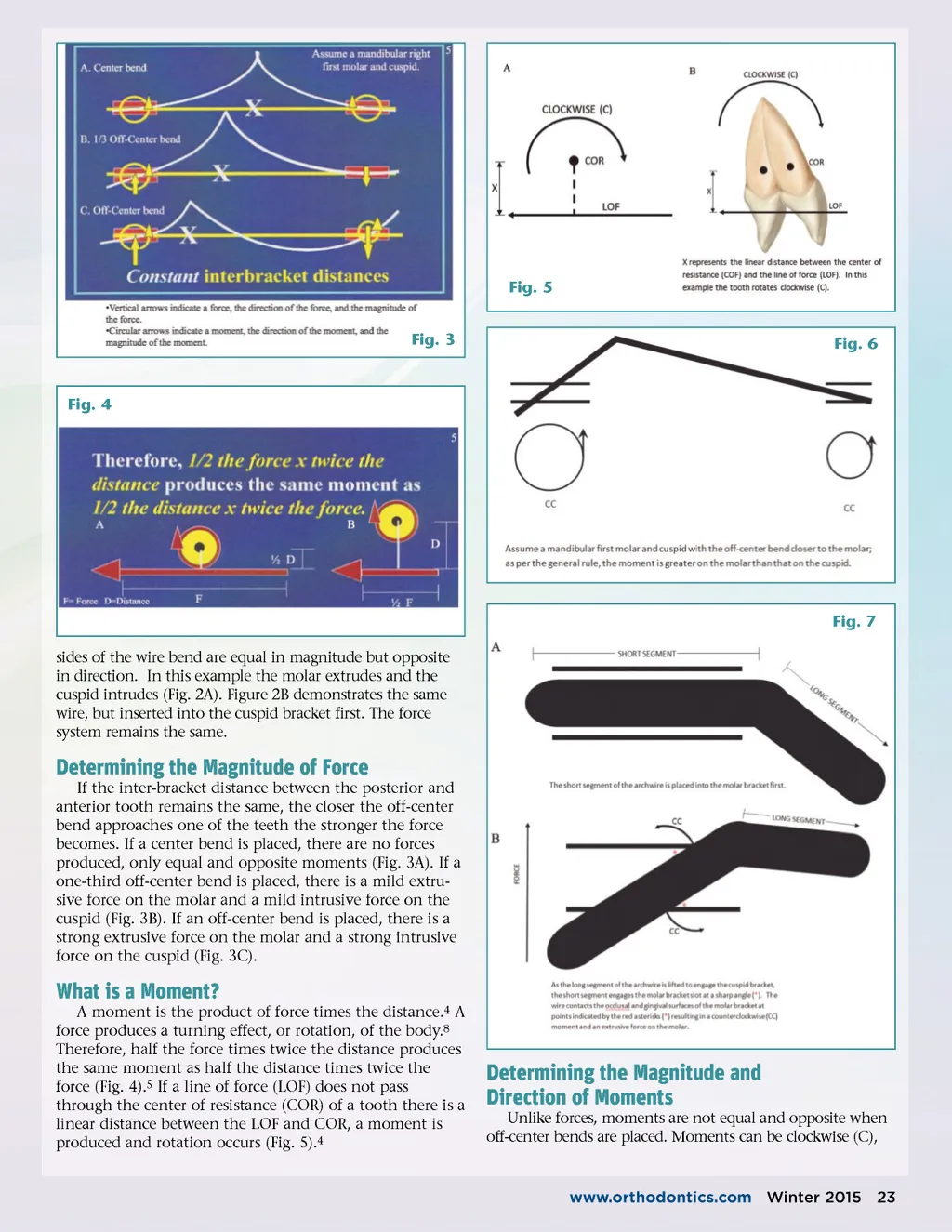
Fig. 5 Fig. 3 Fig. 6 Fig. 4 Fig. 7 sides of the wire bend are equal in magnitude but opposite in direction. In this example the molar extrudes and the cuspid intrudes (Fig. 2A). Figure 2B demonstrates the same wire, but inserted into the cuspid bracket first. The force system remains the same. Determining the Magnitude of Force If the inter-bracket distance between the posterior and anterior tooth remains the same, the closer the off-center bend approaches one of the teeth the stronger the force becomes. If a center bend is placed, there are no forces produced, only equal and opposite moments (Fig. 3A). If a one-third off-center bend is placed, there is a mild extru-sive force on the molar and a mild intrusive force on the cuspid (Fig. 3B). If an off-center bend is placed, there is a strong extrusive force on the molar and a strong intrusive force on the cuspid (Fig. 3C). What is a Moment? A moment is the product of force times the distance. 4 A force produces a turning effect, or rotation, of the body. 8 Therefore, half the force times twice the distance produces the same moment as half the distance times twice the force (Fig. 4). 5 If a line of force (LOF) does not pass through the center of resistance (COR) of a tooth there is a linear distance between the LOF and COR, a moment is produced and rotation occurs (Fig. 5). 4 Determining the Magnitude and Direction of Moments Unlike forces, moments are not equal and opposite when off-center bends are placed. Moments can be clockwise (C), www.orthodontics.com Winter 2015 23
Journal of the American Orthodontic Society Winter 2015: Page 23