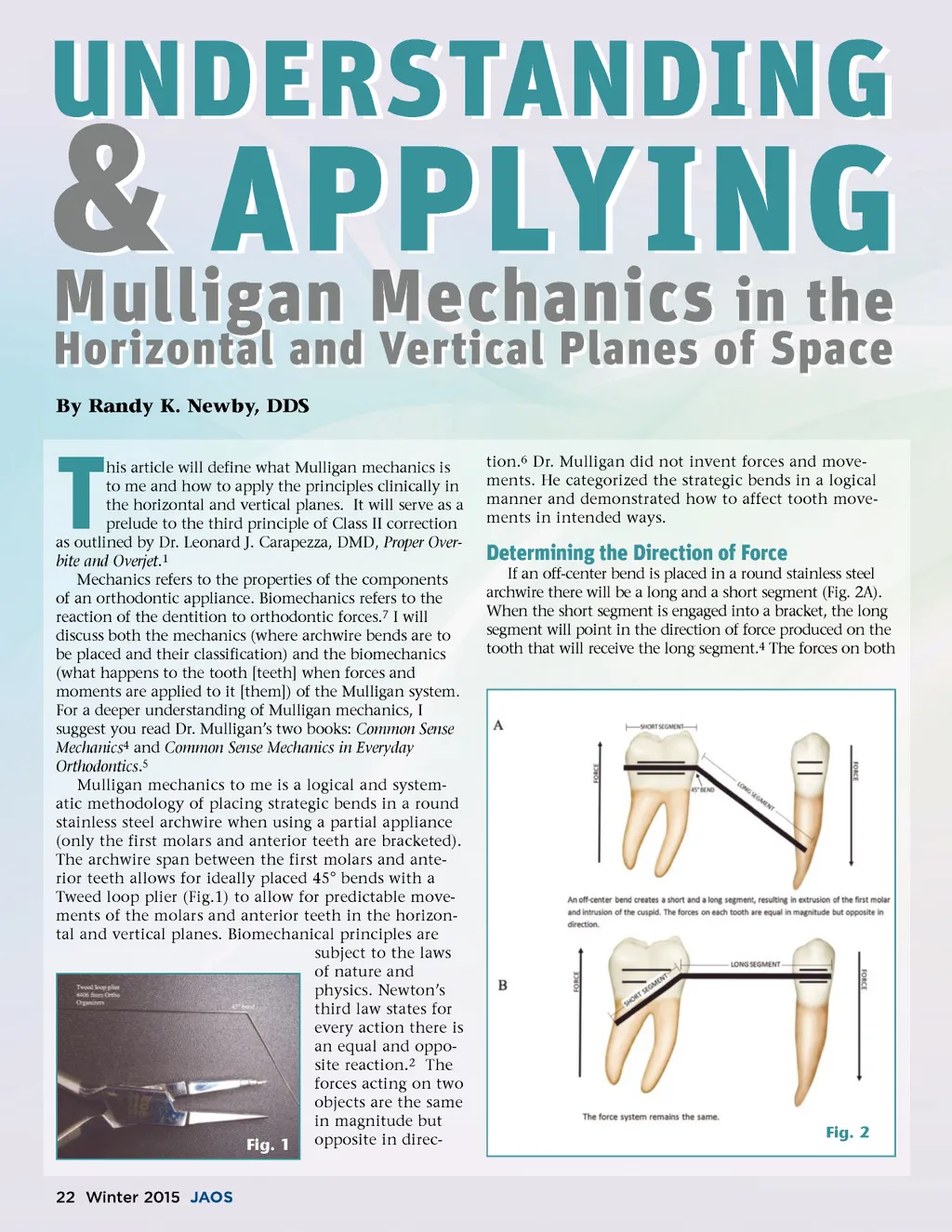
UNDERSTANDING By Randy K. Newby, DDS his article will define what Mulligan mechanics is to me and how to apply the principles clinically in the horizontal and vertical planes. It will serve as a prelude to the third principle of Class II correction as outlined by Dr. Leonard J. Carapezza, DMD, Proper Over-bite and Overjet . 1 Mechanics refers to the properties of the components of an orthodontic appliance. Biomechanics refers to the reaction of the dentition to orthodontic forces. 7 I will discuss both the mechanics (where archwire bends are to be placed and their classification) and the biomechanics (what happens to the tooth [teeth] when forces and moments are applied to it [them]) of the Mulligan system. For a deeper understanding of Mulligan mechanics, I suggest you read Dr. Mulligan’s two books: Common Sense Mechanics 4 and Common Sense Mechanics in Everyday Orthodontics . 5 Mulligan mechanics to me is a logical and system-atic methodology of placing strategic bends in a round stainless steel archwire when using a partial appliance (only the first molars and anterior teeth are bracketed). The archwire span between the first molars and ante-rior teeth allows for ideally placed 45° bends with a Tweed loop plier (Fig.1) to allow for predictable move-ments of the molars and anterior teeth in the horizon-tal and vertical planes. Biomechanical principles are subject to the laws of nature and physics. Newton’s third law states for every action there is an equal and oppo-site reaction. 2 The forces acting on two objects are the same in magnitude but opposite in direc-Fig. 1 22 Winter 2015 JAOS & APPLYING Mulligan Mechanics Horizontal and Vertical Planes of Space in the T tion. 6 Dr. Mulligan did not invent forces and move-ments. He categorized the strategic bends in a logical manner and demonstrated how to affect tooth move-ments in intended ways. Determining the Direction of Force If an off-center bend is placed in a round stainless steel archwire there will be a long and a short segment (Fig. 2A). When the short segment is engaged into a bracket, the long segment will point in the direction of force produced on the tooth that will receive the long segment. 4 The forces on both Fig. 2
Journal of the American Orthodontic Society Winter 2015: Page 22