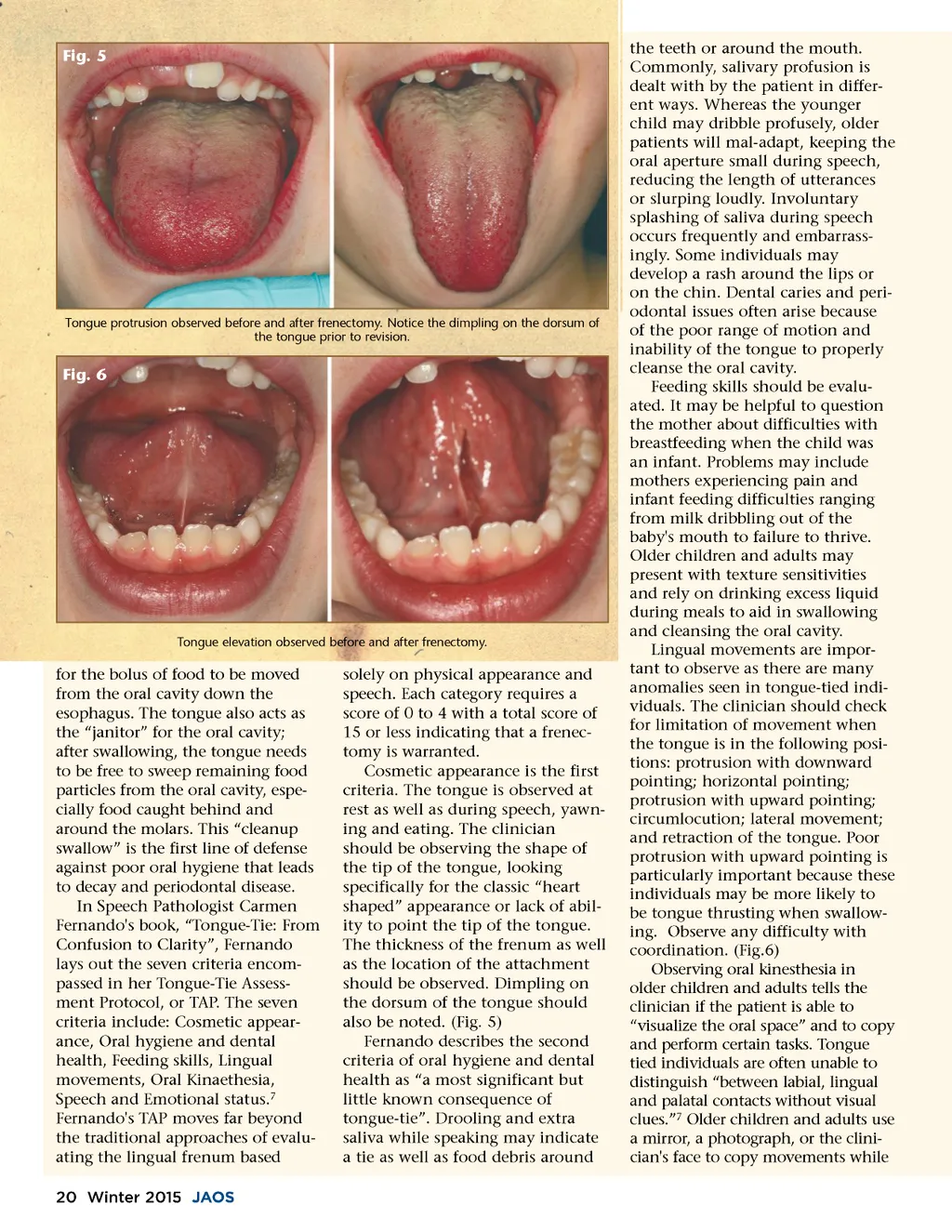
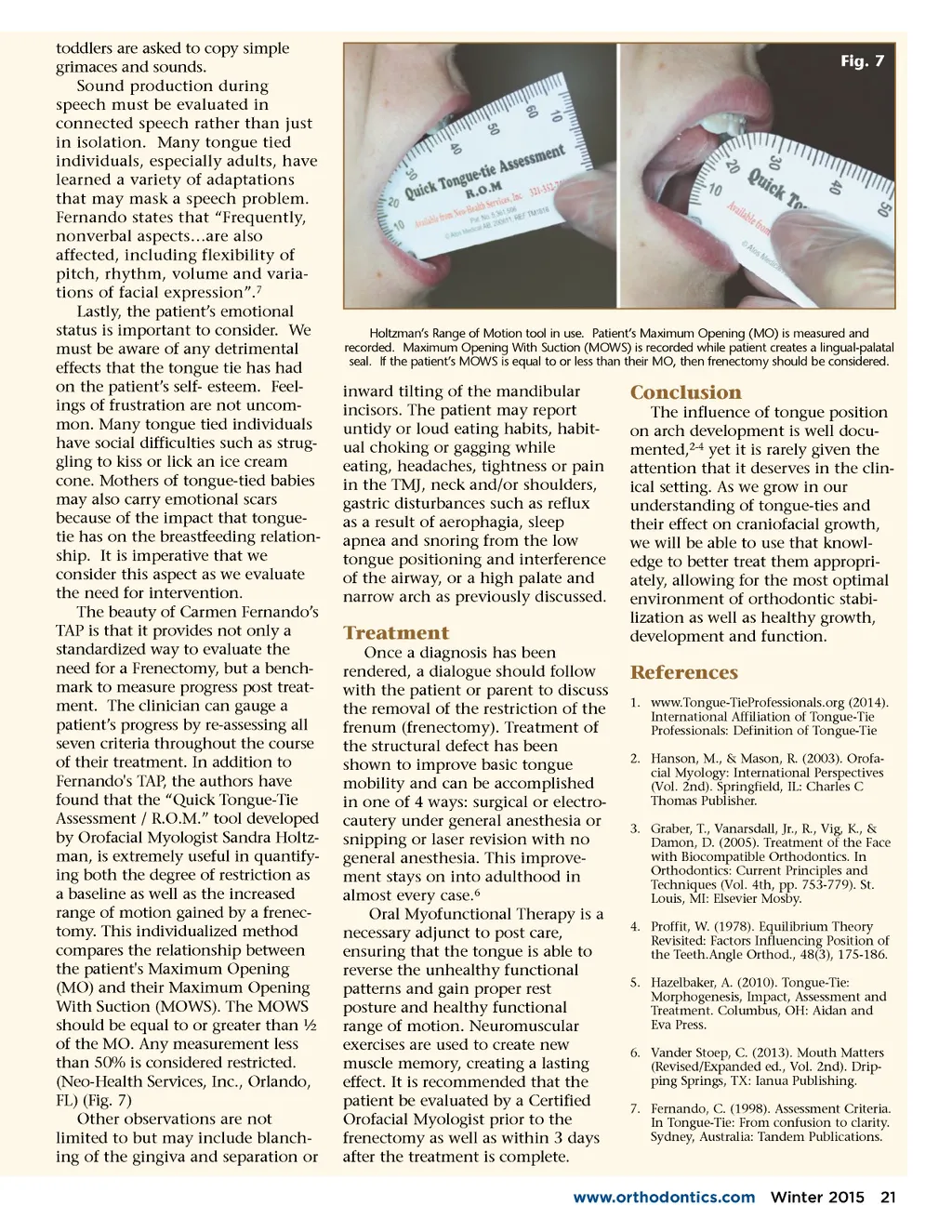
toddlers are asked to copy simple grimaces and sounds. Sound production during speech must be evaluated in connected speech rather than just in isolation. Many tongue tied individuals, especially adults, have learned a variety of adaptations that may mask a speech problem. Fernando states that “Frequently, nonverbal aspects…are also affected, including flexibility of pitch, rhythm, volume and varia-tions of facial expression”. 7 Lastly, the patient’s emotional status is important to consider. We must be aware of any detrimental effects that the tongue tie has had on the patient’s self-esteem. Feel-ings of frustration are not uncom-mon. Many tongue tied individuals have social difficulties such as strug-gling to kiss or lick an ice cream cone. Mothers of tongue-tied babies may also carry emotional scars because of the impact that tongue-tie has on the breastfeeding relation-ship. It is imperative that we consider this aspect as we evaluate the need for intervention. The beauty of Carmen Fernando’s TAP is that it provides not only a standardized way to evaluate the need for a Frenectomy, but a bench-mark to measure progress post treat-ment. The clinician can gauge a patient’s progress by re-assessing all seven criteria throughout the course of their treatment. In addition to Fernando's TAP, the authors have found that the “Quick Tongue-Tie Assessment / R.O.M.” tool developed by Orofacial Myologist Sandra Holtz-man, is extremely useful in quantify-ing both the degree of restriction as a baseline as well as the increased range of motion gained by a frenec-tomy. This individualized method compares the relationship between the patient's Maximum Opening (MO) and their Maximum Opening With Suction (MOWS). The MOWS should be equal to or greater than ½ of the MO. Any measurement less than 50% is considered restricted. (Neo-Health Services, Inc., Orlando, FL) (Fig. 7) Other observations are not limited to but may include blanch-ing of the gingiva and separation or Fig. 7 Holtzman’s Range of Motion tool in use. Patient’s Maximum Opening (MO) is measured and recorded. Maximum Opening With Suction (MOWS) is recorded while patient creates a lingual-palatal seal. If the patient’s MOWS is equal to or less than their MO, then frenectomy should be considered. inward tilting of the mandibular incisors. The patient may report untidy or loud eating habits, habit-ual choking or gagging while eating, headaches, tightness or pain in the TMJ, neck and/or shoulders, gastric disturbances such as reflux as a result of aerophagia, sleep apnea and snoring from the low tongue positioning and interference of the airway, or a high palate and narrow arch as previously discussed. Conclusion The influence of tongue position on arch development is well docu-mented, 2-4 yet it is rarely given the attention that it deserves in the clin-ical setting. As we grow in our understanding of tongue-ties and their effect on craniofacial growth, we will be able to use that knowl-edge to better treat them appropri-ately, allowing for the most optimal environment of orthodontic stabi-lization as well as healthy growth, development and function. Treatment Once a diagnosis has been rendered, a dialogue should follow with the patient or parent to discuss the removal of the restriction of the frenum (frenectomy). Treatment of the structural defect has been shown to improve basic tongue mobility and can be accomplished in one of 4 ways: surgical or electro-cautery under general anesthesia or snipping or laser revision with no general anesthesia. This improve-ment stays on into adulthood in almost every case. 6 Oral Myofunctional Therapy is a necessary adjunct to post care, ensuring that the tongue is able to reverse the unhealthy functional patterns and gain proper rest posture and healthy functional range of motion. Neuromuscular exercises are used to create new muscle memory, creating a lasting effect. It is recommended that the patient be evaluated by a Certified Orofacial Myologist prior to the frenectomy as well as within 3 days after the treatment is complete. References 1. www.Tongue-TieProfessionals.org (2014). International Affiliation of Tongue-Tie Professionals: Definition of Tongue-Tie 2. Hanson, M., & Mason, R. (2003). Orofa-cial Myology: International Perspectives (Vol. 2nd). Springfield, IL: Charles C Thomas Publisher. 3. Graber, T., Vanarsdall, Jr., R., Vig, K., & Damon, D. (2005). Treatment of the Face with Biocompatible Orthodontics. In Orthodontics: Current Principles and Techniques (Vol. 4th, pp. 753-779). St. Louis, MI: Elsevier Mosby. 4. Proffit, W. (1978). Equilibrium Theory Revisited: Factors Influencing Position of the Teeth.Angle Orthod., 48(3), 175-186. 5. Hazelbaker, A. (2010). Tongue-Tie: Morphogenesis, Impact, Assessment and Treatment. Columbus, OH: Aidan and Eva Press. 6. Vander Stoep, C. (2013). Mouth Matters (Revised/Expanded ed., Vol. 2nd). Drip-ping Springs, TX: Ianua Publishing. 7. Fernando, C. (1998). Assessment Criteria. In Tongue-Tie: From confusion to clarity. Sydney, Australia: Tandem Publications. www.orthodontics.com Winter 2015 21
Journal of the American Orthodontic Society Winter 2015: Page 21