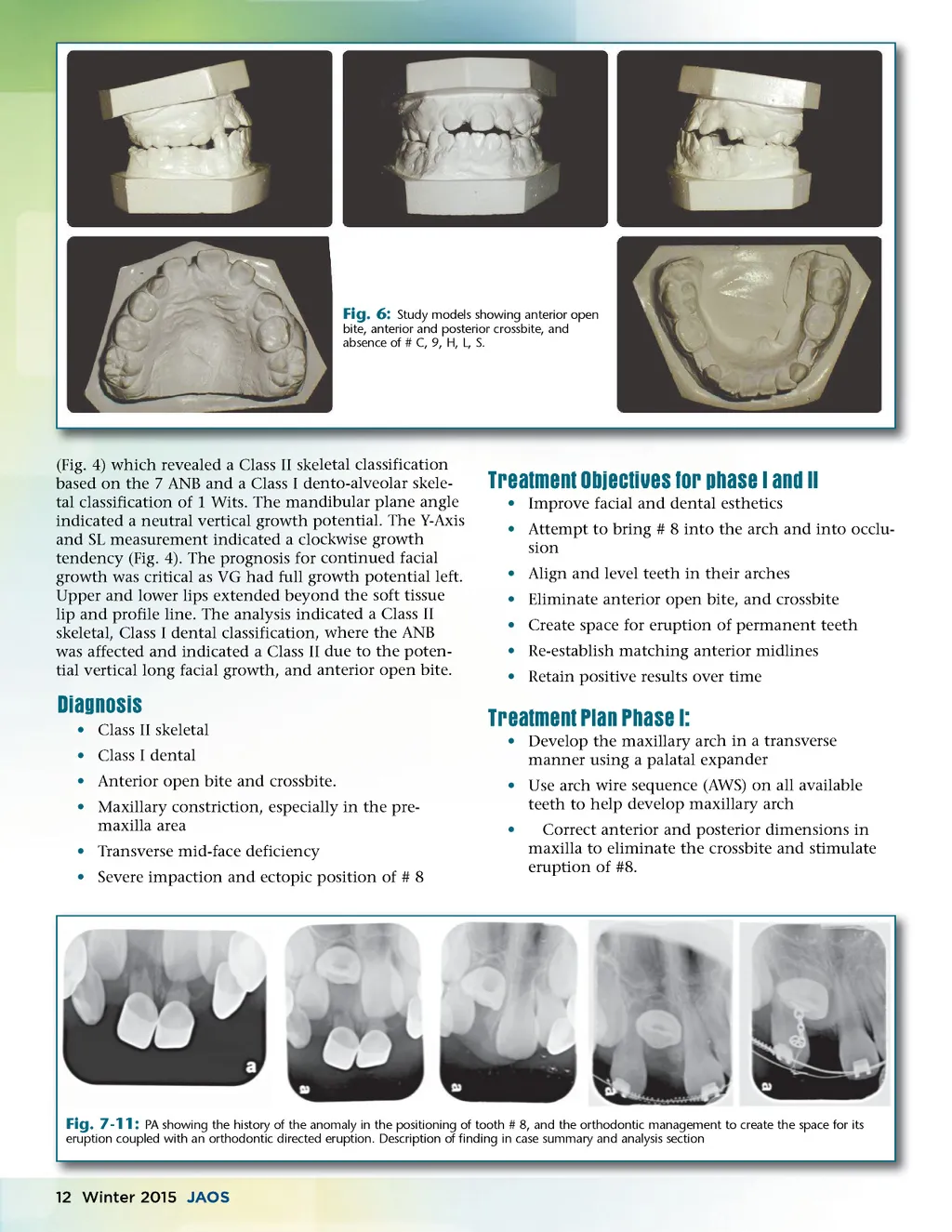
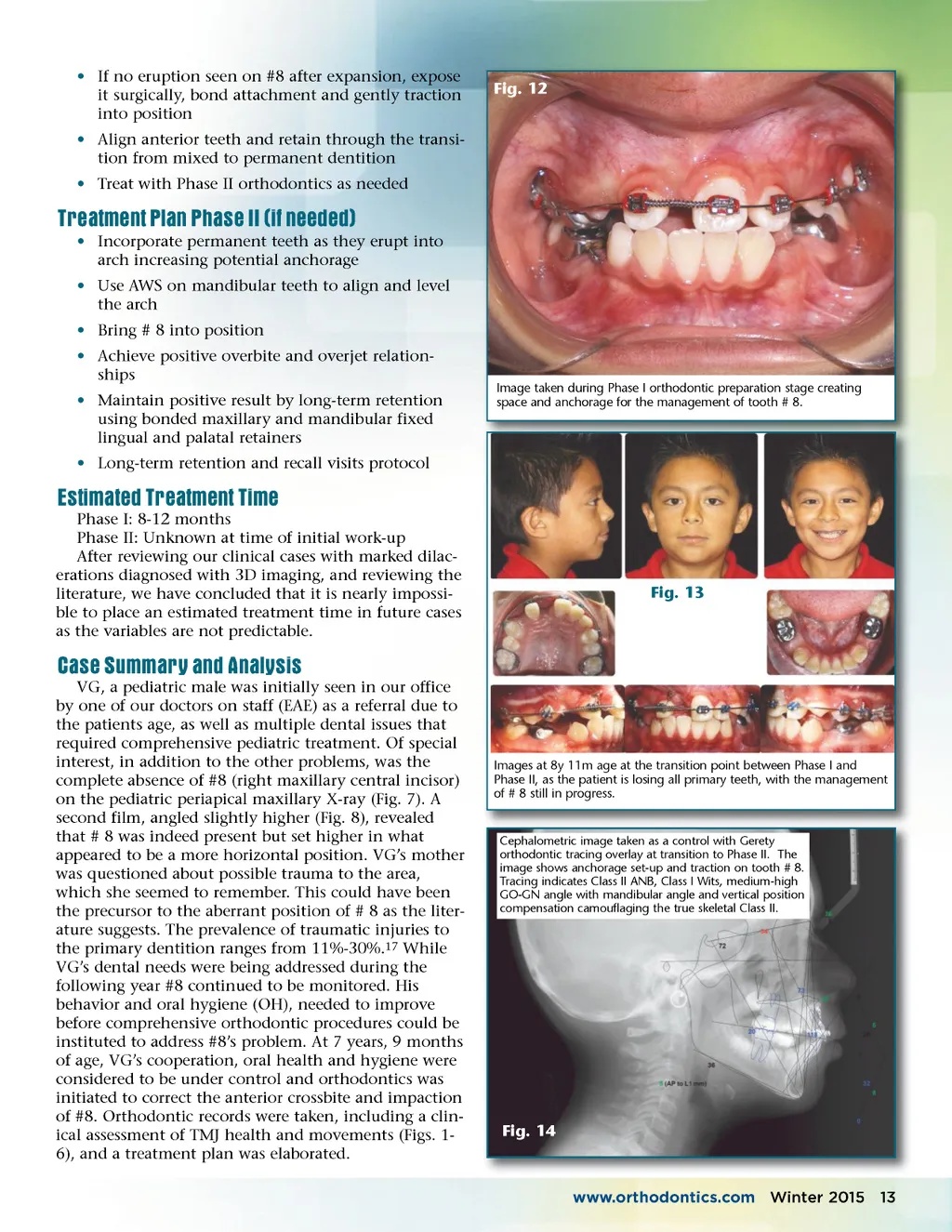
Fig. 6: Study models showing anterior open bite, anterior and posterior crossbite, and absence of # C, 9, H, L, S. (Fig. 4) which revealed a Class II skeletal classification based on the 7 ANB and a Class I dento-alveolar skele-tal classification of 1 Wits. The mandibular plane angle indicated a neutral vertical growth potential. The Y-Axis and SL measurement indicated a clockwise growth tendency (Fig. 4). The prognosis for continued facial growth was critical as VG had full growth potential left. Upper and lower lips extended beyond the soft tissue lip and profile line. The analysis indicated a Class II skeletal, Class I dental classification, where the ANB was affected and indicated a Class II due to the poten-tial vertical long facial growth, and anterior open bite. Treatment Objectives for phase I and II • Improve facial and dental esthetics • Attempt to bring # 8 into the arch and into occlu-sion • Align and level teeth in their arches • Eliminate anterior open bite, and crossbite • Create space for eruption of permanent teeth • Re-establish matching anterior midlines • Retain positive results over time Diagnosis • Class II skeletal • Class I dental • Anterior open bite and crossbite. • Maxillary constriction, especially in the pre-maxilla area • Transverse mid-face deficiency • Severe impaction and ectopic position of # 8 Treatment Plan Phase I: • Develop the maxillary arch in a transverse manner using a palatal expander • Use arch wire sequence (AWS) on all available teeth to help develop maxillary arch • Correct anterior and posterior dimensions in maxilla to eliminate the crossbite and stimulate eruption of #8. Fig. 7-11: PA showing the history of the anomaly in the positioning of tooth # 8, and the orthodontic management to create the space for its eruption coupled with an orthodontic directed eruption. Description of finding in case summary and analysis section 12 Winter 2015 JAOS
Journal of the American Orthodontic Society Winter 2015: Page 12