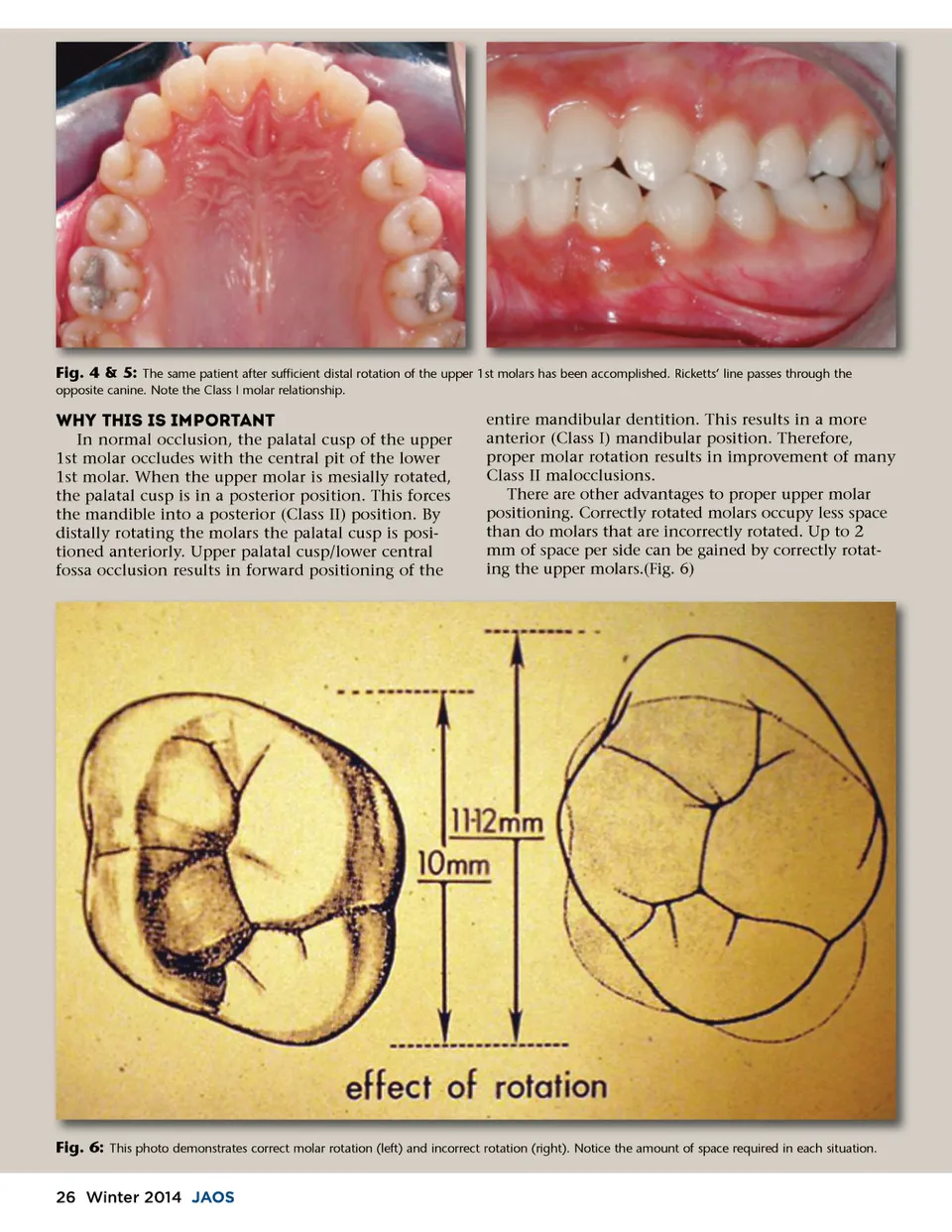
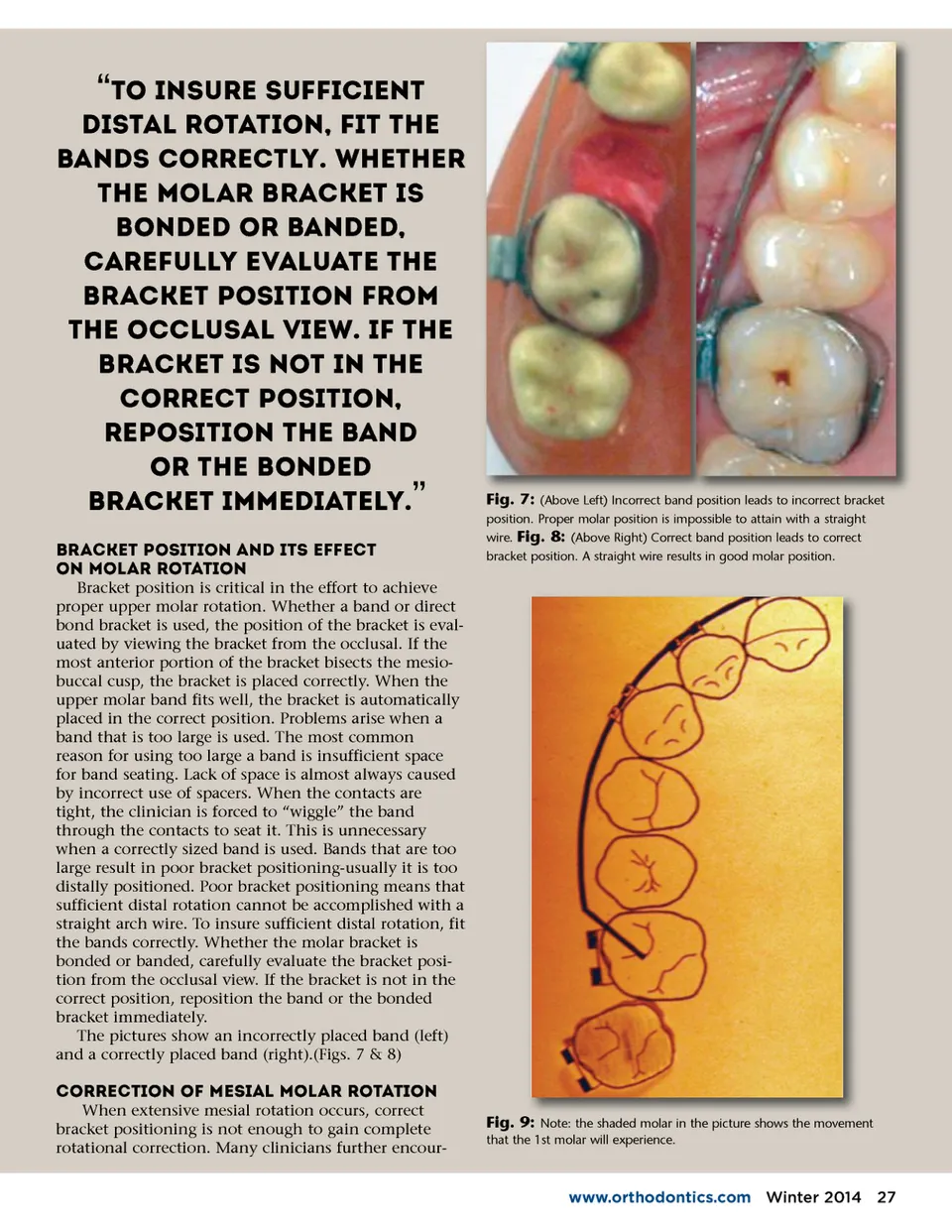
“ To insure sufficient distal rotation, fit the bands correctly. Whether the molar bracket is bonded or banded, carefully evaluate the bracket position from the occlusal view. If the bracket is not in the correct position, reposition the band or the bonded bracket immediately. ” Bracket position and its effect on molar rotation Bracket position is critical in the effort to achieve proper upper molar rotation. Whether a band or direct bond bracket is used, the position of the bracket is eval-uated by viewing the bracket from the occlusal. If the most anterior portion of the bracket bisects the mesio-buccal cusp, the bracket is placed correctly. When the upper molar band fits well, the bracket is automatically placed in the correct position. Problems arise when a band that is too large is used. The most common reason for using too large a band is insufficient space for band seating. Lack of space is almost always caused by incorrect use of spacers. When the contacts are tight, the clinician is forced to “wiggle” the band through the contacts to seat it. This is unnecessary when a correctly sized band is used. Bands that are too large result in poor bracket positioning-usually it is too distally positioned. Poor bracket positioning means that sufficient distal rotation cannot be accomplished with a straight arch wire. To insure sufficient distal rotation, fit the bands correctly. Whether the molar bracket is bonded or banded, carefully evaluate the bracket posi-tion from the occlusal view. If the bracket is not in the correct position, reposition the band or the bonded bracket immediately. The pictures show an incorrectly placed band (left) and a correctly placed band (right).(Figs. 7 & 8) Fig. 7: (Above Left) Incorrect band position leads to incorrect bracket position. Proper molar position is impossible to attain with a straight wire. Fig. 8: (Above Right) Correct band position leads to correct bracket position. A straight wire results in good molar position. Correction of mesial molar rotation When extensive mesial rotation occurs, correct bracket positioning is not enough to gain complete rotational correction. Many clinicians further encour-Fig. 9: Note: the shaded molar in the picture shows the movement that the 1st molar will experience. www.orthodontics.com Winter 2014 27
Journal of the American Orthodontic Society Winter 2014: Page 27