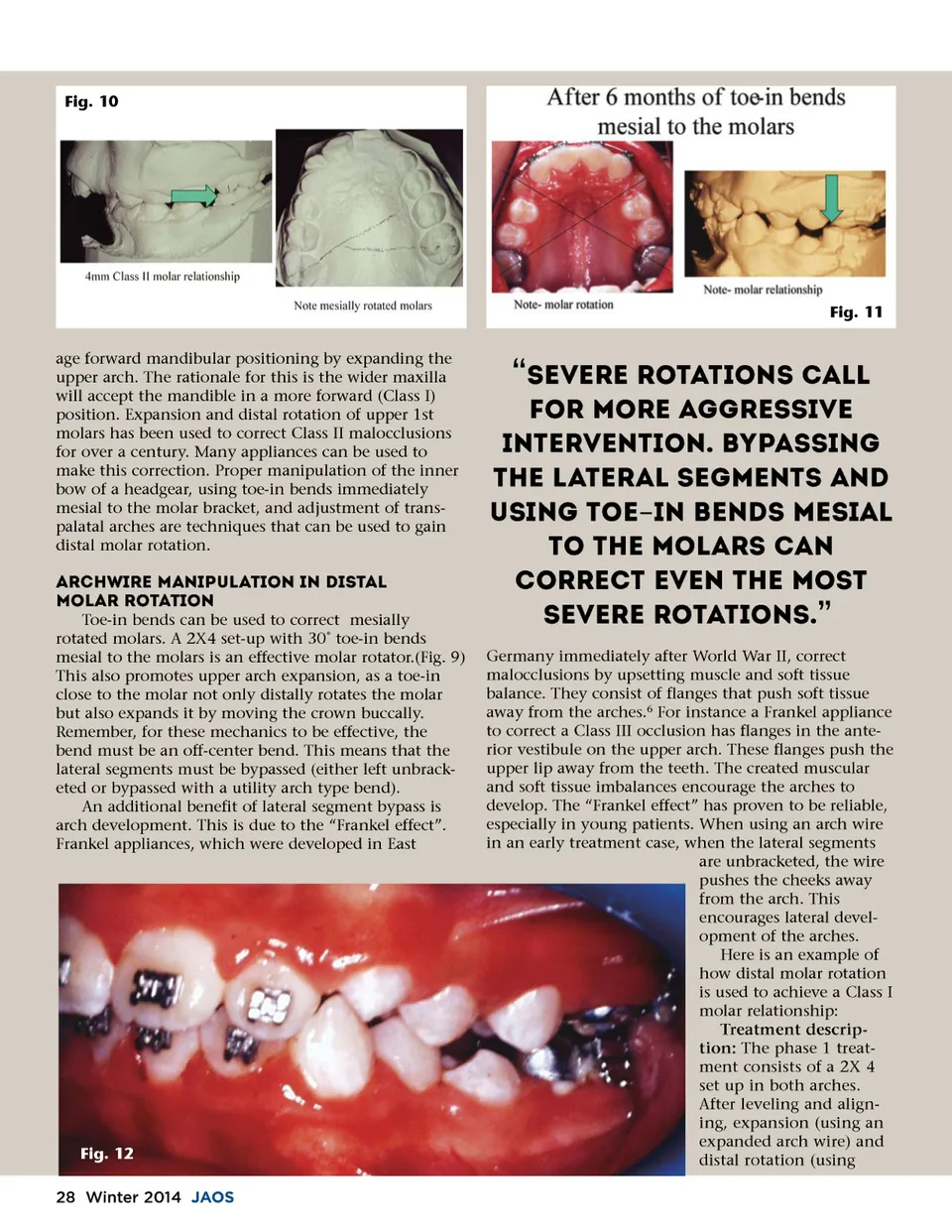
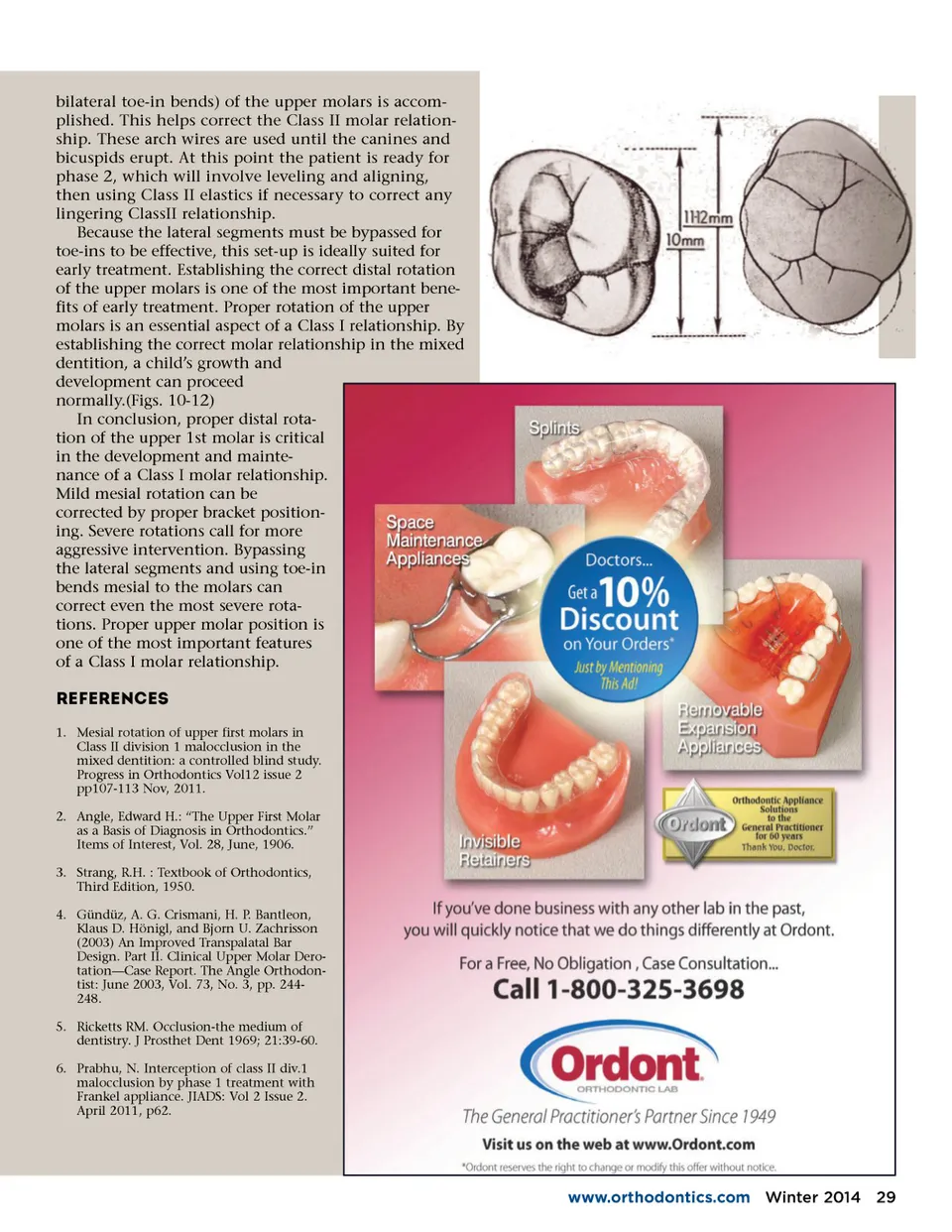
Fig. 10 Fig. 11 age forward mandibular positioning by expanding the upper arch. The rationale for this is the wider maxilla will accept the mandible in a more forward (Class I) position. Expansion and distal rotation of upper 1st molars has been used to correct Class II malocclusions for over a century. Many appliances can be used to make this correction. Proper manipulation of the inner bow of a headgear, using toe-in bends immediately mesial to the molar bracket, and adjustment of trans-palatal arches are techniques that can be used to gain distal molar rotation. “ Severe rotations call for more aggressive intervention. Bypassing the lateral segments and using toe -in bends mesial to the molars can correct even the most severe rotations. ” Germany immediately after World War II, correct malocclusions by upsetting muscle and soft tissue balance. They consist of flanges that push soft tissue away from the arches. 6 For instance a Frankel appliance to correct a Class III occlusion has flanges in the ante-rior vestibule on the upper arch. These flanges push the upper lip away from the teeth. The created muscular and soft tissue imbalances encourage the arches to develop. The “Frankel effect” has proven to be reliable, especially in young patients. When using an arch wire in an early treatment case, when the lateral segments are unbracketed, the wire pushes the cheeks away from the arch. This encourages lateral devel-opment of the arches. Here is an example of how distal molar rotation is used to achieve a Class I molar relationship: Treatment descrip-tion: The phase 1 treat-ment consists of a 2X 4 set up in both arches. After leveling and align-ing, expansion (using an expanded arch wire) and distal rotation (using Archwire manipulation in distal molar rotation Toe-in bends can be used to correct mesially rotated molars. A 2X4 set-up with 30˚ toe-in bends mesial to the molars is an effective molar rotator.(Fig. 9) This also promotes upper arch expansion, as a toe-in close to the molar not only distally rotates the molar but also expands it by moving the crown buccally. Remember, for these mechanics to be effective, the bend must be an off-center bend. This means that the lateral segments must be bypassed (either left unbrack-eted or bypassed with a utility arch type bend). An additional benefit of lateral segment bypass is arch development. This is due to the “Frankel effect”. Frankel appliances, which were developed in East Fig. 12 28 Winter 2014 JAOS
Journal of the American Orthodontic Society Winter 2014: Page 28