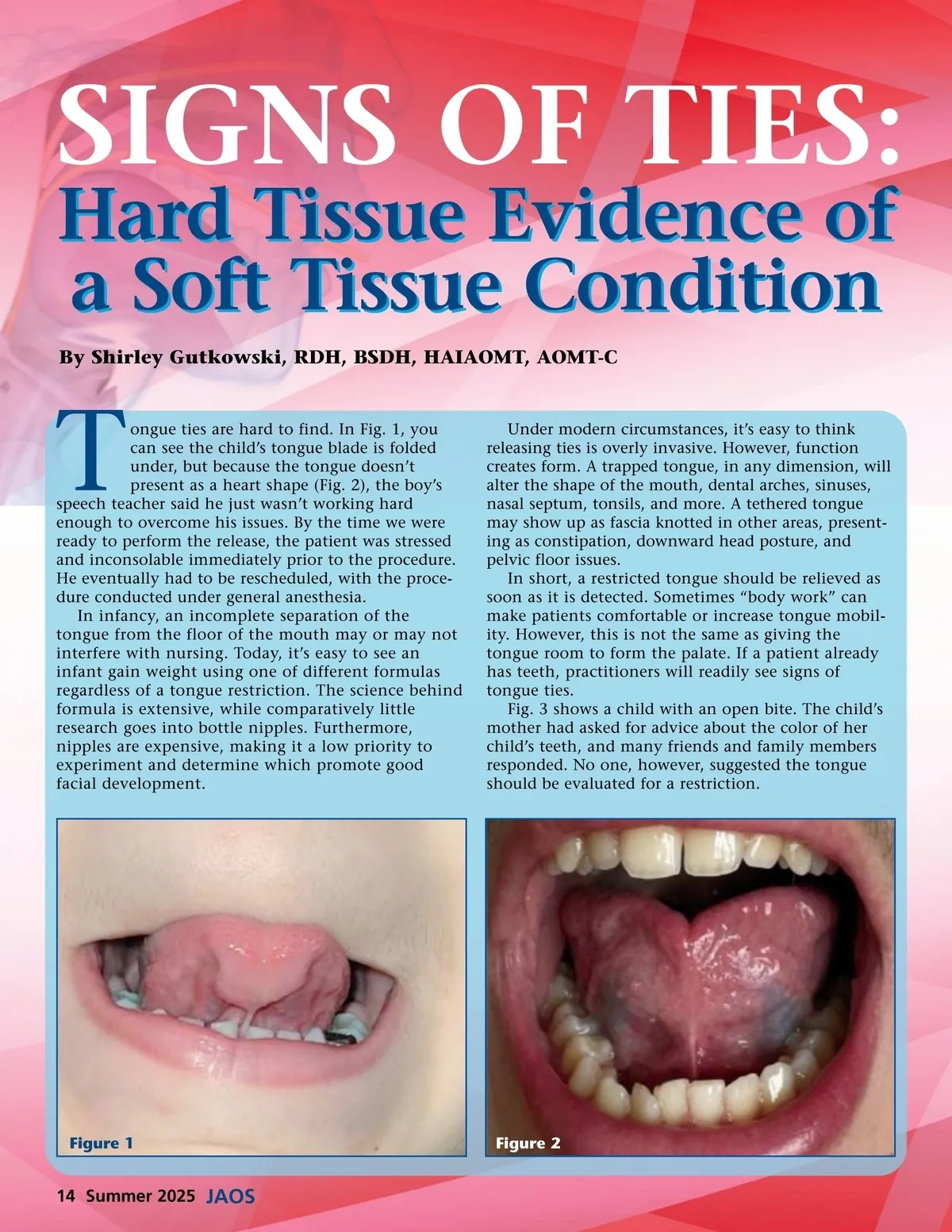
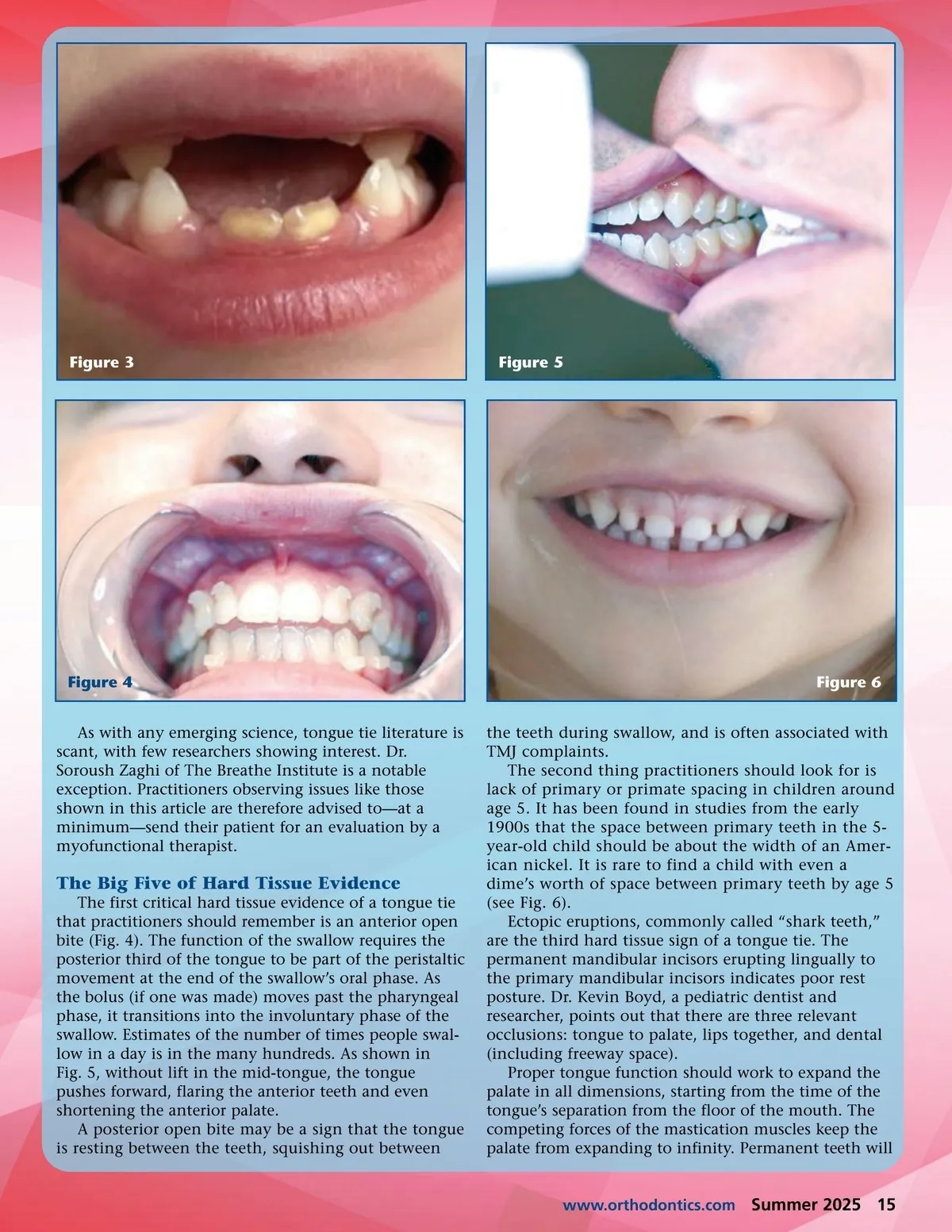
Figure 3 Figure 5 Figure 4 As with any emerging science, tongue tie literature is scant, with few researchers showing interest. Dr. Soroush Zaghi of The Breathe Institute is a notable exception. Practitioners observing issues like those shown in this article are therefore advised to—at a minimum—send their patient for an evaluation by a myofunctional therapist. Figure 6 the teeth during swallow, and is often associated with TMJ complaints. The second thing practitioners should look for is lack of primary or primate spacing in children around age 5. It has been found in studies from the early 1900s that the space between primary teeth in the 5-year-old child should be about the width of an Amer-ican nickel. It is rare to find a child with even a dime’s worth of space between primary teeth by age 5 (see Fig. 6). Ectopic eruptions, commonly called “shark teeth,” are the third hard tissue sign of a tongue tie. The permanent mandibular incisors erupting lingually to the primary mandibular incisors indicates poor rest posture. Dr. Kevin Boyd, a pediatric dentist and researcher, points out that there are three relevant occlusions: tongue to palate, lips together, and dental (including freeway space). Proper tongue function should work to expand the palate in all dimensions, starting from the time of the tongue’s separation from the floor of the mouth. The competing forces of the mastication muscles keep the palate from expanding to infinity. Permanent teeth will The Big Five of Hard Tissue Evidence The first critical hard tissue evidence of a tongue tie that practitioners should remember is an anterior open bite (Fig. 4). The function of the swallow requires the posterior third of the tongue to be part of the peristaltic movement at the end of the swallow’s oral phase. As the bolus (if one was made) moves past the pharyngeal phase, it transitions into the involuntary phase of the swallow. Estimates of the number of times people swal-low in a day is in the many hundreds. As shown in Fig. 5, without lift in the mid-tongue, the tongue pushes forward, flaring the anterior teeth and even shortening the anterior palate. A posterior open bite may be a sign that the tongue is resting between the teeth, squishing out between www.orthodontics.com Summer 2025 15
Journal of the American Orthodontic Society Summer 2025: Page 15