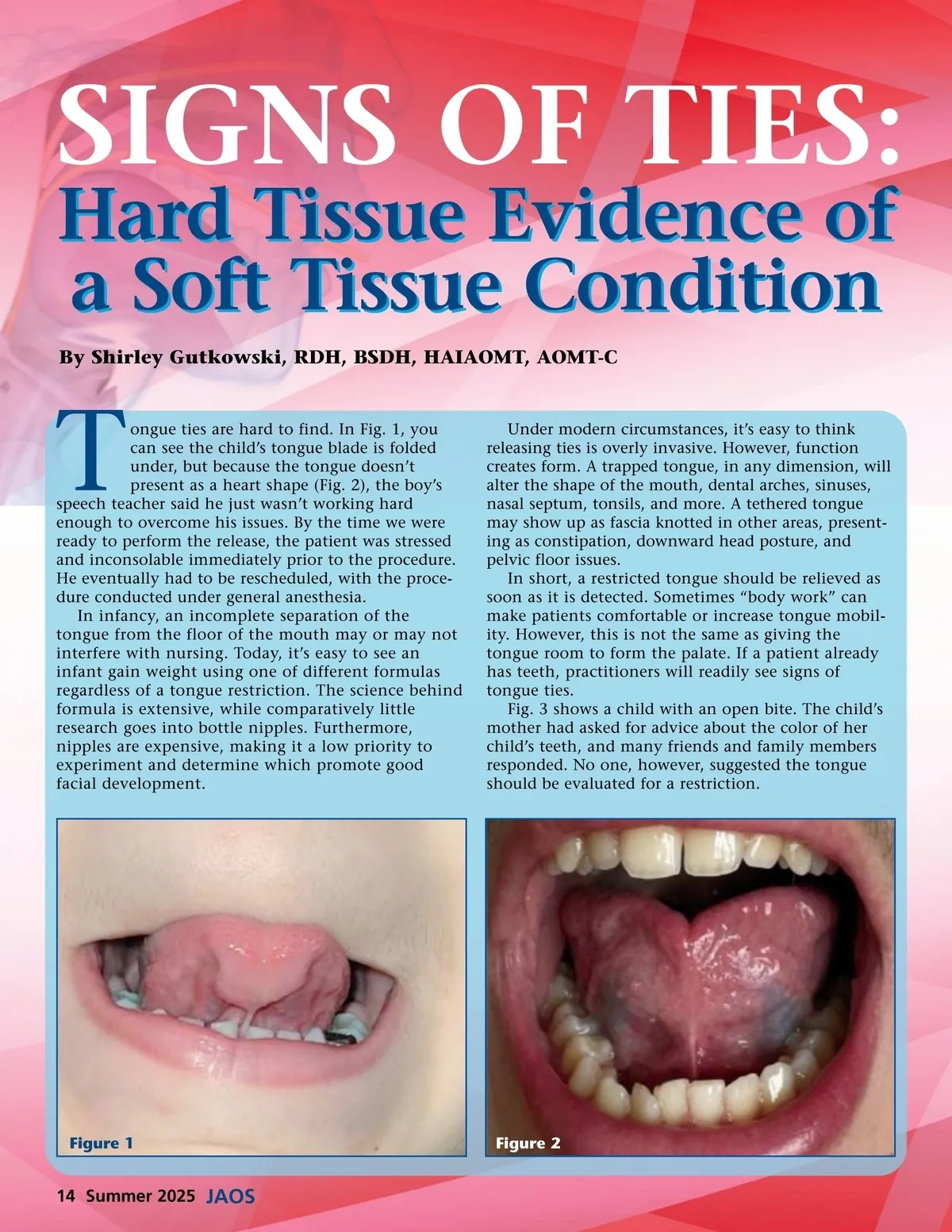
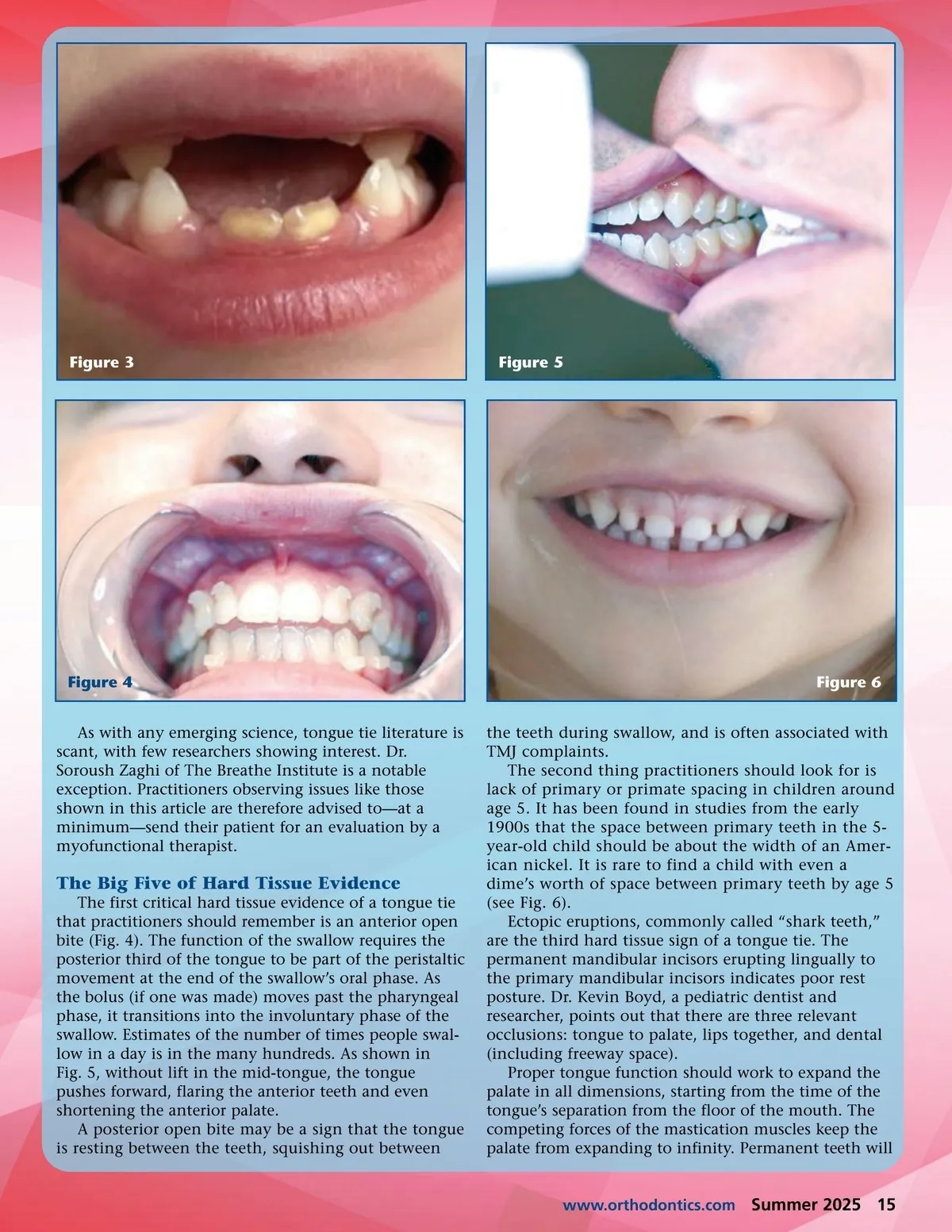
SIGNS OF TIES: Hard Tissue Evidence of a Soft Tissue Condition By Shirley Gutkowski, RDH, BSDH, HAIAOMT, AOMT-C Under modern circumstances, it’s easy to think releasing ties is overly invasive. However, function creates form. A trapped tongue, in any dimension, will alter the shape of the mouth, dental arches, sinuses, nasal septum, tonsils, and more. A tethered tongue may show up as fascia knotted in other areas, present-ing as constipation, downward head posture, and pelvic floor issues. In short, a restricted tongue should be relieved as soon as it is detected. Sometimes “body work” can make patients comfortable or increase tongue mobil-ity. However, this is not the same as giving the tongue room to form the palate. If a patient already has teeth, practitioners will readily see signs of tongue ties. Fig. 3 shows a child with an open bite. The child’s mother had asked for advice about the color of her child’s teeth, and many friends and family members responded. No one, however, suggested the tongue should be evaluated for a restriction. T ongue ties are hard to find. In Fig. 1, you can see the child’s tongue blade is folded under, but because the tongue doesn’t present as a heart shape (Fig. 2), the boy’s speech teacher said he just wasn’t working hard enough to overcome his issues. By the time we were ready to perform the release, the patient was stressed and inconsolable immediately prior to the procedure. He eventually had to be rescheduled, with the proce-dure conducted under general anesthesia. In infancy, an incomplete separation of the tongue from the floor of the mouth may or may not interfere with nursing. Today, it’s easy to see an infant gain weight using one of different formulas regardless of a tongue restriction. The science behind formula is extensive, while comparatively little research goes into bottle nipples. Furthermore, nipples are expensive, making it a low priority to experiment and determine which promote good facial development. Figure 1 Figure 2 14 Summer 2025 JAOS
Journal of the American Orthodontic Society Summer 2025: Page 14