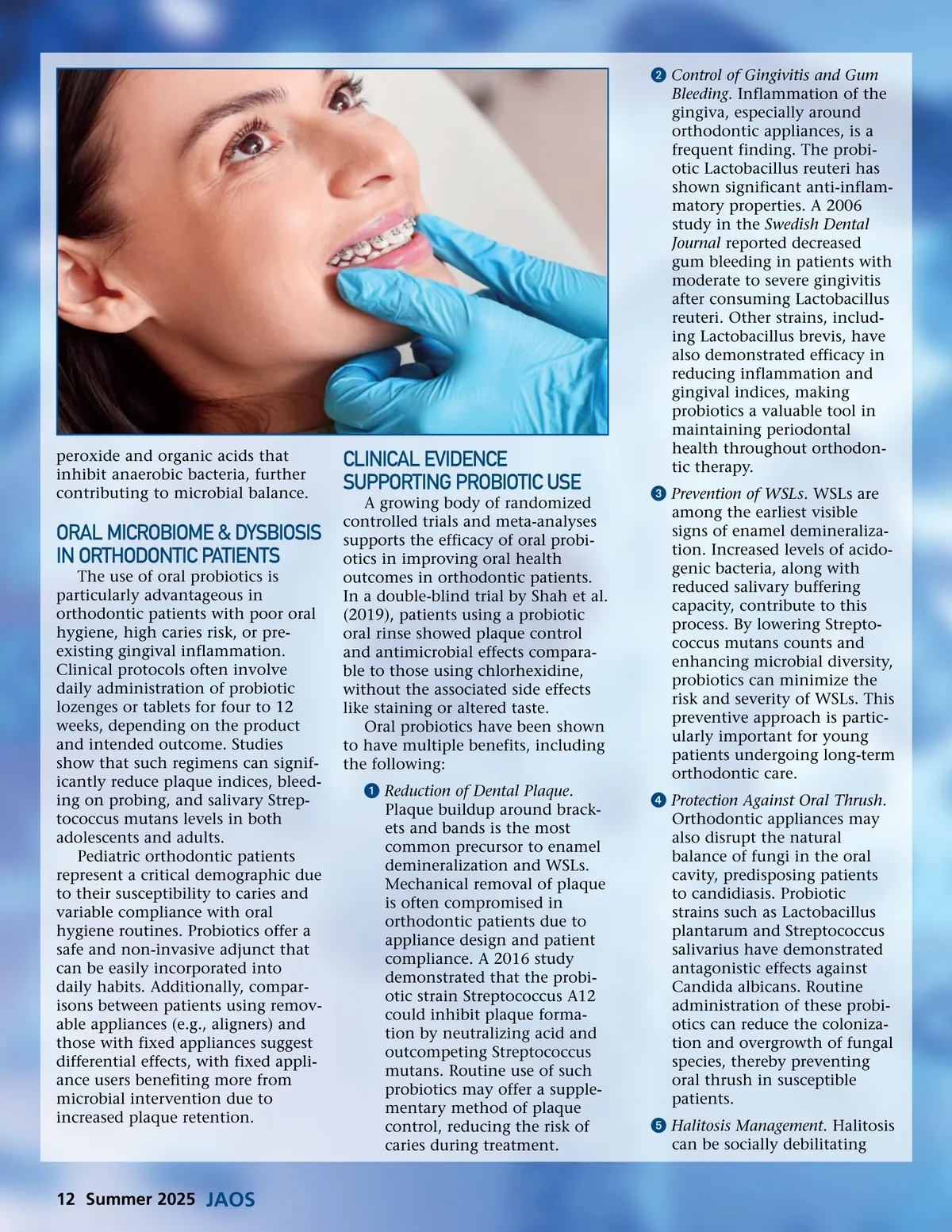
and is often caused by volatile sulfur compounds produced by anaerobic bacteria. Unlike antiseptic mouthwashes, which may indiscriminately kill both beneficial and harm-ful bacteria, probiotics selec-tively inhibit odor-causing pathogens. A 2006 study involving Lactobacillus sali-varius supplementation reported a marked reduction in sulfur compound levels and overall improvement in breath freshness. ᕦ Systemic Health Implications . The oral microbiome is increasingly recognized as a contributor to systemic health. Dysbiosis has been linked to conditions like cardiovascular disease, diabetes, and certain cancers. Maintaining microbial balance through probiotics not only benefits oral health but may also have far-reaching effects on overall health. Probiotic use in orthodontic care aligns with a holistic view of health, promoting wellness beyond the oral cavity. product formulation, and patient compliance. Products such as ProBiora Health's oral probiotic mints have been developed for ease of use and daily administration. These formulations often include patented blends that not only reduce cariogenic bacteria but also produce hydrogen peroxide—a natural byproduct that contributes to tooth whitening. Patient educa-tion regarding proper use and expected outcomes is essential to achieving optimal results. The inclusion of oral probiotics in orthodontic care represents a promising adjunct to traditional preventive strategies. With the abil-ity to reduce plaque, control gingivi-tis, prevent WSLs, combat candidia-sis, and manage halitosis, probiotics offer a multifaceted approach to improving oral health. As the scien-tific literature continues to validate their efficacy, probiotics are increas-ingly being adopted by orthodon-tists and general practitioners. More-over, by reducing reliance on antibi-otics and antiseptics, probiotics support microbial stewardship and long-term patient health. K12 on oral malodor parameters.” J Appl Microbiol , 2006, 100: 754–764. Huang, X., S.R. Palmer, S. Ahn, V.P. Richards, M.L. Williams, M.M. Nasei-mento, and R.A. Burne. “A Highly Arginolytic Streptococcus Species That Potently Antagonizes Strepto-coccus Mutans.” Appl Environ Micro-biol , 2016, 82(7): 2187–2191. Kang, M.S., J. Chung, S.M. Kim, K.H. Yang, and J.S. Oh. “Effect of Weis-sella cibaria isolates on the forma-tion of Streptococcus mutans biofilm.” Caries Res , 2006, 40(5): 418–425. Krasse, P., B. Carlsson, C. Dahl, A. Paulsson, A. Nilsson, and G. Sinkiewicz. “Decreased gum bleeding and reduced gingivitis by the probi-otic Lactobacillus reuteri.” Swed Dent J , 2006, 30(2): 55–60. Ogaard, B. “White spot lesions during orthodontic treatment.” Semin Orthod , 2008, 14(3): 209–219. Prakash, S. “Suppression of Strepto-coccus mutans and Candida albicans by probiotics: an in vitro study.” Dentistry , 2012, 2(6): 141–148. Shah, S.S., S. Nambiar, D.A. Desari, S. Mahajan, and K.K. Dhawan KK. “Comparative Evaluation of Plaque Inhibitory and Antimicrobial Effi-cacy of Probiotic and Chlorhexidine Oral Rinses in Orthodontic Patients: A Randomized Clinical Trial.” Int J Dent , 2019: Article ID 1964158. Zhang, Q., S. Qin, Y. Huang, X. Xu, J. Zhano, H. Zhang, and W. Chen. “Inhibitory and preventative effects of Lactobacillus plantarum FB–T9 on dental caries in rats.” J Oral Microbiol , 2020, 12(1): 1703883. PRACTICAL CONSIDERATIONS FOR CLINICAL USE The incorporation of probiotics into routine orthodontic care must be guided by clinical evidence, REFERENCES Burton, J.P., C.N. Chilcott, C.J. Moore, G. Speiser, and J.R. Tagg. “A preliminary study of the effect of probiotic Streptococcus salivarius www.orthodontics.com Summer 2025 13
Journal of the American Orthodontic Society Summer 2025: Page 13