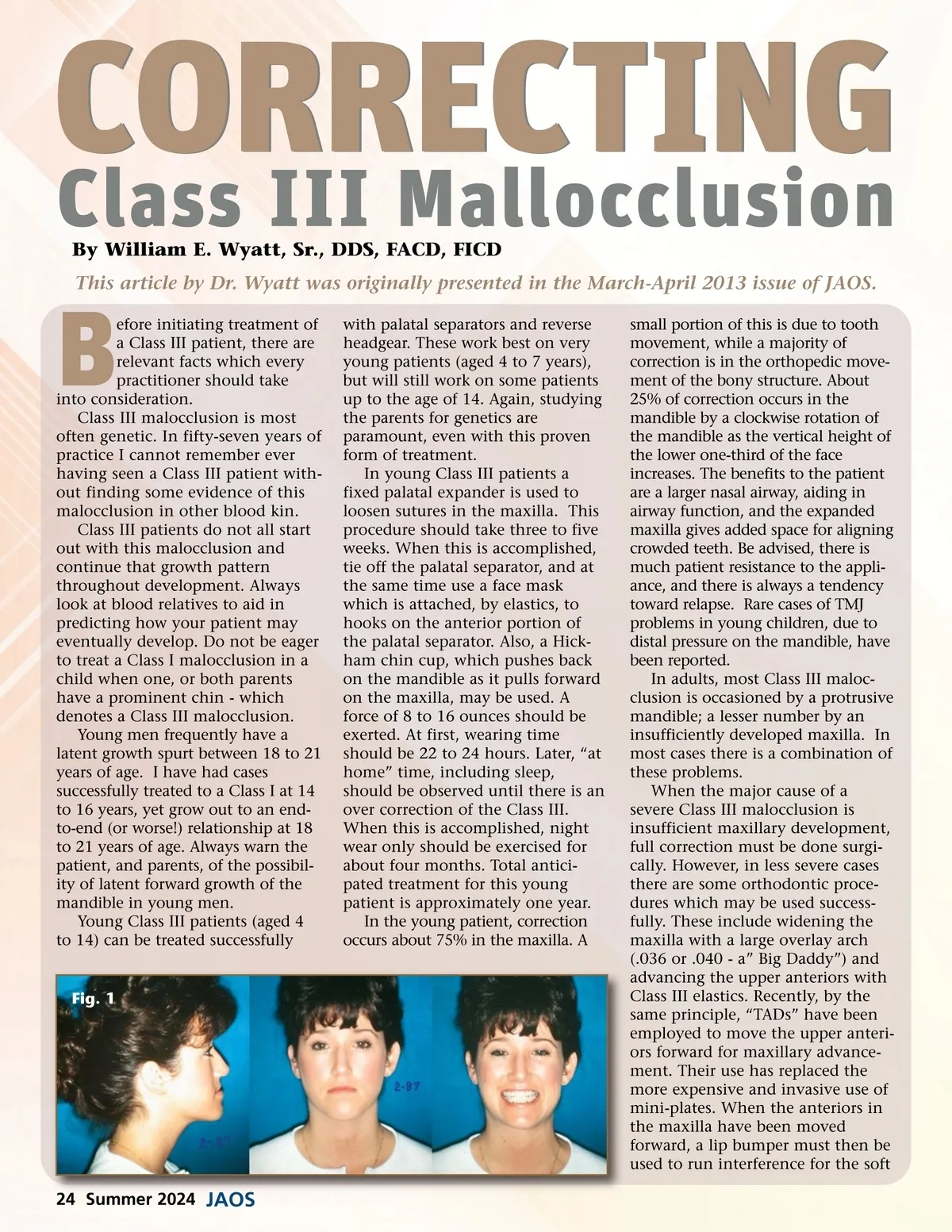
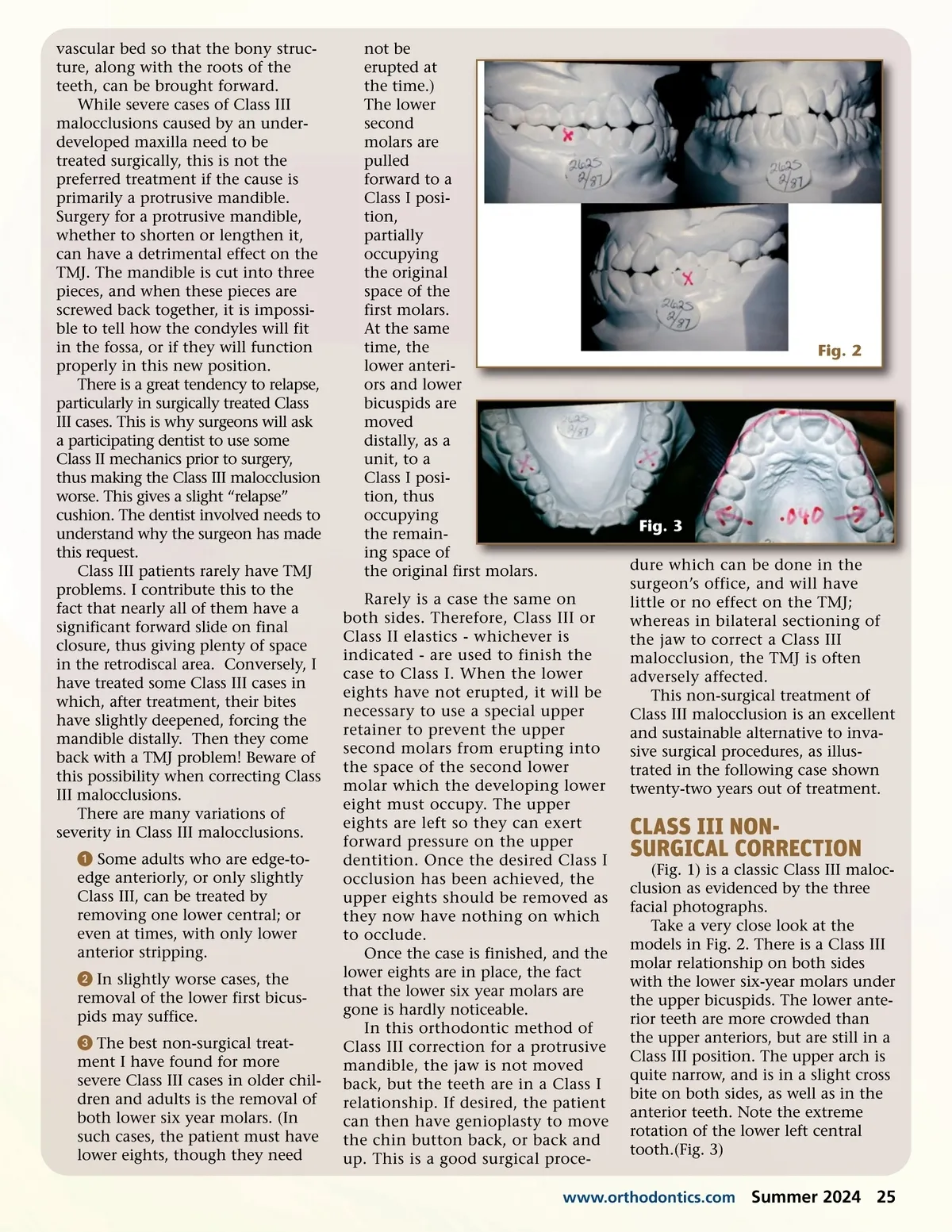
vascular bed so that the bony struc-ture, along with the roots of the teeth, can be brought forward. While severe cases of Class III malocclusions caused by an under-developed maxilla need to be treated surgically, this is not the preferred treatment if the cause is primarily a protrusive mandible. Surgery for a protrusive mandible, whether to shorten or lengthen it, can have a detrimental effect on the TMJ. The mandible is cut into three pieces, and when these pieces are screwed back together, it is impossi-ble to tell how the condyles will fit in the fossa, or if they will function properly in this new position. There is a great tendency to relapse, particularly in surgically treated Class III cases. This is why surgeons will ask a participating dentist to use some Class II mechanics prior to surgery, thus making the Class III malocclusion worse. This gives a slight “relapse” cushion. The dentist involved needs to understand why the surgeon has made this request. Class III patients rarely have TMJ problems. I contribute this to the fact that nearly all of them have a significant forward slide on final closure, thus giving plenty of space in the retrodiscal area. Conversely, I have treated some Class III cases in which, after treatment, their bites have slightly deepened, forcing the mandible distally. Then they come back with a TMJ problem! Beware of this possibility when correcting Class III malocclusions. There are many variations of severity in Class III malocclusions. ᕡ Some adults who are edge-to-edge anteriorly, or only slightly Class III, can be treated by removing one lower central; or even at times, with only lower anterior stripping. ᕢ In slightly worse cases, the removal of the lower first bicus-pids may suffice. ᕣ The best non-surgical treat-ment I have found for more severe Class III cases in older chil-dren and adults is the removal of both lower six year molars. (In such cases, the patient must have lower eights, though they need not be erupted at the time.) The lower second molars are pulled forward to a Class I posi-tion, partially occupying the original space of the first molars. At the same time, the lower anteri-ors and lower bicuspids are moved distally, as a unit, to a Class I posi-tion, thus occupying the remain-ing space of the original first molars. Rarely is a case the same on both sides. Therefore, Class III or Class II elastics -whichever is indicated -are used to finish the case to Class I. When the lower eights have not erupted, it will be necessary to use a special upper retainer to prevent the upper second molars from erupting into the space of the second lower molar which the developing lower eight must occupy. The upper eights are left so they can exert forward pressure on the upper dentition. Once the desired Class I occlusion has been achieved, the upper eights should be removed as they now have nothing on which to occlude. Once the case is finished, and the lower eights are in place, the fact that the lower six year molars are gone is hardly noticeable. In this orthodontic method of Class III correction for a protrusive mandible, the jaw is not moved back, but the teeth are in a Class I relationship. If desired, the patient can then have genioplasty to move the chin button back, or back and up. This is a good surgical proce-Fig. 2 Fig. 3 dure which can be done in the surgeon’s office, and will have little or no effect on the TMJ; whereas in bilateral sectioning of the jaw to correct a Class III malocclusion, the TMJ is often adversely affected. This non-surgical treatment of Class III malocclusion is an excellent and sustainable alternative to inva-sive surgical procedures, as illus-trated in the following case shown twenty-two years out of treatment. CLASS III NON-SURGICAL CORRECTION (Fig. 1) is a classic Class III maloc-clusion as evidenced by the three facial photographs. Take a very close look at the models in Fig. 2. There is a Class III molar relationship on both sides with the lower six-year molars under the upper bicuspids. The lower ante-rior teeth are more crowded than the upper anteriors, but are still in a Class III position. The upper arch is quite narrow, and is in a slight cross bite on both sides, as well as in the anterior teeth. Note the extreme rotation of the lower left central tooth.(Fig. 3) www.orthodontics.com Summer 2024 25
Journal of the American Orthodontic Society Summer 2024: Page 25