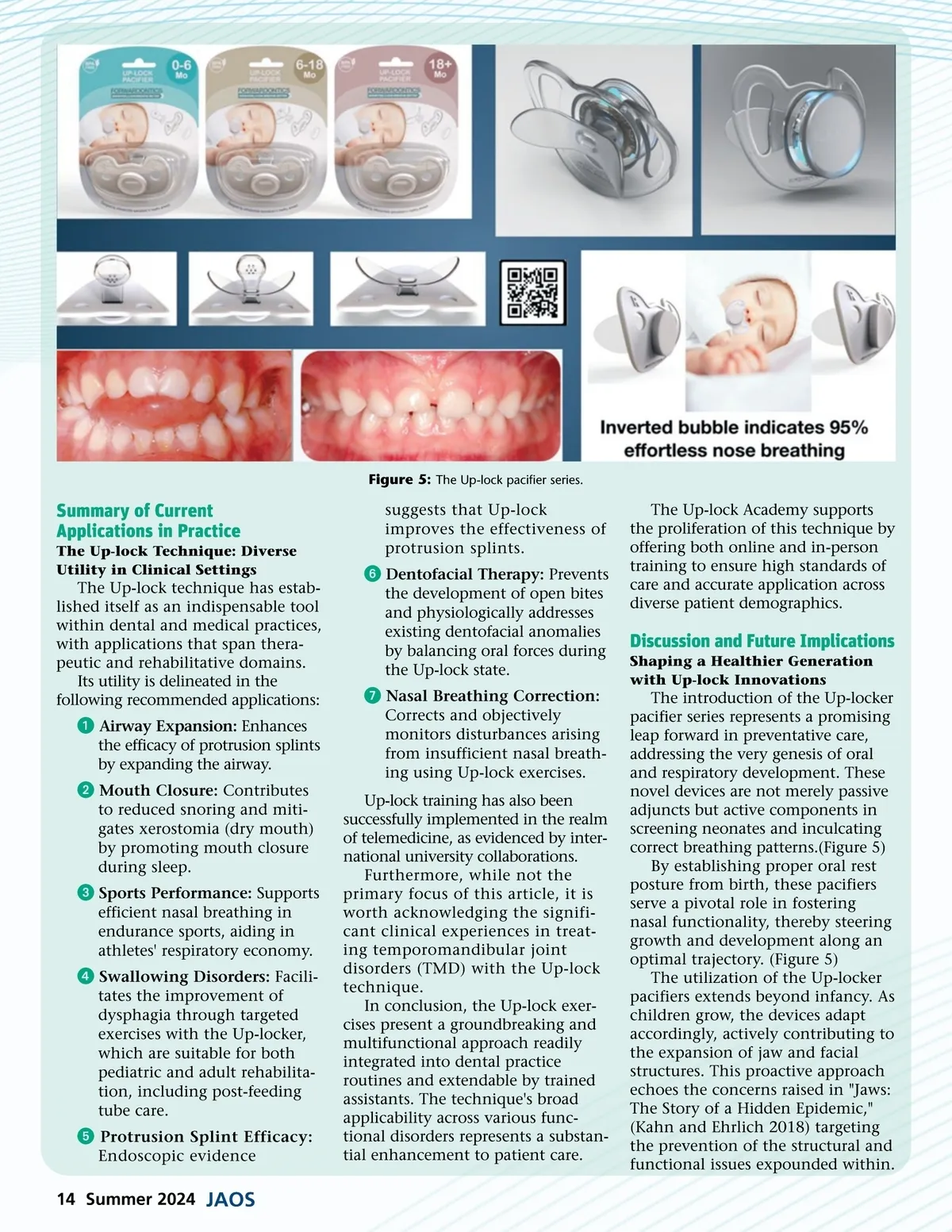
Our foundational paper, "The Jaw Epidemic: Recognition, Origins, Cures, and Prevention," (Kahn et.al 2020) has now been recognized as the authoritative scientific opinion on the environmental roots of a spectrum of health conditions, from dental crowding to Obstructive Sleep Apnea. With the development of the Up-locker pacifier series, shown in Figure 5, featuring both analog and bluetooth-enabled vari-ants — we are on the cusp of not just mitigating, but potentially erad-icating, the prevalence of these widespread concerns. The digital integration of the Up-lock pacifiers ushers in a new era of data-driven care. Through bluetooth connectivity, caregivers and health practitioners can monitor compli-ance and progress, harnessing real-time data to make informed deci-sions that are tailored to the indi-vidual needs of each child. Looking forward, our vision is anchored in the hope that these innovations will become a standard of care, universally accessible and implemented from the earliest stages of life. By embedding these principles in the foundational prac-tices of pediatric care, we anticipate a generational shift towards improved oral health, optimized facial development, and a dramatic reduction in the incidence of myofunctional disorders. The trajectory we foresee is one where the need for reactive inter-ventions is significantly lessened, supplanted by a proactive, preven-tive model. As these techniques and devices become more integrated into routine care, we may witness a decline in the later-life conse-quences that currently burden our health systems. This includes the pressing issue of Sudden Infant Death Syndrome (SIDS), which has been linked to suboptimal nasal breathing and inadequate palatal width (Guilleminault 2012). Through early screening and intervention, the Up-locker pacifiers could play a crucial role in mitigat-ing these risks by promoting proper nasal breathing and supporting the development of the palatal structure from the earliest stages of life. “By addressing the foundational aspects of oral development from infancy, this approach promises not only to enhance facial and airway structure but also to contribute significantly to the reduction of myofunctional disorders and potentially influence factors associated with Sudden Infant Death Syndrome (SIDS).” The Up-locker pacifier series, combined with our growing under-standing of environmental factors influencing oral health, has the potential to transform the land-scape of dental medicine. It is a testament to the interplay of inno-vation, research and clinical prac-tice that we can now envisage a future where the 'hidden epidemic' of structural malformations and its associated pathologies become a relic of the past. Our research underscores the potential of the Up-lock technique as a pivotal intervention for Oral Valve Disorder Syndrome (OVDS). By coining OVDS, we encapsulate a syndrome characterized by a collection of signs and symptoms associated with the dysfunction of oral valves, impacting rest and swallowing functions. The thera-peutic modulation of intraoral pressures and valve functionality through Up-lock maneuvers provides promising prospects for comprehensive management of OVDS, thereby improving orofacial health and functionality. In conclusion, the Up-lock tech-nique and its associated Up-locker pacifiers represent a groundbreaking fusion of innovation and practice, with the potential to redefine preventative oral healthcare. By addressing the foundational aspects of oral development from infancy, this approach promises not only to enhance facial and airway structure but also to contribute significantly to the reduction of myofunctional disorders and poten-tially influence factors associated with Sudden Infant Death Syndrome (SIDS). The implications of widespread adoption could see a paradigm shift towards a future where early intervention sets the stage for a lifetime of improved health outcomes, positioning the Up-lock system as an instrumental player in the global effort to improve pediatric health and development. References Calvo-Henriquez, C., Capasso, R., Chiesa-Estomba, C., Liu, S. Y., Martins-Neves, S., Castedo, E., O'Connor-Reina, C., Ruano-Ravina, A., & Kahn, S. (2020). The role of pediatric maxillary expansion on nasal breathing: A systematic review and meta-analysis. International Journal of Pediatric Otorhinolaryn-gology, 135, 110139. https://doi.org/10.1016/j.ijporl.2020. 110139 Engelke, W. (1990). The videoendo-scopic diagnosis of velopharyngeal closure patterns. Speech-Voice-Hear-ing, 14(4), 153-158. Engelke, W., & Engelhardt, W. (2010). Functional treatment of snoring based on the tongue-repositioning maneuver. European Journal of Orthodontics, 32(5), 490-495. Engelke, W., Jung, K., & Knösel, M. (2010). Intra-oral compartment pres-sures: a biofunctionalmodel and experimental measurements under different conditions of posture. Clin. Oral Invest. Engelke, W., Mendoza, M., & Repetto, G. (2006). Preliminary radiographic observations of the tongue reposi-tioning maneuver. European Journal of Orthodontics, 28, 618-623. Kahn, S., & Ehrlich, P. R. (2018). Jaws: The Story of a Hidden Epidemic. Stanford University Press. Kahn, S., Ehrlich, P. R., Feldman, M., Sapolsky, R., & Wong, S. (2020). The Jaw Epidemic: Recognition, Origins, Cures, and Prevention. BioScience, 70(9), 759-771. https://doi.org/10.1093/biosci/biaa07 3 Rambaud, C., & Guilleminault, C. (2012). Death, nasomaxillary complex, and sleep in young chil-dren. Eur J Pediatr, 171(9), 1349-58. https://doi.org/10.1007/s00431-012-1727-3 Scharfe, S., Ludwig, A., Russo, S., Klaps-ing, P., & Engelke, W. (2016). Somnology, 20, 125-133. www.orthodontics.com Summer 2024 15
Journal of the American Orthodontic Society Summer 2024: Page 15