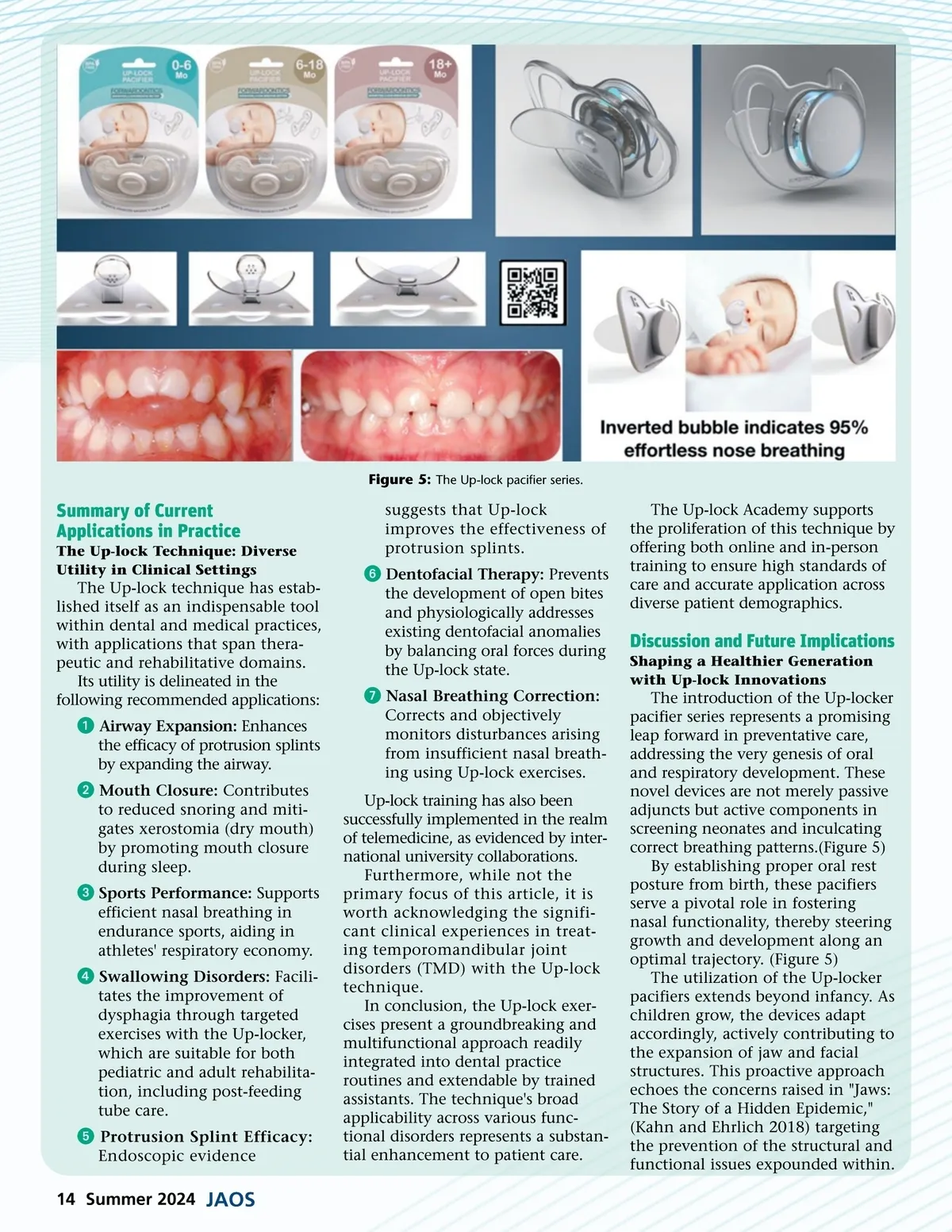
Figure 5: The Up-lock pacifier series. Summary of Current Applications in Practice The Up-lock Technique: Diverse Utility in Clinical Settings suggests that Up-lock improves the effectiveness of protrusion splints. The Up-lock technique has estab-lished itself as an indispensable tool within dental and medical practices, with applications that span thera-peutic and rehabilitative domains. Its utility is delineated in the following recommended applications: ᕦ Dentofacial Therapy: Prevents the development of open bites and physiologically addresses existing dentofacial anomalies by balancing oral forces during the Up-lock state. The Up-lock Academy supports the proliferation of this technique by offering both online and in-person training to ensure high standards of care and accurate application across diverse patient demographics. Discussion and Future Implications Shaping a Healthier Generation with Up-lock Innovations ᕧ Nasal Breathing Correction: Corrects and objectively monitors disturbances arising from insufficient nasal breath-ing using Up-lock exercises. Up-lock training has also been successfully implemented in the realm of telemedicine, as evidenced by inter-national university collaborations. Furthermore, while not the primary focus of this article, it is worth acknowledging the signifi-cant clinical experiences in treat-ing temporomandibular joint disorders (TMD) with the Up-lock technique. In conclusion, the Up-lock exer-cises present a groundbreaking and multifunctional approach readily integrated into dental practice routines and extendable by trained assistants. The technique's broad applicability across various func-tional disorders represents a substan-tial enhancement to patient care. ᕡ Airway Expansion: Enhances the efficacy of protrusion splints by expanding the airway. ᕢ Mouth Closure: Contributes to reduced snoring and miti-gates xerostomia (dry mouth) by promoting mouth closure during sleep. ᕣ Sports Performance: Supports efficient nasal breathing in endurance sports, aiding in athletes' respiratory economy. ᕤ Swallowing Disorders: Facili-tates the improvement of dysphagia through targeted exercises with the Up-locker, which are suitable for both pediatric and adult rehabilita-tion, including post-feeding tube care. ᕥ Protrusion Splint Efficacy: Endoscopic evidence The introduction of the Up-locker pacifier series represents a promising leap forward in preventative care, addressing the very genesis of oral and respiratory development. These novel devices are not merely passive adjuncts but active components in screening neonates and inculcating correct breathing patterns.(Figure 5) By establishing proper oral rest posture from birth, these pacifiers serve a pivotal role in fostering nasal functionality, thereby steering growth and development along an optimal trajectory. (Figure 5) The utilization of the Up-locker pacifiers extends beyond infancy. As children grow, the devices adapt accordingly, actively contributing to the expansion of jaw and facial structures. This proactive approach echoes the concerns raised in "Jaws: The Story of a Hidden Epidemic," (Kahn and Ehrlich 2018) targeting the prevention of the structural and functional issues expounded within. 14 Summer 2024 JAOS
Journal of the American Orthodontic Society Summer 2024: Page 14