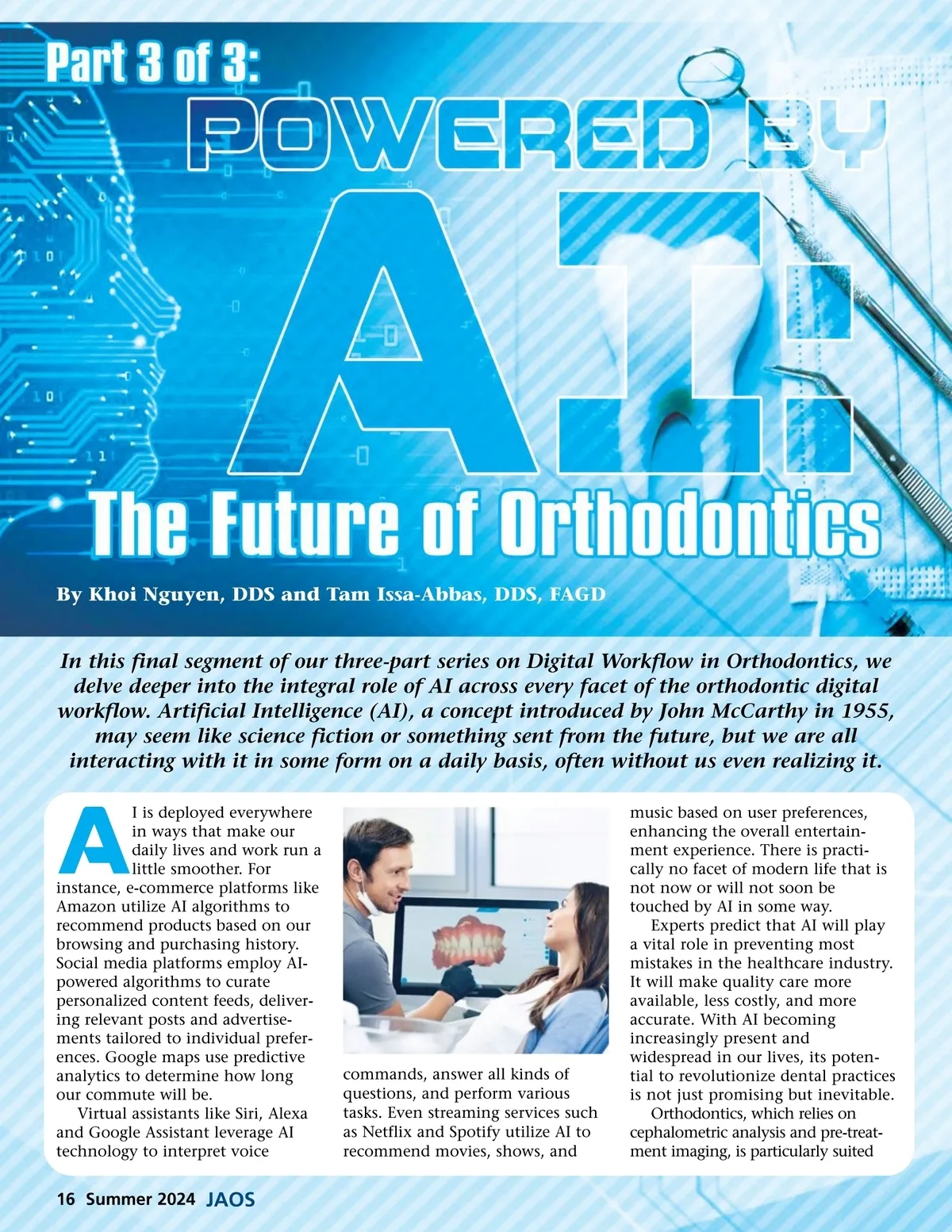
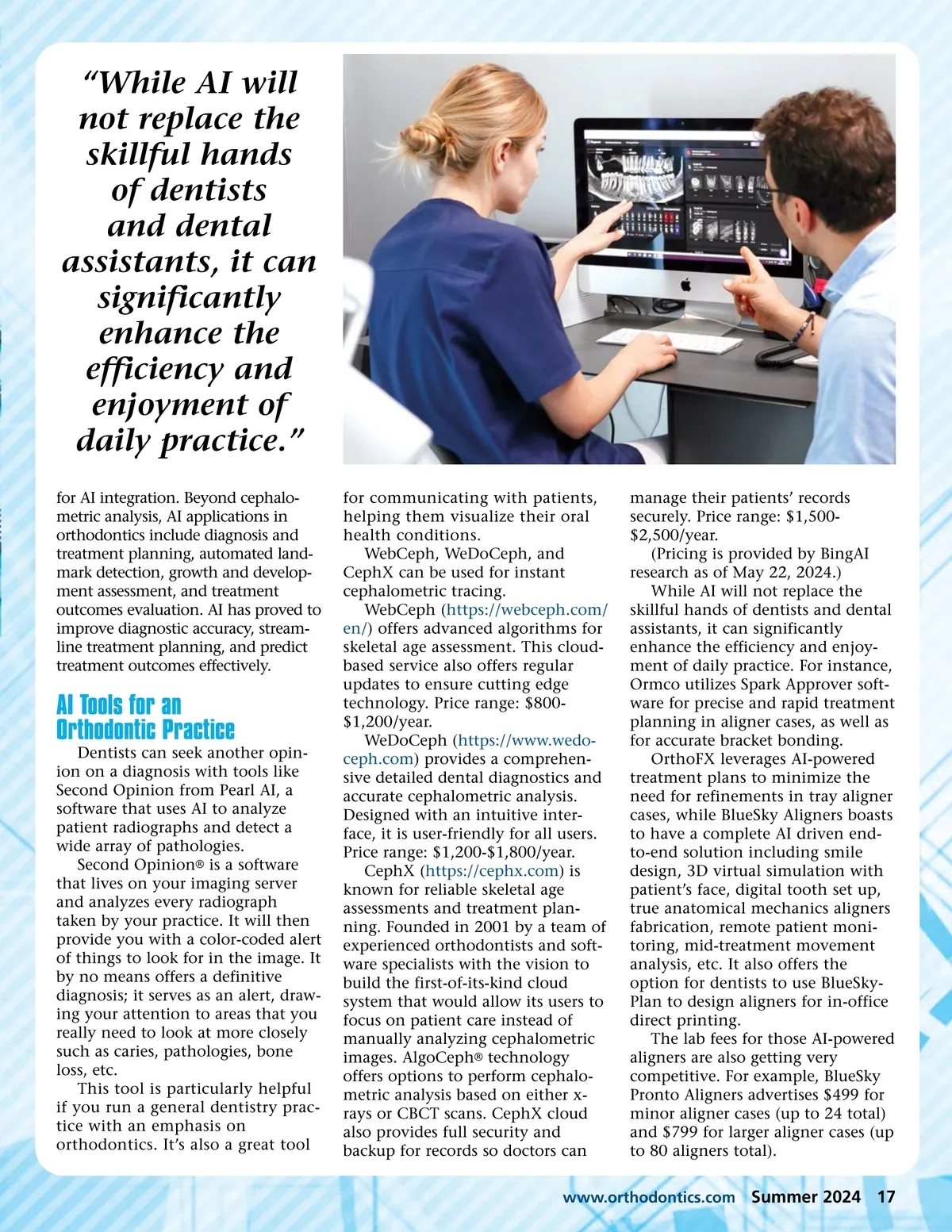
By Khoi Nguyen, DDS and Tam Issa-Abbas, DDS, FAGD I is deployed everywhere in ways that make our daily lives and work run a little smoother. For instance, e-commerce platforms like Amazon utilize AI algorithms to recommend products based on our browsing and purchasing history. Social media platforms employ AI-powered algorithms to curate personalized content feeds, deliver-ing relevant posts and advertise-ments tailored to individual prefer-ences. Google maps use predictive analytics to determine how long our commute will be. Virtual assistants like Siri, Alexa and Google Assistant leverage AI technology to interpret voice a In this final segment of our three-part series on Digital Workflow in Orthodontics, we delve deeper into the integral role of AI across every facet of the orthodontic digital workflow. Artificial Intelligence (AI), a concept introduced by John McCarthy in 1955, may seem like science fiction or something sent from the future, but we are all interacting with it in some form on a daily basis, often without us even realizing it. music based on user preferences, enhancing the overall entertain-ment experience. There is practi-cally no facet of modern life that is not now or will not soon be touched by AI in some way. Experts predict that AI will play a vital role in preventing most mistakes in the healthcare industry. It will make quality care more available, less costly, and more accurate. With AI becoming increasingly present and widespread in our lives, its poten-tial to revolutionize dental practices is not just promising but inevitable. Orthodontics, which relies on cephalometric analysis and pre-treat-ment imaging, is particularly suited commands, answer all kinds of questions, and perform various tasks. Even streaming services such as Netflix and Spotify utilize AI to recommend movies, shows, and 16 Summer 2024 JAOS
Journal of the American Orthodontic Society Summer 2024: Page 16