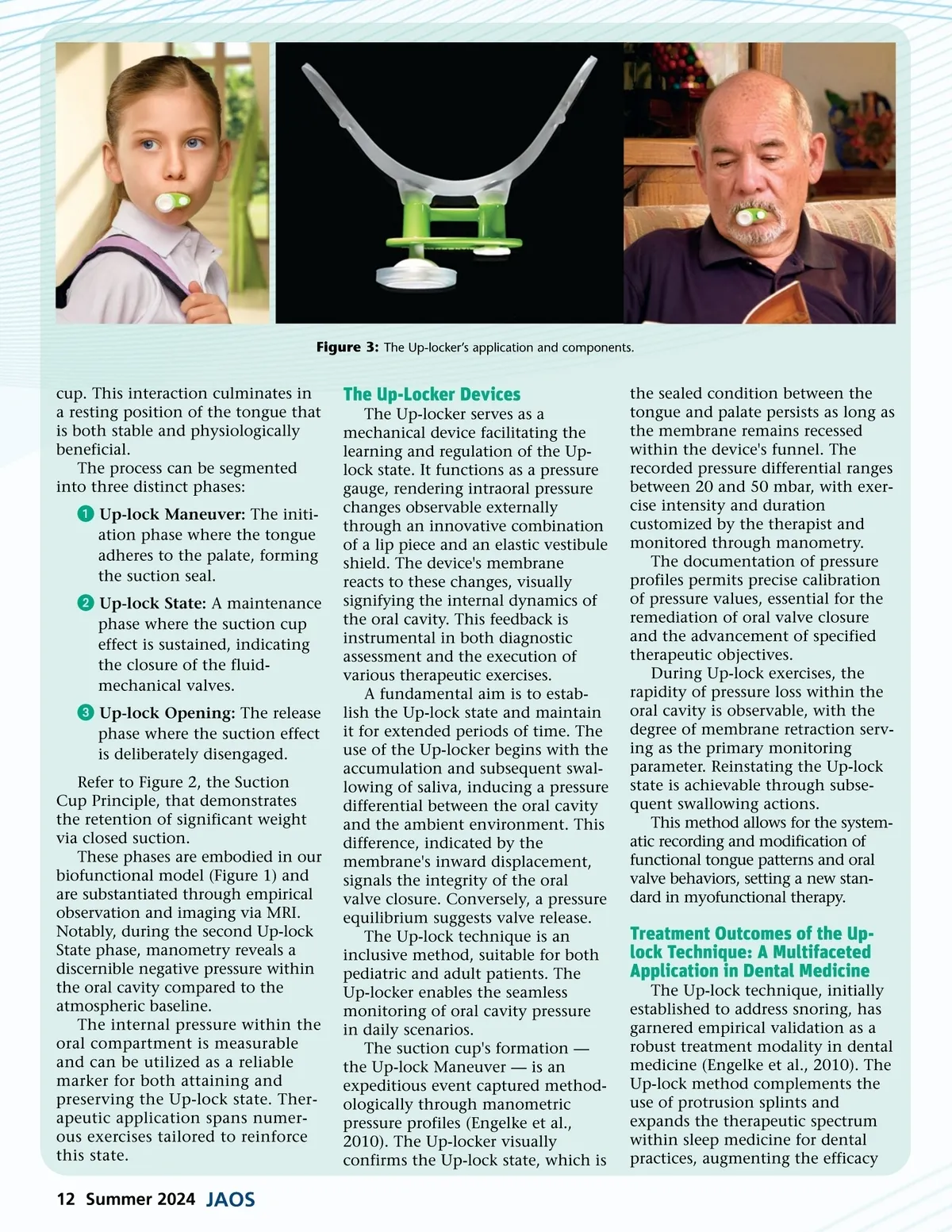
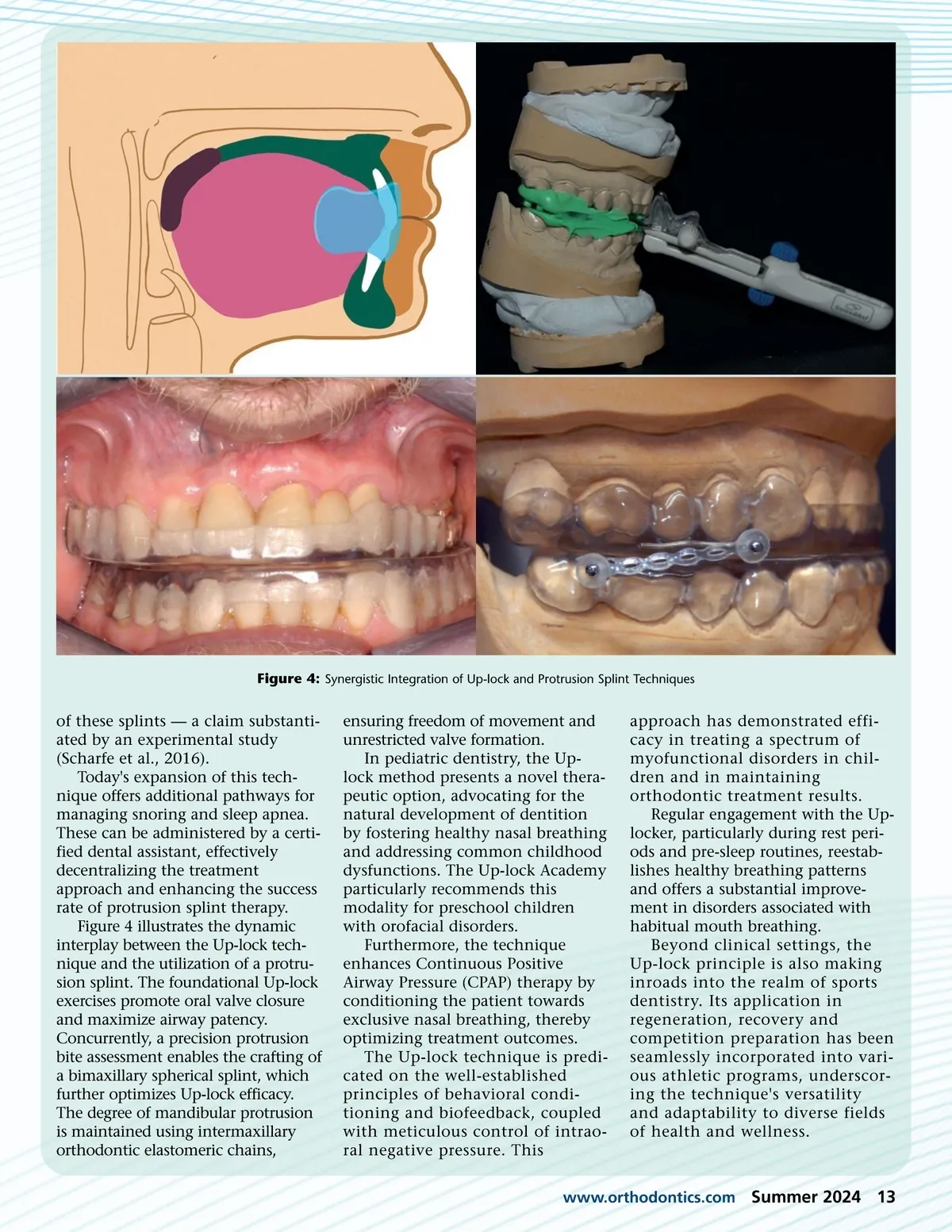
Figure 3: The Up-locker’s application and components. cup. This interaction culminates in a resting position of the tongue that is both stable and physiologically beneficial. The process can be segmented into three distinct phases: The Up-Locker Devices The Up-locker serves as a mechanical device facilitating the learning and regulation of the Up-lock state. It functions as a pressure gauge, rendering intraoral pressure changes observable externally through an innovative combination of a lip piece and an elastic vestibule shield. The device's membrane reacts to these changes, visually signifying the internal dynamics of the oral cavity. This feedback is instrumental in both diagnostic assessment and the execution of various therapeutic exercises. A fundamental aim is to estab-lish the Up-lock state and maintain it for extended periods of time. The use of the Up-locker begins with the accumulation and subsequent swal-lowing of saliva, inducing a pressure differential between the oral cavity and the ambient environment. This difference, indicated by the membrane's inward displacement, signals the integrity of the oral valve closure. Conversely, a pressure equilibrium suggests valve release. The Up-lock technique is an inclusive method, suitable for both pediatric and adult patients. The Up-locker enables the seamless monitoring of oral cavity pressure in daily scenarios. The suction cup's formation — the Up-lock Maneuver — is an expeditious event captured method-ologically through manometric pressure profiles (Engelke et al., 2010). The Up-locker visually confirms the Up-lock state, which is ᕡ Up-lock Maneuver: The initi-ation phase where the tongue adheres to the palate, forming the suction seal. ᕢ Up-lock State: A maintenance phase where the suction cup effect is sustained, indicating the closure of the fluid-mechanical valves. ᕣ Up-lock Opening: The release phase where the suction effect is deliberately disengaged. Refer to Figure 2, the Suction Cup Principle, that demonstrates the retention of significant weight via closed suction. These phases are embodied in our biofunctional model (Figure 1) and are substantiated through empirical observation and imaging via MRI. Notably, during the second Up-lock State phase, manometry reveals a discernible negative pressure within the oral cavity compared to the atmospheric baseline. The internal pressure within the oral compartment is measurable and can be utilized as a reliable marker for both attaining and preserving the Up-lock state. Ther-apeutic application spans numer-ous exercises tailored to reinforce this state. the sealed condition between the tongue and palate persists as long as the membrane remains recessed within the device's funnel. The recorded pressure differential ranges between 20 and 50 mbar, with exer-cise intensity and duration customized by the therapist and monitored through manometry. The documentation of pressure profiles permits precise calibration of pressure values, essential for the remediation of oral valve closure and the advancement of specified therapeutic objectives. During Up-lock exercises, the rapidity of pressure loss within the oral cavity is observable, with the degree of membrane retraction serv-ing as the primary monitoring parameter. Reinstating the Up-lock state is achievable through subse-quent swallowing actions. This method allows for the system-atic recording and modification of functional tongue patterns and oral valve behaviors, setting a new stan-dard in myofunctional therapy. Treatment Outcomes of the Up-lock Technique: A Multifaceted Application in Dental Medicine The Up-lock technique, initially established to address snoring, has garnered empirical validation as a robust treatment modality in dental medicine (Engelke et al., 2010). The Up-lock method complements the use of protrusion splints and expands the therapeutic spectrum within sleep medicine for dental practices, augmenting the efficacy 12 Summer 2024 JAOS
Journal of the American Orthodontic Society Summer 2024: Page 12