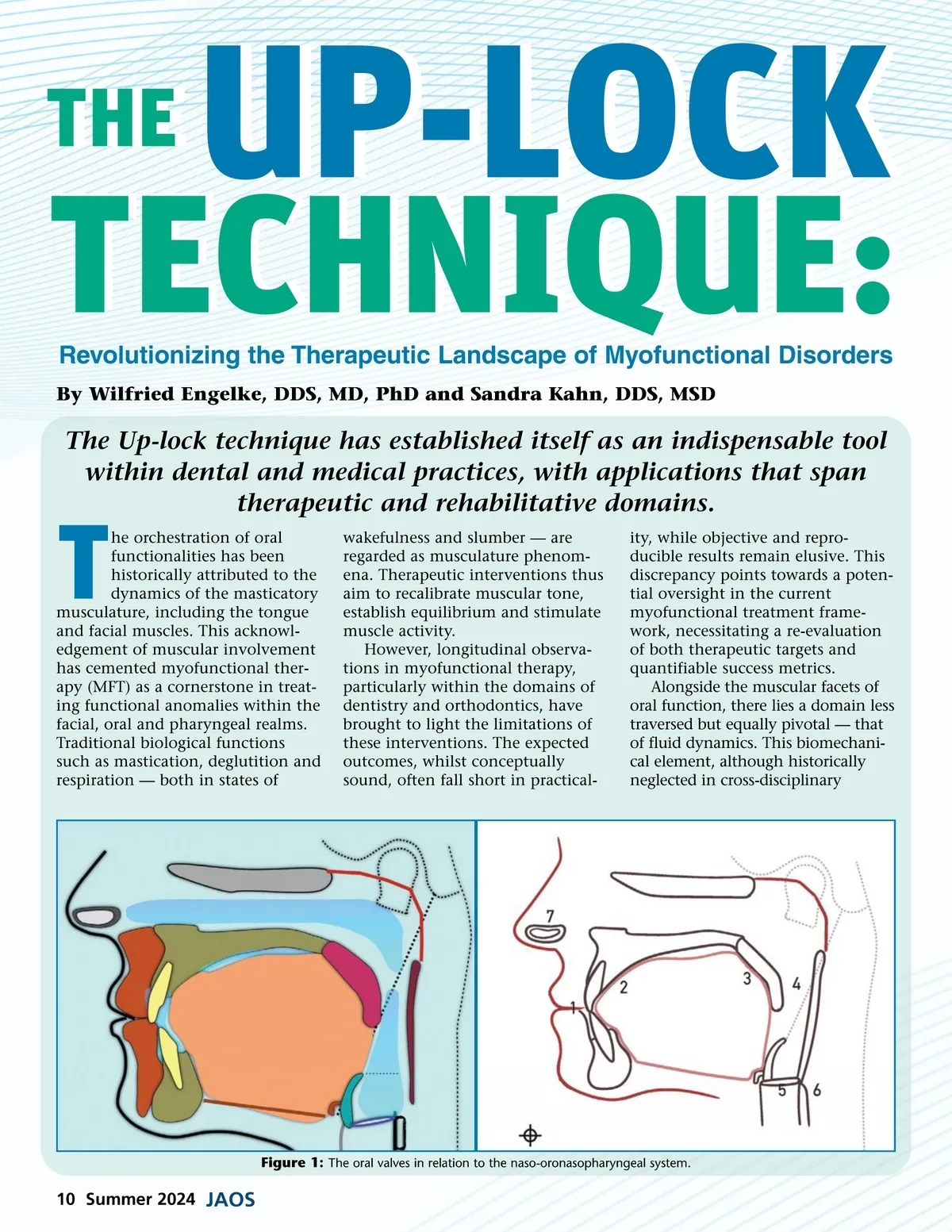
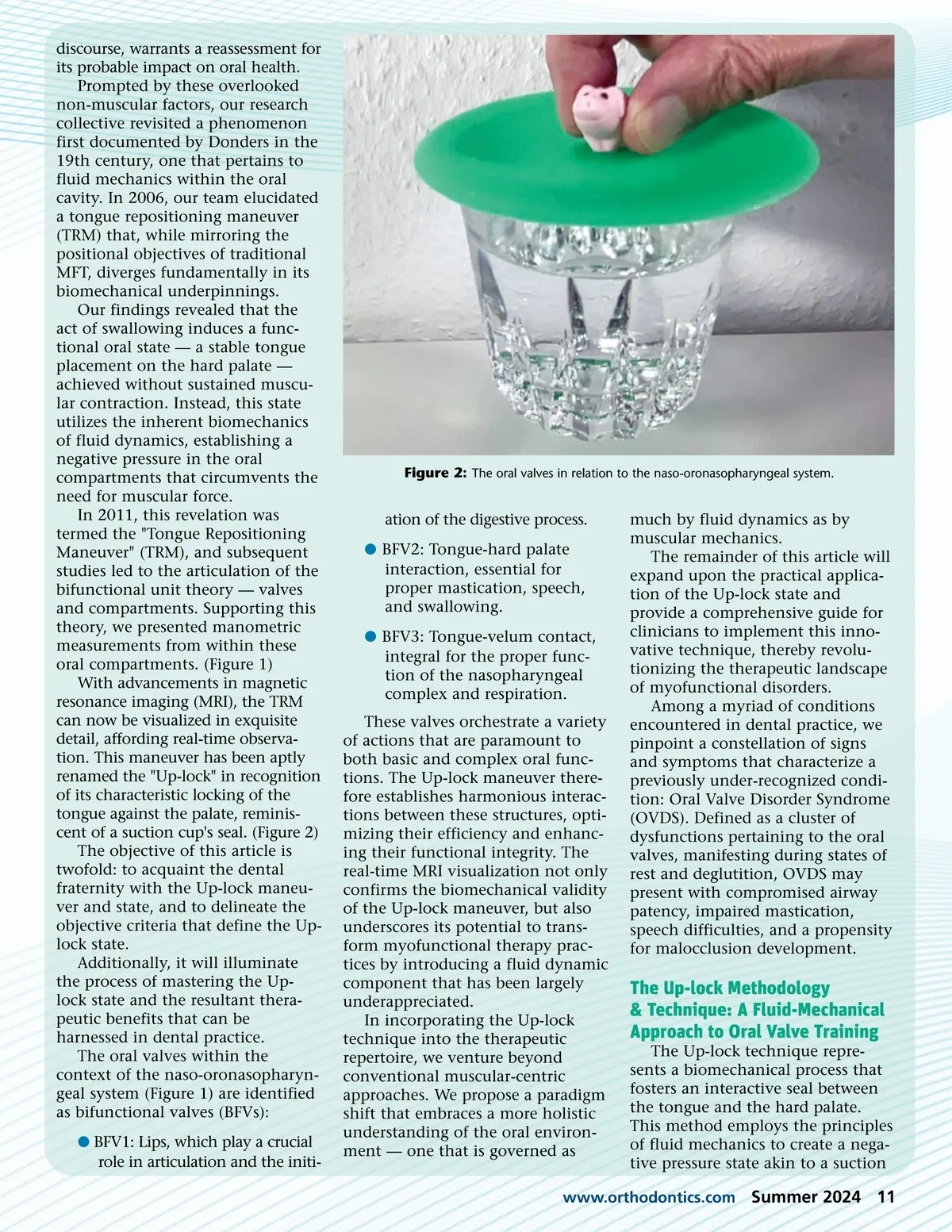
discourse, warrants a reassessment for its probable impact on oral health. Prompted by these overlooked non-muscular factors, our research collective revisited a phenomenon first documented by Donders in the 19th century, one that pertains to fluid mechanics within the oral cavity. In 2006, our team elucidated a tongue repositioning maneuver (TRM) that, while mirroring the positional objectives of traditional MFT, diverges fundamentally in its biomechanical underpinnings. Our findings revealed that the act of swallowing induces a func-tional oral state — a stable tongue placement on the hard palate — achieved without sustained muscu-lar contraction. Instead, this state utilizes the inherent biomechanics of fluid dynamics, establishing a negative pressure in the oral compartments that circumvents the need for muscular force. In 2011, this revelation was termed the "Tongue Repositioning Maneuver" (TRM), and subsequent studies led to the articulation of the bifunctional unit theory — valves and compartments. Supporting this theory, we presented manometric measurements from within these oral compartments. (Figure 1) With advancements in magnetic resonance imaging (MRI), the TRM can now be visualized in exquisite detail, affording real-time observa-tion. This maneuver has been aptly renamed the "Up-lock" in recognition of its characteristic locking of the tongue against the palate, reminis-cent of a suction cup's seal. (Figure 2) The objective of this article is twofold: to acquaint the dental fraternity with the Up-lock maneu-ver and state, and to delineate the objective criteria that define the Up-lock state. Additionally, it will illuminate the process of mastering the Up-lock state and the resultant thera-peutic benefits that can be harnessed in dental practice. The oral valves within the context of the naso-oronasopharyn-geal system (Figure 1) are identified as bifunctional valves (BFVs): b BFV1: Lips, which play a crucial role in articulation and the initi-Figure 2: The oral valves in relation to the naso-oronasopharyngeal system. ation of the digestive process. b BFV2: Tongue-hard palate interaction, essential for proper mastication, speech, and swallowing. b BFV3: Tongue-velum contact, integral for the proper func-tion of the nasopharyngeal complex and respiration. These valves orchestrate a variety of actions that are paramount to both basic and complex oral func-tions. The Up-lock maneuver there-fore establishes harmonious interac-tions between these structures, opti-mizing their efficiency and enhanc-ing their functional integrity. The real-time MRI visualization not only confirms the biomechanical validity of the Up-lock maneuver, but also underscores its potential to trans-form myofunctional therapy prac-tices by introducing a fluid dynamic component that has been largely underappreciated. In incorporating the Up-lock technique into the therapeutic repertoire, we venture beyond conventional muscular-centric approaches. We propose a paradigm shift that embraces a more holistic understanding of the oral environ-ment — one that is governed as much by fluid dynamics as by muscular mechanics. The remainder of this article will expand upon the practical applica-tion of the Up-lock state and provide a comprehensive guide for clinicians to implement this inno-vative technique, thereby revolu-tionizing the therapeutic landscape of myofunctional disorders. Among a myriad of conditions encountered in dental practice, we pinpoint a constellation of signs and symptoms that characterize a previously under-recognized condi-tion: Oral Valve Disorder Syndrome (OVDS). Defined as a cluster of dysfunctions pertaining to the oral valves, manifesting during states of rest and deglutition, OVDS may present with compromised airway patency, impaired mastication, speech difficulties, and a propensity for malocclusion development. The Up-lock Methodology & Technique: A Fluid-Mechanical Approach to Oral Valve Training The Up-lock technique repre-sents a biomechanical process that fosters an interactive seal between the tongue and the hard palate. This method employs the principles of fluid mechanics to create a nega-tive pressure state akin to a suction www.orthodontics.com Summer 2024 11
Journal of the American Orthodontic Society Summer 2024: Page 11